
UW Graduate Student Presents Hunger in Wyoming Workshops Across State
Published July 22, 2026
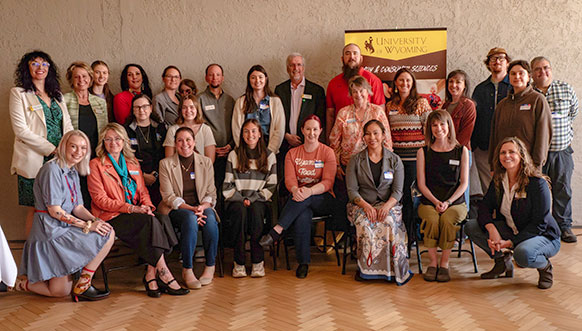
Speakers, UW faculty and students, including Julie Hampton-Lyon (first row, fifth from left), gather for a HIWY workshop in Laramie. Hampton-Lyon has organized a workshop series addressing the issue of food security. (UW Photo)
In partnership with the Food Bank of Wyoming, University of Wyoming graduate student Julie Hampton-Lyon, of Laramie, has organized a workshop series addressing the issue of food security.
Hampton-Lyon, a master’s student in the Department of Family and Consumer Sciences’ Food Science and Human Nutrition Program, has spearheaded six Hunger in Wyoming (HIWY) workshops sharing information about Wyoming food policy with communities across the state.
The workshops are a chance for Wyomingites with lived experience, community organizations, researchers, policy stakeholders and legislators to come together for constructive conversations about how stakeholders can collaborate to create a more food-secure Wyoming.
So far, Hampton-Lyon has facilitated HIWY workshops in Laramie, Sheridan and Gillette.
The sessions, which are about five hours, include a panel discussion, networking luncheon and group brainstorming session with a question-and-answer portion. Panels of experts vary from location to location and may include local or regional food security leaders; UW researchers; child nutrition experts; regional representatives from the Food Bank of Wyoming and the Wyoming Hunger Initiative; and state legislators.
The HIWY workshops give policymakers the opportunity to actively engage with their fellow community members, with the aim of coming together to better understand current food needs and what legislators or communities can do to improve food security and food systems in their areas.
“As students, engaging with legislators and community members gives us an opportunity to voice our lived experiences to create systems that work for us,” Hampton-Lyon says.
For her, one of the biggest motivators for launching this project was the discontinuation of SNAP-Ed (Supplemental Nutrition Assistance Program-Education) funding.
SNAP-Ed, which provided nutrition education to families and individuals, was a branch of the state’s SNAP program that was impacted by federal policy changes. SNAP-Ed was defunded by the One Big Beautiful Bill starting in October 2025.
The HIWY workshops were launched after Hampton-Lyon secured a $2,000 starter grant from Research!America supporting civic engagement in Wyoming communities. After the success of the initial launch, an additional $15,000 was secured by the Food Bank of Wyoming through a MAZON grant.
While Hampton-Lyon serves as the lead organizer of HIWY, she credits the program’s success to collaborations with local partners; fellow graduate student Denyse Ute; faculty mentor Grace Shearrer; Kali McCrackin Goodenough, food security policy advocate for the Food Bank of Wyoming; and Carrie Bennett, a professional facilitator and mediator.
Her collaborators offered significant contributions to launching the workshops, Hampton-Lyon says.
“I love collaborating with people who want to see Wyoming continue to grow and improve their communities,” she adds.
From a research standpoint, HIWY investigates how Wyoming communities are currently contributing to food security and sustainability efforts in the state through focused and open dialogue.
Hampton-Lyon hopes these workshops can help Wyoming communities explore a deeper understanding of what food security and food systems issues are most important to them, she says.
HIWY is currently inviting food security partners, food producers, community members and policymakers from the southwest corner of Wyoming to join the Evanston event Wednesday, July 29.
The Evanston workshop will take place from 10:30 a.m.-3 p.m. at the Lord’s Storehouse, located at 50 Yellow Creek Road.
Dates, locations and times for additional HIWY workshops will be released later this summer.
For more information, contact Christopher Weber, senior office associate in the Department of Family and Consumer Sciences, at fam-consci@uwyo.edu.
About the UW College of Agriculture, Life Sciences and Natural Resources
UW’s College of Agriculture, Life Sciences and Natural Resources serves students and communities through innovative scholarship, research and outreach. Guided by the land-grant principles of discovery and experiential learning, the college facilitates meaningful educational opportunities in the classroom, laboratory and community. The college offers degrees in the departments of agricultural and applied economics, animal science, botany, ecosystem science and management, family and consumer sciences, molecular biology, plant sciences, veterinary sciences, and zoology and physiology. The college also offers degree programs in agricultural communications, microbiology, and ranch management and agricultural leadership. To learn more, visit www.uwyo.edu/uwag or call (307) 766-4133.

The University of Wyoming has earned its Research Level 1 (R1) status from the Carnegie Classification of Institutions of Higher Education, placing Wyoming's only four-year university with the top research universities in the United States.