
UW Planetarium to Host Hybrid Program, ‘Dome After Dark’ Event to Kick Off Fall Semester
Published July 29, 2026
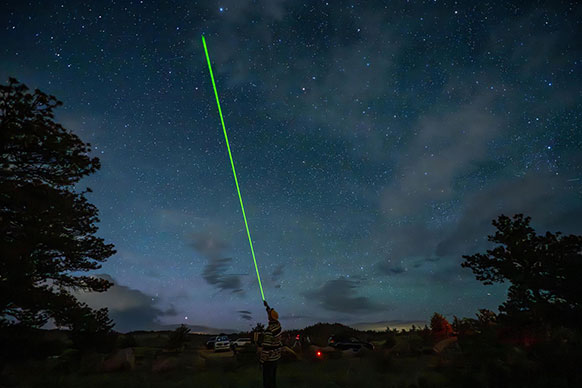
The University of Wyoming Harry C. Vaughan Planetarium will host an “Observing Night at North Crow Reservoir” from 8:15-10:30 p.m. Wednesday, August 5. Here, Max Gilbraith, the planetarium’s coordinator, uses a laser to draw the summer constellations during a similar event at North Crow Reservoir in June. (UW Photo)
The University of Wyoming Harry C. Vaughan Planetarium will kick off the fall semester with a hybrid offering of a short film and “Wyoming Skies” program Friday, Aug. 28, and welcome back students with a “Dome After Dark” event Saturday, Aug. 29.
“Our first Friday evening program for the fall semester will be a special free program in cooperation with the Laramie Audubon Society,” says Max Gilbraith, the planetarium’s director. “It will feature a showing of the short film ‘Losing the Dark,’ highlighting the effects of light pollution, which will be followed by a custom ‘Wyoming Skies’ program of all the bird-themed constellations and deep sky objects. After the planetarium programming finishes at 8 p.m., we will take a tour of the STAR rooftop observatory and use the telescopes, weather permitting.”
Gilbraith adds the summer format, which includes a planetarium film followed by a “star talk,” will continue during the first half of August. Star talks consist of a brief follow-up of concepts from the film; a mini “Wyoming Skies” program; a question-and-answer session; and requests from the audience.
“We have really enjoyed all the visits during our summer hours these past months,” Gilbraith says of the adjusted weekday afternoon schedule. “We will continue hosting afternoon movie and star talks for a few more weeks before we swing back to weekend programming to allow for the regular use of field trips and classes at the planetarium during the semester.”
To get tickets or receive more information about programs, email planetarium@uwyo.edu or leave a voicemail and a callback phone number at (307) 766-6506. Tickets are $5 for the public or online tickets, and $3 for students, senior citizens, veterans, first responders and those under 18. Seating is free for children under 5. Bulk tickets/gift cards are available at $2 each when 10 or more tickets are purchased.
Reservations or pre-purchase is not required, and walk-ins are welcome. Tickets can be purchased online with a credit card, reserved by email or voicemail, or purchased at the start of the show. Cash or check is accepted at the door. The planetarium, which seats 64, is in the basement of the Physical Sciences Building. Seating is on a first-come, first-served basis outside of designated ADA/wheelchair seating.
To pay for tickets with a credit card, go to www.uwyo.edu/uwplanetarium/ticket.aspx. For a group larger than six, email the planetarium for a private show at https://uwyo.sjc1.qualtrics.com/jfe/form/SV_bKuqIynOn7gFK2F. Tickets for private shows are the same as the public programs.
A film and special live talk for audiences will be featured each week. All programs are approximately an hour in length. As time allows, a portion of the show also may focus on a live sky tour or supporting information related to the film’s topic.
The August schedule is:
-- Tuesday, August 4, 1 p.m.: “The Sun: Our Living Star,” a full-dome movie, and a star talk. The sun consumes 600 million tons of hydrogen each second and is 500 times as massive as all of the planets combined. Viewers will discover the secrets of the sun and experience never-before-seen images of its violent surface.
-- Tuesday, August 4, 7 p.m.: “Dark Biosphere,” a full-dome movie, and a star talk. Deep beneath the Earth’s crust, hundreds of meters or kilometers below the surface -- with no light, no air and very little water, in pores and fissures of hard rock -- scientists have found an enormous biodiversity of micro-organisms that thrive in extreme conditions in an area known as the dark biosphere. This film is narrated by actor Viggo Mortensen.
-- Wednesday, August 5, 8:15-10:30 p.m.: “Observing Night at North Crow Reservoir.” The UW Planetarium and Curt Gowdy State Park host a night-sky star party overlooking North Crow Reservoir, located 24 miles east of Laramie. The event will include using lasers to draw the summer constellations; telescopes for observing; and astro-photography to reveal deep-sky objects. Attendees are asked to bring a flashlight/headlamp with a red light setting, if possible; bug spray; appropriate clothing layers for an evening program; and a camping chair. The event is free, and no reservations are needed.
-- Thursday, August 6, 1 p.m.: “The Great Solar System Adventure,” a full-dome movie, and a star talk. Join showman extraordinaire “The Great Schiaparelli” as he takes the audience on a death-defying, space-time adventure within his wondrous observatorium. From the sun-scorched surface of Mercury to the icy expanses of Pluto and beyond, the audience will be subjected to the myriad dangers and wonders of our solar system.
-- Tuesday, August 11, 1 p.m.: “Dawn of the Space Age,” a full-dome movie, and a star talk. The film explores the launch of the first artificial satellite, Sputnik, the magnificent lunar landings and privately operated space flights.
-- Thursday, August 13, 1 p.m.: “One Sky,” a full-dome series of short films, and a star talk. Each short film represents the perspective of a different culture or Indigenous society from around the globe. Each film stands alone as a short story, or in combination, as a longer narrative organized around themes of finding patterns and developing tools. Short films are “The Forge of Artemis,” “Thunderbird,” “Jai Singh’s Dream,” “Celestial Canoe,” “The Samurai and Stars” and “Wayfinders.”
-- Tuesday, Aug. 18, 1 p.m.: “Distant Worlds: Alien Life?” a full-dome movie and a star talk. This film takes viewers on a journey outward to see what it takes for life to develop, starting with life on Earth and moving out to the rest of our solar system and on to alien planets that orbit distant stars in our galaxy.
-- Tuesday, Aug. 18, 7 p.m.: “Forward! To the Moon,” a full-dome movie and a star talk. Narrator Kari Byron, from “Crash Test World” and “MythBusters,” takes viewers on a journey beyond Earth toward a sustainable future in space. NASA’s 21st century Artemis program is the next step in the mission to explore the universe and land the first woman and person of color on the moon. This film is produced by Fiske Planetarium in collaboration with Tend Studio.
-- Thursday, August 20, 1 p.m.: “From Earth to the Universe,” a full-dome movie, and a star talk. This film takes the audience out to the colorful birthplaces and burial grounds of stars and still farther out beyond the Milky Way to the unimaginable immensity of myriad galaxies.
-- Friday, Aug. 28, 7 p.m.: Wyoming Skies: “Losing the Dark,” a full-dome short film, and the Laramie Audubon Society. In cooperation with the Laramie Audubon Society, this special free show of Wyoming Skies and a telescope night will highlight the avian links to the sky with bird-themed constellations and deep sky objects.
“Losing the Dark,” a public service announcement planetarium show, introduces and illustrates some of the issues regarding light pollution and suggests three simple actions people can take to help mitigate it. The film is a collaboration of Loch Ness Productions and DarkSky International.
After the planetarium show finishes at 8 p.m., informal telescope observing on the rooftop of the Physical Sciences Building at the STAR Observatory will be available, weather permitting.
-- Saturday, Aug. 29, 2 p.m.: “We Are Stars,” a full-dome movie, and a star talk. The film connects life on Earth to the evolution of the universe by following the formation of hydrogen atoms to the synthesis of carbon and the molecules for life. This film is narrated by Andy Serkis.
-- Saturday, Aug. 29, 9 p.m.-1 a.m.: “Dome After Dark - Dance and Create.” Lose yourself in a 360-degree universe of music, lasers and creative play. The UW Planetarium dome becomes a living canvas -- part dance floor and part immersive art installation, with pop-up makerspace activities, interactive visuals and plenty of space to create and connect. Supplies will be provided for attendees to make something creative and explore the technology in the SciDIY Makerspace. Doors open at 8:30 p.m. and the cost is $15. Light refreshments will be served.
For more detailed descriptions of all programs, go to www.uwyo.edu/physics/planetarium/schedule.html.

The University of Wyoming has earned its Research Level 1 (R1) status from the Carnegie Classification of Institutions of Higher Education, placing Wyoming's only four-year university with the top research universities in the United States.