
UW Researchers Confirm Your Rain Comes from Farther Away Than Before
Published July 16, 2026
Computer models and thermodynamic theory have long predicted changes in the ways water
vapor is transported through the atmosphere between its location of evaporation and
precipitation in a warming climate. Research led by a University of Wyoming scientist
is the first to confirm these predictions in the historical record.
Travis Aerenson -- an associate research scientist in the University of Wyoming’s
Department of Atmospheric Science -- led research confirming changes including water
in the atmosphere increasingly coming from ocean sources, as opposed to continental
sources, and water vapor staying longer in the atmosphere, traveling greater distances
before returning to the Earth’s surface through precipitation.
Aerenson and his fellow researchers confirmed these predictions by applying atmospheric
moisture tracking to 35 years of historical reanalysis data related to atmospheric
moisture transport into watershed regions of the contiguous United States. Their findings
indicate that, in certain areas, water vapor travels an average 30-50 miles farther,
with time spent in the atmosphere increasing by 2-4 hours between evaporation and
precipitation.
These findings, detailed in the research paper “Precipitation over the Contiguous United States is coming from farther away than in
the past,” were published Wednesday, July 15, in the scientific journal Geophysical Research
Letters. Aerenson was the paper’s lead author, with Daniel McCoy, a UW assistant professor
of atmospheric science; Dana Caulton, a UW associate professor of atmospheric science;
and Patrick Keys, an assistant professor of in the Department of Earth and Environment
at Boston University, serving as co-authors of the paper.
The changing transport times and distances outlined in this most recent paper may
have a significant impact on the economy for two reasons, Aerenson says. First, understanding
how the water cycle is changing allows researchers to evaluate moisture transport
and precipitation forecasts to verify that projections line up with physical theory
and historical changes. Second, the paper’s results show major trends in moisture
transport that can come with changes in precipitation intensity and location, which
influences water availability.
Understanding these current and future atmospheric moisture transport trends is important
for community stakeholders, industry and governments, according to Aerenson and his
co-authors, who cite past research that asserts moisture transport links states and
countries by land use and water availability.
According to the paper, it’s essential that moisture sources are monitored and tracked
for inclusion in international policymaking that will address the impacts of climate
change.
“If future water resource governance incorporates atmospheric transport -- for example,
if changes in land-use/irrigation accounts for changes in downwind precipitation --
my results indicate that they would have to account for the trends in moisture transport
pathways, as the distance between evaporation and precipitation of water vapor is
growing,” Aerenson says.
To arrive at these conclusions, the researchers used the European Centre for Medium
Range Weather Forecasts Reanalysis Version 5, which assimilates about 24 million satellite
instrument and in situ observations each day. Aerenson and his co-authors used the
Water Accounting Model -- 2 Layer Version 3 (WAM2layersv3) to back track source regions
for precipitation sink and generate the publicly available Evaporation Dataset of
Regional Precipitation Sources (E-DRoPS). They then applied statistical trend detection
techniques to E-DRoPS.
During the analysis of the data, it was observed that changes in moisture sources
depend on the watershed region, and moisture transport changes depend on the mechanism
of moisture transport.
In the Southwest, Aerenson’s research found statistically significant changes in the
duration of moisture transportation and amount of land sources contributing water
vapor compared to the number of total evaporation sources in areas that included:
the Upper and Lower Colorado River basins, the Rio Grande Basin and the Arkansas White-Red
River Basin.
The research also found positive trends in duration, but not in the amount of land
sources compared to the number of total sources, in the Lower Mississippi River Basin,
Texas Gulf Basin and the Great Basin. Negative trends were found in all watersheds
except for in the northernmost regions, such as the Pacific Northwest, Souris-Red-Rainy,
Great Lakes and New England, according to the paper.
“On average, there is a reduction of evaporation from land surfaces and increased
evaporation from oceanic surfaces, which cause greater moisture divergence over oceans
and moisture convergence over land,” the paper says. “The mean-state pattern of moisture
convergence/divergence has been strengthening in recent decades, such that moisture
over land travels farther, and over longer periods of time before precipitating, even
when oceanic sources are not considered.”
Aerenson was motivated to research this topic after his previous research in 2025
found atmospheric moisture convergence “contributes a large portion of our uncertainty
surrounding how snowpack in the Mountain West is changing on decadal timescales.”
“I have focused on this field of moisture-transport/precipitation dynamics because
it offers a unique intersection between the climate dynamics and cloud physics that
I find interesting, with topics of hydroclimate that are of growing importance, especially
in the Mountain West region, where even at the best of times water budgets are very
tight,” Aerenson says.
This research was funded by Global to Regional Origins of Water Stress, a NASA Established
Program to Stimulate Competitive Research project, and leveraged high-performance
computing from the National Center for Atmospheric Research-Wyoming Supercomputing
Center.
To read the research paper, visit https://agupubs.onlinelibrary.wiley.com/doi/10.1029/2026GL122565
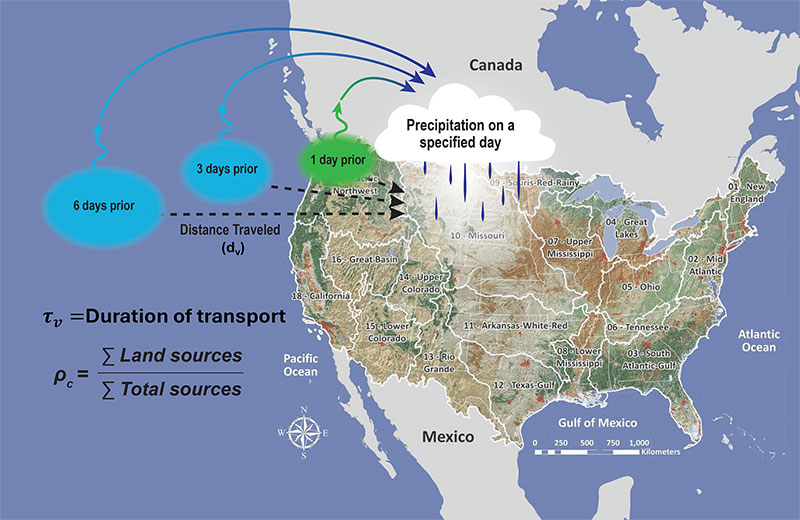
This schematic diagram of moisture tracking shows how Travis Aerenson, an associate research scientist in the University of Wyoming’s Department of Atmospheric Science, and his fellow researchers measured the rate that moisture from land sources was recycled, how long water vapor stayed in the atmosphere and how far water vapor traveled. The research, “Precipitation over the Contiguous United States is coming from farther away than in the past,” was published in the scientific journal Geophysical Research Letters Wednesday, July 15. (Travis Aerenson Graphic)

The University of Wyoming has earned its Research Level 1 (R1) status from the Carnegie Classification of Institutions of Higher Education, placing Wyoming's only four-year university with the top research universities in the United States.