
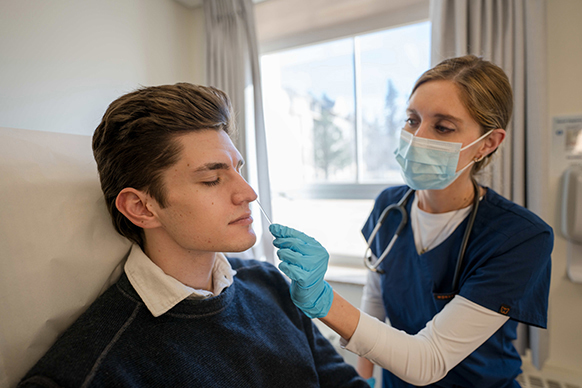
Registered nurse Liberty Barker, of UW’s Student Health Service, administers an innovative flu test nasal swab to UW student Raymond Mondragon. The Student Health Service has been testing the swab and test developed by UW researchers to significantly improve administration and accuracy of flu tests. (UW Photo)
Researchers at the University of Wyoming are designing a higher-accuracy flu test that has undergone preliminary human testing at UW’s Student Health Service.
Titled “Development of a Sensitive Lateral Flow Immunoassay Device for Analyzing Nasal Swab Samples Collected on a Dissolvable Surface,” the project is led by analytical chemistry Professor Debashis Dutta and doctoral student Amit Acharzo.
Each year in the United States, millions of people get sick from the flu, hundreds of thousands are hospitalized, and tens of thousands die from the flu or related complications, according to the National Foundation for Infectious Diseases. While the current rapid influenza diagnostic tests are inexpensive, don’t require specialized equipment and can provide results within 15 minutes, they often produce false-negative results due to their poor sensitivity. This requires that their outcomes be validated with more advanced tests.
“We want to have the sensitivity closer to these more sophisticated tests, but in the ones that are more accessible to the clinicians,” Dutta says. “We have been working on this for about a year and a half and, within this relatively short period of time, we have been able to develop a nasal swab that we can then hand to a nurse in a clinical setting, and he or she can use it to actually test patients with the higher sensitivity that we are promising.”
Dutta and his team have demonstrated over a 20-fold improvement in the detection limit for flu antigens collected on a 3D-printed dissolvable nasal swab surface and analyzed using the team’s proprietary testing platform. The proposed method also reduces reliance on user skills for performing the tests, cutting down variability in test results.
This type of research, which can be quickly brought to market to solve real-life problems, is called translational research. Dutta’s project is one of several at UW to receive a National Science Foundation Seed Translational Acceleration of Research (STAR) Project award, provided under the Accelerating Research Translation (ART) award. UW was among the first cohort of awardees.
The goal of these programs is to build translational research capacity and infrastructure for U.S. institutions of higher education and to enhance their role in regional innovation ecosystems. The projects have strong commercial potential and industry support.
“Because the emphasis is so much on translation, we really wanted the community to get involved in testing and validating the research that we are doing in the
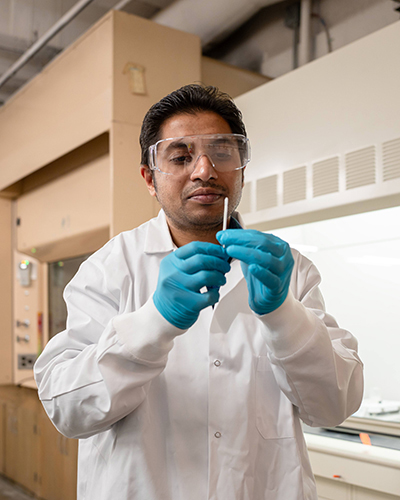
UW doctoral student Amit Acharzo holds a high-accuracy flu test nasal swab developed by analytical chemistry Professor Debashis Dutta and his team. They hope to see the test brought to market in the next two to three years. (UW Photo)
lab,” Dutta says. “So, fortunately, we have been able to collaborate with UW Student Health Service, which is helping us in getting nasal swab samples using the nasal swabs that we have built. Also, one of the local clinics, Laramie Pediatrics, is helping us test those samples and validate that our technology offers the highest sensitivity that we are promising. So, I feel like the entire community is getting involved, more than just my research lab.”
Making a difference in people’s lives is exactly what inspires Acharzo, who came to UW from his home country of Bangladesh.
“It’s very interesting working in this research group, knowing your research will eventually help society and benefit humankind,” he says. “It really inspires my research.”
In general, the lab specializes in micro-instrumentation that enables analysis of complex samples, including blood samples and nasal swabs. For example, another project the team is tackling looks at bacteria in blood samples for early disease detection and treatment.
For the flu project, Dutta and team are now validating their research findings in the human samples. Then, they can move toward commercialization.
“Our hope is that we will lay the groundwork for a full-fledged human study the next flu season,” Dutta says. “It all depends on the level of funding and how much you can accelerate the research and turn a laboratory product into something that can be marketed.”
They hope to see the test brought to market in the next two to three years. When that happens, it will have widespread use in rural settings as well as home use.
Learn more at www.uwyo.edu/research/economic-development/technology-transfer-office/accelerated-research-translation/star-grants.

The University of Wyoming has earned its Research Level 1 (R1) status from the Carnegie Classification of Institutions of Higher Education, placing Wyoming's only four-year university with the top research universities in the United States.