
UW Researchers Work to Convert Liquid Medicines to Dry State for Transport, Storage
Published July 20, 2026
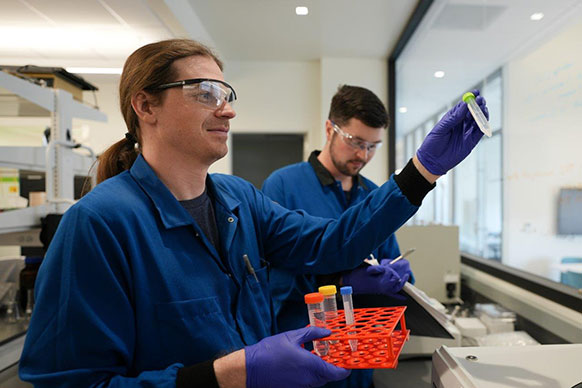
UW graduate student Tyler Gonzales, left, and molecular biology undergraduate Carter Wiberg, of Rock Springs, work on a project to enable RNA-based medicines to be transported and stored at room temperature. (UW Photo)
University of Wyoming Department of Molecular Biology Associate Professor Thomas Boothby
and his team are working on a project to enable RNA-based medicines to be transported
and stored at room temperature.
The project is one of several at UW to receive a National Science Foundation Seed
Translational Acceleration of Research (STAR) Project award, provided under the Accelerating
Research Translation (ART) program. UW was among the first cohort of awardees. The
projects have strong commercial potential and industry support.
From vaccines to genetic disorders, RNA-based medicines have applications in many
aspects of human health and disease. However, a major drawback of these new medicines
is the need to keep them frozen, making them reliant on a robust cold chain.
Led by Boothby and graduate student Tyler Gonzalez -- with company partner Sigma Genetics
-- the project, “Cold-chain free Stabilization of RNA-Lipid Nanoparticle Formulations,”
looks to keep these new medicines stable in a dry state, making them much less sensitive
to temperature and allowing them to be stored at room temperature. This would allow
these medicines to be shipped and stored more easily as well as to be distributed
to areas with less stable electricity or lack of refrigeration.
The researchers hope to achieve these results by applying techniques used by organisms
that can survive extreme drying, such as tardigrades, and to translate that basic
biological knowledge into a product that enables dry-state stabilization of these
sensitive RNA-based medicines.
Measuring less than half a millimeter long, tardigrades also are known as “water bears”
because they look like little bears floating in the water. These microscopic creatures
can survive extreme conditions, including being completely dried out; being frozen
to just above absolute zero (about minus 458 degrees Fahrenheit, when all molecular
motion stops); heated to more than 300 degrees Fahrenheit; and irradiated several
thousand times beyond what a human could withstand. They can even survive the vacuum
of outer space. Tardigrades survive these conditions by using proteins that form gels
inside of cells to slow down life processes.
Previous research conducted by Boothby’s team showed that natural and engineered versions
of tardigrade proteins can be used to stabilize an important pharmaceutical for people
with hemophilia and other conditions without the need for refrigeration.
“Translational research takes some of that basic biology that may not seem to be directly
applicable and translates it into a product that’s useful for the general population,”
says Gonzalez, a molecular biology doctoral student from Bradenton, Fla. “Our research
is trying to address that big inherent drawback to RNA-based medicines and vaccines
to stabilize these pharmaceuticals in the dry state to allow them to be distributed
at room temperature instead of needing to be frozen.”
Cold-chain logistics are expensive, and many locations worldwide cannot support cold-storage
medications.
“Even a lot of hospitals don’t have access to that,” Gonzalez says. Power outages
in developed countries also pose a problem with these medications.
Taking basic research and translating it into something useful for the general population
is exciting, Gonzalez says, and working in the Science Initiative Building at UW allows
for cross-disciplinary collaboration.
“We have one big open lab space, and that’s really allowed for strong collaboration
between our lab and other labs in the building,” he says. “We have people from molecular
biology, physiology and engineering, and there’s a very strong network of connections.”
In the past few months, Gonzalez says the team has made a great deal of progress on
the project. In the future, human trials will be necessary, a process that takes time.
“Hopefully, once we have our proof of concept, we can get outside funding to get this
into actual vaccines,” he says. “The ART award has allowed us to jump-start this research,
get some of our preliminary patents and do market analysis.”
With this foundation, some of the STAR award projects can turn their research into spin-out companies. Read more at www.uwyo.edu/research/economic-development/technology-transfer-office/accelerated-research-translation/star-grants.

The University of Wyoming has earned its Research Level 1 (R1) status from the Carnegie Classification of Institutions of Higher Education, placing Wyoming's only four-year university with the top research universities in the United States.