
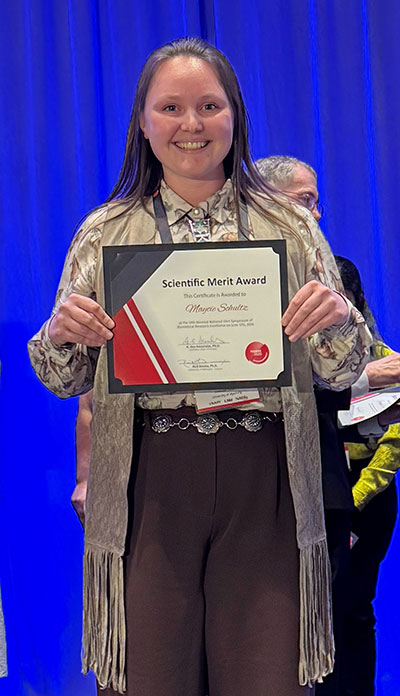
UW graduate student Maycie Schultz received a Scientific Merit Award for her presentation on Alzheimer’s disease at the recent National IDeA Symposium of Biomedical Research Excellence. (Annie Bergman Photo)
University of Wyoming students earned multiple honors while presenting their biomedical
research at the recent 10th biennial National IDeA Symposium of Biomedical Research
Excellence (NISBRE), a four-day national conference that showcases achievements of
the National Institute of General Medical Sciences (NIGMS) IDeA Program.
The NIGMS IDeA Program supports institutes that train biomedical scientists in the
24 IDeA-eligible states, including Wyoming. Close to 1,200 students attended the event
in Rockville, Md., where they heard keynote speakers; participated in plenary panels;
presented research either orally or during a poster session; attended professional
development workshops; and networked with peers, researchers and administrators from
across the United States and Puerto Rico.
UW’s INBRE and Centers of Biomedical Research Excellence (COBRE) programs support
faculty, graduate and undergraduate students in biomedical research. Their missions
center on conducting high-quality scientific research and building biomedical research
capacity through support for UW and Wyoming community college faculty members; and
mentoring to help students hone their skills for graduate school, professional schools
or work in industry jobs after graduation.
“NISBRE is a chance for invited students to present their own research at a multidisciplinary
conference and expand the experience into networking with others at all levels,” says
Annie Bergman, the director of the Wyoming INBRE student research program, who mentors
undergraduate and graduate students in biomedical research tracks. “This is the perfect
atmosphere for those students with a growth mindset willing to engage in conversations
about career paths and opportunities they have not yet considered.”
Maycie Schultz, a UW doctoral student in zoology and physiology from Sioux Falls,
S.D., was selected to give an oral presentation on her research, “Transcriptomic Insights
into Alzheimer’s Disease Progression: scRNAseq and Visium HD Spatial Mapping Reveal
AD-Specific Molecular Drivers in A Mouse Model.” She received a Scientific Merit Award
for her presentation.
Of the 369 posters displayed over three days, UW zoology and physiology undergraduate
student Cutter Barrus, of Powell, received one of three Outstanding Poster Presentation
Awards for his research poster, “Xenopus Tadpoles Display Distinct and Enduring Visual
Preferences.” He also received an Undergraduate Travel Award, with selection of these
awards based on abstracts submitted by the students.
“At NISBRE, I was able to meet many new people across a variety of scientific fields.
I was also able to meet those within my own field and gain new ideas for my work,”
says Barrus, who also visited a National Institutes of Health (NIH) research lab during
the symposium. “As someone who got to visit the NIH lab, that was an incredible experience.
I was able to see how a neuroscience lab from the NIH campus operates. This allows
me to branch more ideas into what is possible in research.”
Priscilla Phan, a fourth-year doctoral student in molecular biology from Cheyenne,
says NISBRE provided a unique and invaluable experience.
“Unlike molecular biology-focused events, it allowed me to explore new biomedical
science and attend tailored career advancement talks. As I begin thinking about the
end of my Ph.D., the conference reminded me of the diverse career paths available,”
Phan says. “I networked with professionals who offered practical advice on transitioning
from graduate school to the workforce and tips for getting hired. Ultimately, NISBRE
was an essential experience for building the professional skills and networks I need
to advance my career.”
Also attending was Danny Burns, a UW doctoral student from Wall, N.J.
“Attending the biennial NISBRE conference this year was a wonderful learning and networking
experience. I was able to meet staff from the NIH and learn about many of the funding
opportunities available to students and early career faculty, which was very useful,”
he says. “It was great being able to meet students and faculty from network peer institutions
and learn about their ongoing research and experiences and to discuss potential future
collaborations. The NIH is very large, and its offerings are vast and complex; thanks
to the many useful and informative sessions provided at the conference, I have a much
better idea of what is relevant to me and where to go to find more information and
to ask questions.”
The following Wyoming students had research abstracts accepted and presented posters
at the symposium:
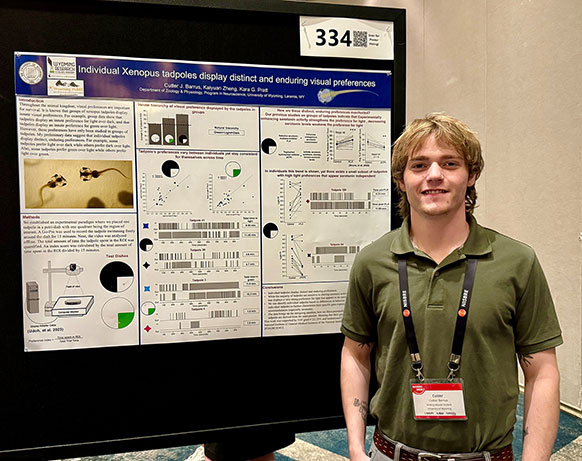
UW undergraduate Cutter Barrus, of Powell, received one of three Outstanding Poster Presentation Awards for his research poster, “Xenopus Tadpoles Display Distinct and Enduring Visual Preferences,” at the National IDeA Symposium of Biomedical Research Excellence. (Annie Bergman Photo)
University of Wyoming
-- Maria Azmerin, a doctoral student from Bangladesh in the School of Pharmacy, “Generation
and Preliminary Behavioral Characterization of 5xFAD-iRhom2-Deficient Mice in Alzheimer’s
Disease.”
-- Cutter Barrus, a senior from Powell in the Pratt Lab in zoology and physiology,
“Xenopus Tadpoles Display Distinct and Enduring Visual Preferences.”
-- Danny Burns, a fourth-year doctoral student from Wall, N.J., in the Robinson Lab
in statistics, “Paging Dr. Chatbot: A Cross-sectional Comparison of Emotional Content
of Text Responses to Patient Health Queries between Physicians & Artificial Intelligence
Chatbots.”
-- Ethan Forbis, a senior from Riverton in the Schmitt Lab in kinesiology and health
sciences, “Refining Circadian Biomarkers: Core Temperature Logging as an Alternative
to Exercise-Derived Metrics.”
-- Gustavo Hernandez, a senior from Laramie in the Schmitt Lab in kinesiology and
health sciences, “Tick Tock Exercise O’Clock.”
-- Bailey Isaak, a senior from Laramie in the Navratil Lab in zoology and physiology,
“Female Peptidylarginine Deiminase 2 and 4 Double Knockout Mice have Abnormal Estrous
Cycles and Reduced Fertility.”
-- Priscilla Phan, a fourth-year doctoral student from Cheyenne in the Levy Lab in
molecular biology, “Investigating the Role of the LINC Complex in Nuclear Morphology
Regulation Using Xenopus Laevis Egg Extracts.”
-- Maycie Schultz, a doctoral student in zoology and physiology from Sioux Falls,
S.D., “Transcriptomic Insights into Alzheimer’s Disease Progression: scRNAseq and
Visium HD Spatial Mapping Reveal AD-Specific Molecular Drivers in A Mouse Model.”
-- Abagail Straight, a senior from Casper in the Bowman Lab in molecular biology,
“Mechanisms of PopZ-Mediated Client Recruitment.”
-- Isabelle Wasseen, a senior from Rock Springs in the Nair Lab in the School of Pharmacy,
“iRhom2 Regulates Neuroinflammation-Driven Cognitive Dysfunction.”
-- William Weader, of Casper, in the Teulé-Finley Lab, “Citrullination and Aging in
Female Mice: Investigating the Patterns of Peptidylarginine Deiminase 2 Production.”
Western Wyoming Community College
Sam Latimer, Breelyn Semon and Jazmin Jamal, from Rock Springs, in the Holmes Lab,
“High Resolution Genetic Analysis of Connectivity in a Membraneless Compartment.”
Latimer will be a first-year graduate student in UW’s graduate program in molecular and cellular life sciences, and Jamal is accepted into the UW INBRE Transfer Fellow Program starting this fall.

The University of Wyoming has earned its Research Level 1 (R1) status from the Carnegie Classification of Institutions of Higher Education, placing Wyoming's only four-year university with the top research universities in the United States.