
Volunteers Spot 13 Moose During UW Biodiversity Institute’s Summer Moose Day Weekend
Published July 27, 2026
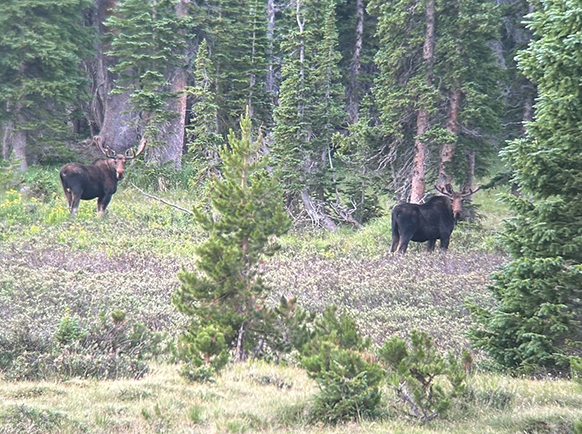
These bull moose were seen on the Sand Lake route in the Snowy Range during Summer Moose Day weekend July 18-19. During this year’s event, surveyors spotted six bull moose, five females and two calves in the Pole Mountain area and in the Snowy Range. The UW Biodiversity Institute sponsored the event. (Blaine Kroger Photo)
For the 10th year, community scientists helped identify moose populations in the mountains outside of Laramie for Summer Moose Day weekend.
The 13 moose seen this year were far more than the eight witnessed in 2025.
“Summer Moose Day 2026 was a great success. Despite the heat, volunteers got out early to survey moose during their period of greatest activity, and weather conditions provided near-perfect viewing conditions for the routes,” says Mason Lee, senior project coordinator for the University of Wyoming’s Biodiversity Institute. “Additionally, for the third year in a row, the Biodiversity Institute led a moose hike and BioBlitz Walk at Curt Gowdy State Park. Although no moose were spotted on the guided hike, participants enjoyed getting to know the native plants and lichens found in the area.”
Sixty-six volunteers across 22 groups ventured out in Albany County July 18-19 for Summer Moose Day weekend, covering nine routes in the Pole Mountain area and another nine in the Snowy Range. The Biodiversity Institute sponsored the event.
The community scientists hiked or drove designated routes between dawn and midmorning. They recorded observations of moose or their signs, which include tracks/hoofprints, bed areas, scat droppings and browse on aspen and willows.
Of the 13 moose surveyors saw, six were male bulls, five were females and two were calves, Lee says. The record of 16 moose spotted on Summer Moose Day was set in 2016 and matched again in 2022.
Ninety-nine percent of volunteers agreed or strongly agreed that Moose Day was a great experience, Lee says. One surveyor found a bull moose bedded down on his survey route.
“He saw me before I saw him, and he jumped up out of his bed and ran off and out of sight before I could get my camera on him,” says Doug Miller, a Wyoming
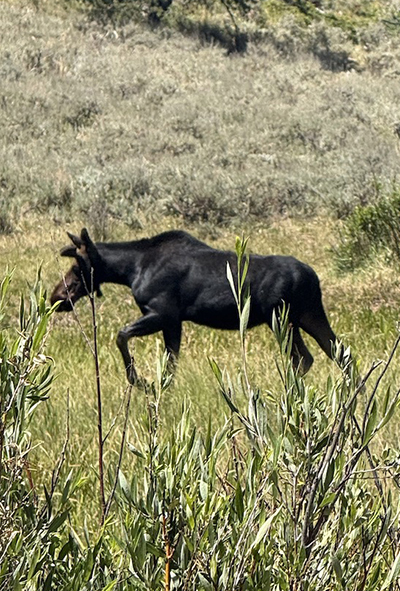
Rollin Abernathy, one of the surveyors who participated in the Summer Moose Day weekend, did not see a moose during the actual survey. But he did spot this moose while scouting his survey route in the Turtle Rock area a few days prior. (Rollin Abernathy Photo)
naturalist. “He was a big one. I estimate his antlers were already close to 40 inches wide.”
Other wildlife spotted include deer, rabbits, chipmunks, marmot, elk, turkey and a pika.
Postings from the current season can be found at www.inaturalist.org/projects/2026-statewide-wyoming-bioblitz. iNaturalist is a joint initiative of the California Academy of Sciences and the National Geographic Society.
The data gathered from Summer Moose Day are shared with biologists at UW. These biologists use the data collected by community scientists to further their understanding of the population densities of local moose, their reproductive rates, summer habitat quality, their winter ranges and how these variables change over time.
More will be learned after Dave Christianson, an associate professor in the UW Department of Ecosystem Science and Management, and his graduate students analyze the Summer Moose Day data as well as external factors that can affect moose counts, Lee says.
Both summer and winter Moose Day events are geared toward increasing the public’s understanding of moose in the Laramie area and involving the public in asking and answering questions. These events are an extension of the original program, Moose Day, held by Nature Mapping Jackson Hole (NMJH) in Jackson each winter. NMJH is a citizen science program created by the Jackson Hole Wildlife Foundation.
About the University of Wyoming Biodiversity Institute
The UW Biodiversity Institute fosters conservation of biodiversity through scientific discovery, creative dissemination, education and public engagement. In this setting, scientists, citizens, students and educators come together to share a wealth of perspectives on the study and appreciation of biodiversity -- from microbes to poetry and ecosystems to economics. Learn more at www.wyomingbiodiversity.org.

The University of Wyoming has earned its Research Level 1 (R1) status from the Carnegie Classification of Institutions of Higher Education, placing Wyoming's only four-year university with the top research universities in the United States.