
Rare Broad-Winged Hawk Released at UW After Discovery on Campus in June
Published August 05, 2026
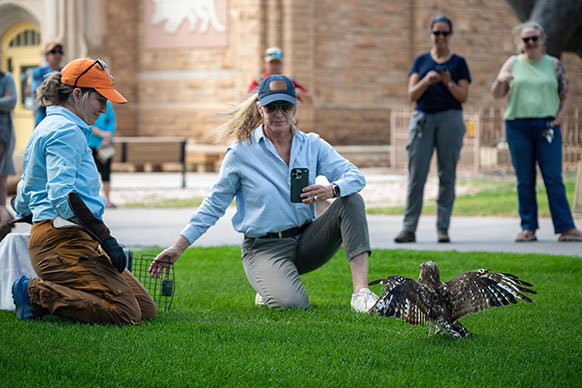
A broad-winged hawk, a migratory bird that’s uncommon in Wyoming, is released Thursday, July 30, after being found on campus in early June. From left are Emily Wade, a pre-vet extern with the Teton Raptor Center, and Valerie Page, chair of the center’s board. (UW Photo)
At the edge of the University of Wyoming’s Prexy’s Pasture Thursday, July 30, people
gathered around a rare sight in Wyoming for this time of year -- a broad-winged hawk.
The uncommon bird of prey was found on campus in June with a fractured beak and a
significant parasite load. A month later, the young hawk, healed and ready to resume
its journey, flew from UW’s lawn to the trees between the S.H. Knight Geology Building
and the Engineering Building before heading southeast. Its release was possible thanks
to the work of UW staff and faculty members, the Teton Raptor Center, the Wyoming
Game and Fish Department (WGFD) and the Rocky Mountain Raptor Program.
Broad-winged hawks, a small forest species, are close relatives of red-tailed hawks
and Swainson’s hawks, which are more common in Wyoming. Both Swainson’s and broad-winged
hawks travel across North America on migration, with broad-winged hawks breeding from
the eastern United States into southern Canada, says Beth Wommack, staff curator and
collections manager at UW’s Museum of Vertebrates, who assisted in the hawk’s retrieval
June 6 after it was found at the edge of Prexy’s Pasture on its back with its wings
spread.
While migrating, this specific hawk may have chosen campus as a refuge area, as UW
has an abundance of trees in an otherwise desert area, according to information relayed
to Kara DeShazo, clinic coordinator at the Teton Raptor Center, by its Conservation Director Bryan Bedrosian, who transported the bird to the center
with WGFD staff for rehabilitation.
DeShazo also notes that a small group of broad-winged hawks comes through Wyoming every year,
and sightings have been growing, but it is still an abnormal place for the bird to
be seen.
“Overall, broad-winged hawks are not found breeding in Wyoming but, every year in the spring and fall, you can see a few individuals soaring up high on migration,” Wommack says. “I’ve always assumed that our migrants are traveling to northern Montana and Canada to breed, but I don’t think anyone knows yet where the birds that migrate over Wyoming come from.”
According to Cornell Lab’s Birds of the World, broad-winged hawks are among the few North American raptors that travel in flocks during migration. In Texas, Central America and Mexico, during fall and spring migrations, they can be seen in the tens of thousands, the webpage says.
The hawk’s discovery in Laramie shows how “birdy” UW’s campus is, Wommack says, as
many different types of birds use the campus for shelter, food and nesting sites.
“Our campus has some great habitat for a forest bird traveling through the open spaces of Wyoming, and a lot of prey species present in the area for them to utilize if it was making a stopover to hunt,” Wommack says. “I would say that it is a great reminder to take a little bit of time while you are walking around campus and look at the birds and wildlife around. You never know what may be sitting in a tree or on a building right next to you.”
The broad-winged hawk was actually found while Merav Ben-David, a retired professor
of wildlife ecology in UW’s Department of Zoology and Physiology, was walking her
dogs on campus. During her walk, Ben-David’s dogs ran to someone crouching in the
grass, who was attempting to call WGFD. Ben-David called Wommack -- whose research
includes working with birds of prey, trapping and banding them -- and she contacted
WGFD wardens, the Rocky Mountain Raptor Program and the Teton Raptor Center to confirm
the best course of action.
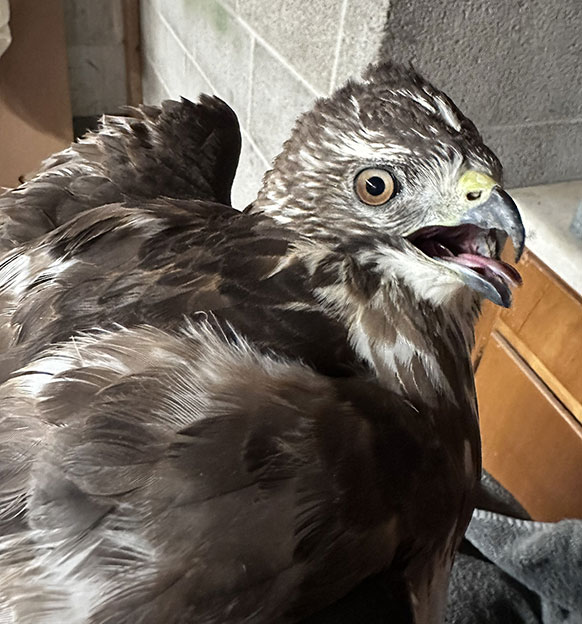
The broad-winged hawk looks into the camera soon after being rescued from the University of Wyoming campus June 6, ahead of its hand-off to the Teton Raptor Center and Wyoming Game and Fish Department for transport. (Beth Wommack Photo)
“When I did the initial capture of the bird, I could tell it was very thin, but feisty,”
Wommack says. “It didn’t want to fly but did not appear to have any obvious broken
bones. That was a good sign and gave hope to all of us that the bird had a chance.”
The bird was transported to the Teton Raptor Center, which has provided Wommack with
specimens for the Museum of Vertebrates. The center also has a history of collaborating
with UW on research projects that included graduate students and labs in the Department
of Zoology and Physiology.
“I think this is probably the heaviest parasite load I’ve seen in any raptor to come through the Teton Raptor Center, probably one of the heaviest parasite loads in my career, too,” DeShazo says.
The hawk also was emaciated, and its keel score (essentially a gauge for a bird’s
health) was at a one out of a one-to-five scale.
The fractured beak also had to be addressed, which meant the fracture had to be cut
off and that portion of the beak had to grow back, DeShazo says, adding that, like
human hair, it’s made of keratin.
Once the hawk was able to shred and eat increasingly larger food portions, and catch
live prey, it was ready for release.
Initially, the center hoped to fit the bird with telemetry to track its movements,
but the device exceeded 3 percent of the hawk’s body weight and couldn’t be attached.
The center still banded the bird, and, when it’s found again, hopefully, how far it’s
traveled can be logged, DeShazo says.
Wommack is unsure what the hawk will do now that it’s released, she says, partly because
its species is not often in Wyoming this time of year. But this year also presented
odd bird behavior, including early and late migrants and reports of other broad-winged
hawks “on the move in Albany and Laramie counties.”
“So, perhaps this bird will stick around to hunt for a little bit and then start an
early migration down south of us,” she says.
If an injured bird is located, people can visit the Teton Raptor Center’s website
at tetonraptorcenter.org/found-injured-bird/ ; the WGFD’s website at wgfd.wyo.gov/Ask-Game-and-Fish/Greg-and-Jessica,-what-is-the-best-way-to-contact; and the Rocky Mountain Raptor Program’s website at www.rmrp.org/raptoremergency/ for next steps.
For more information about UW’s Museum of Vertebrates, visit https://uwymv.wyomingbiodiversity.org/.

The University of Wyoming has earned its Research Level 1 (R1) status from the Carnegie Classification of Institutions of Higher Education, placing Wyoming's only four-year university with the top research universities in the United States.