
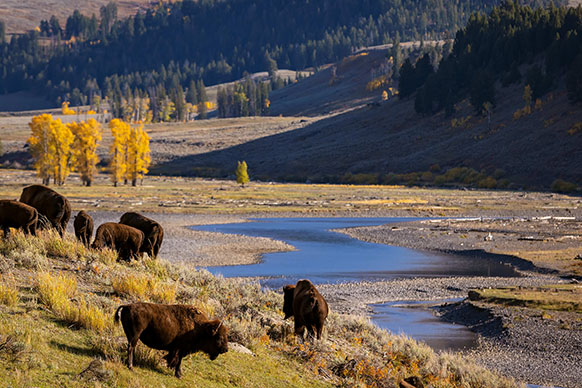
Bison graze in Yellowstone National Park’s Lamar Valley. A new study -- using material from University of Wyoming collections -- shows that, before the population collapse of the late 19th century, bison ranged widely across North America and were genetically connected, with few genetic distinctions developing until different populations were isolated in attempts to conserve the species over the past century. (UW Photo)
Genetic material from bison bones collected at Wyoming archaeological sites -- and
housed at the University of Wyoming -- played a key role in a sweeping new study about
the history of the iconic species in North America.
The study -- which involved researchers from more than 30 institutions and organizations,
including Wyoming State Archaeologist Spencer Pelton at UW -- appears today in the
journal Science. The scientists sequenced 115 ancient and 45 modern bison genomes from across North
America to show how the animals have evolved over the past 20,000 years, including
the human-driven collapse that nearly led to their extinction by the start of the
20th century.
Most notably, the researchers concluded that, before the population collapse, bison
across the continent ranged widely and were genetically connected, with few genetic
distinctions developing until different populations were isolated in attempts to conserve
the species over the past century.
Additionally, contrary to assertions in recent years that almost all modern bison
have at least some cattle ancestry due to breeding experiments aimed at creating bison-cattle
hybrids for agriculture, the scientists found limited cattle ancestry in modern herds.
It’s small enough that cattle genes could eventually be eliminated from those herds,
the researchers say.
“This study provides, perhaps, the most comprehensive assessment of North American
bison and how they’ve changed over the past 20,000 years, and it’s noteworthy that
so much of the genetic material used in the study comes directly out of UW’s archaeological
repository,” Pelton says. “This really demonstrates the value of the university’s
investment in collections management.”
In fact, the researchers used remains from 27 bison in Wyoming -- 16 of those from
five archaeological sites in the state -- to create what they described as a 10,000-year
time transect. That component of the study was instrumental in reaching the conclusion
that bison across North America once were widely connected, with extensive gene flow
and few genetic distinctions.
Since the total population of North American bison was reduced from tens of millions
to just a few hundred during the last decades of the 19th century, the animals were
brought back from the brink of extinction through concerted efforts of individuals,
tribes, government entities and others. Now numbering in the hundreds of thousands,
bison today are largely managed in small, isolated herds -- as well as some larger,
wild herds in Wyoming’s Grand Teton and Yellowstone national parks, as well as Canada’s
Wood Buffalo National Park, for example.
Wood bison, which historically ranged across the boreal forest of north Canada and
Alaska, now only exist in several small herds occupying a fraction of their previous
habitat. In the 1920s, the Canadian government translocated about 7,000 plains bison
to Wood Buffalo National Park. As a result, all of today’s wood bison have evidence
of plains bison genes, the researchers say.
When it comes to cattle ancestry, the researchers found it present in 32 of the 97
modern plains bison samples they analyzed. That contradicts earlier analyses suggesting
that all modern bison have cattle ancestry.
“Together, these results suggest that cattle ancestry is much less common than previously
thought and could potentially be lost over time through (genetic) drift, as long as
gene flow between herds is frequent enough to prevent particular segments of cattle
ancestry from becoming fixed within herds,” the scientists wrote.
The scientists say the new research findings are largely encouraging, but the future
of bison in North America depends upon management strategies informed by the historical
information they uncovered.
“While species such as elk, bighorn sheep and pronghorn have more thoroughly returned to their role as wildlife, there is much more work remaining to restore bison as important members of the Great Plains ecosystem …,” the researchers wrote.

The University of Wyoming has earned its Research Level 1 (R1) status from the Carnegie Classification of Institutions of Higher Education, placing Wyoming's only four-year university with the top research universities in the United States.