
UW Receives $14.8 Million NSF Grant to Operate New King Air Research Aircraft
Published August 20, 2026
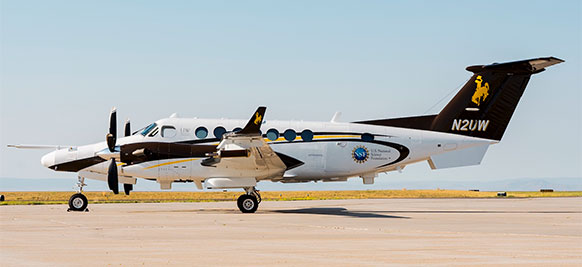
The University of Wyoming recently received a five-year, $14.8 million NSF grant that will provide operation and maintenance funding for the new NSF/King Air Research Aircraft. The King Air is pictured here shortly after it was delivered to UW in 2024. (UW Photo)
The University of Wyoming received a $14.8 million U.S. National Science Foundation
(NSF) grant that will provide operation and maintenance funding for the new NSF/King
Air Atmospheric Research Aircraft that is already in the midst of its first study
mission.
The five-year grant begins Sept. 1 and runs through Aug. 31, 2031, for UW, which is
the only academic institution in the United States that provides a research aircraft
facility to the atmospheric science community.
“This grant is absolutely critical for using the King Air to conduct research over
the next five years. The grant funds the basic infrastructure that is needed for operation
and maintenance of the aircraft, including all of the scientific instruments that
are part of the NSF/UW King Air Facility,” says Jeff French, a professor and head
of UW’s Department of Atmospheric Science. “A lot of this comes down to people whose skill sets are highly specialized. This
includes scientists, engineers, technicians, aircraft mechanics and pilots. We have
18 persons who are funded either full-time or half-time through this grant, and their
skills and knowledge are what allow us to maintain a state-of-the-art research facility
and support the atmospheric science research community.”
“NSF is excited to continue this unique partnership between the federal government
and the state of Wyoming,” says NSF Program Director Nicholas Anderson. “The new NSF/King
Air aircraft was purchased by the state; converted to a highly capable research platform
through NSF funding from the Mid-scale Research Infrastructure-1 program; and will
continue to be operated by the University of Wyoming through this new grant.”
The NSF grant award totals $14,818,934 over five years for UW for support of the project
“NSF-University of Wyoming King Air Research Aircraft Operations and Maintenance.”
This grant is based on a proposal submitted earlier this year by French, the grant’s
principal investigator, and co-principal investigators Matthew Burkhart, a senior
research scientist, and Dana Caulton, an associate professor, both in the UW Department
of Atmospheric Science.
The Department of Atmospheric Science has been operating a King Air atmospheric research aircraft since 1977, when it was purchased for $1 million. Over
the ensuing years, additional millions have been awarded by NSF and other federal
agencies for instrumentation and airframe modification, such as for radar and lidar.
The old King Air was retired in August 2022. It flew roughly 9,000 research hours
during that 45-year period, logging thousands of flights. A typical research flight
lasted between 3.5 and four hours, French says. The new NSF/King Air aircraft, which
cost $13.4 million, was celebrated with an open house and ribbon-cutting in September
2024.
Since 1988, the King Air has been part of the NSF Lower Atmospheric Observing Facilities
Program, which provides base funding to UW to deploy the aircraft and its instruments
in support of NSF-funded research. Under the cooperative agreement, the NSF provides
nearly $3 million in base funding annually to UW to maintain the aircraft. As mentioned,
the funding also helps pay for the staff of 18 individuals, including three professional
pilots, two aircraft mechanics and 13 research scientists, engineers and technicians.
In exchange, UW provides the plane and instrumentation to NSF-funded investigators
as “a national facility.”
“The grant illustrates the University of Wyoming’s prominence in the field. We are the only university in the country that houses a research aircraft that is funded as a national facility through NSF. NSF’s two other aircraft are operated by NCAR (National Center for Atmospheric Research),” French says. “Other research aircraft that are in the U.S. are operated by large agencies, such as NASA and the Department of Energy. The University of Wyoming is internationally recognized as an expert institution for airborne atmospheric measurements. We collaborate closely with many of the other aircraft operators, both in the U.S. and outside of the U.S.”
French says one of the pluses about having the NSF/UW King Air based at a university is the opportunities for students to be involved in the research. All of the research projects where the aircraft is used have some type of student involvement, usually graduate students, and provides students the opportunity to work side-by-side with UW scientists and engineers, he says.
“This often includes flying on research flights; operating instruments in real time; and working with the data following the flights,” French says. “UW is really the only university in the country that can provide this type of experience for students, which is why we have a such a strong reputation nationally and internationally for educating scientists within the specialty field.”
Maiden flights and the future
The new King Air’s maiden research mission, led by a collaboration involving Colorado
State University, the University of Utah and the University of Montana -- in conjunction
with NASA and the Utah Division of Air Quality -- is measuring summer ozone levels
in the Salt Lake Valley. At lower elevations, ozone is harmful pollution that can
trigger asthma, reduce lung breathing capacity and is harmful to plants.
The NSF/King Air is outfitted with equipment that can measure components of ozone,
including volatile organic compounds and nitrogen oxides. The flights -- taking place
twice a day over the Salt Lake Valley -- began in mid-July and will conclude at the
end of this month.
“The focus of the study is to understand the formation of ozone in the Salt Lake Valley during the summer, which is a huge air quality issue. The project was approved by NSF even before the completion of the aircraft, and we’ve known for a couple of years this would be our first project,” French says. “We’ve worked with many of the same scientists on previous projects with our old aircraft, which was retired in 2022. Instrumenting and operating an aircraft for its first project has brought a number of challenges, but it has been helpful to work with a group of scientists we are familiar with and have worked with in the past.”
French says the next project is slated for this upcoming winter, likely the February-through-late-March 2027 timeframe. The project will be based in Laramie and will focus on the measurements of clouds over and downwind of the mountains.
“This is a really good area to study clouds during the late winter/early spring because they tend to be very predictable on when and where they form,” he says.
The project has two principal objectives. The first is just to test and verify the standard cloud physics instrumentation package on the new aircraft. Most of these instruments fly on the outside of the fuselage, mounted under the wings or on the fuselage itself.
“So, proper operation of the instruments can be tricky. Imagine flying through an icing cloud at 200 mph and trying to measure cloud droplets and snowflakes,” French says.
The second objective is focused on developing and testing new algorithms for retrieving cloud characteristics from the aircraft’s radar and lidar instruments that will be mounted on the aircraft.
“These techniques that are being developed can help ‘extend’ the measurements we make to regions away -- above and below the aircraft -- to study the entire depth of a cloud, while still being grounded in ’truth’ based on the detailed measurements we make right at the aircraft,” French says.
After the cloud study, French says there are several projects that are under consideration. NSF, based on merit reviews, in conjunction with UW, will make decisions on funding for projects typically six to eight months in advance, sometimes longer if the project is especially complex.
“We don’t know exactly what is next. We anticipate we will be supporting another NSF-funded campaign later in 2027,” he says.
Historically, about 50 percent of the research conducted with King Air is related to cloud physics. Another 30 percent focuses on aerosols and air quality, French says. The remaining 20 percent of the aircraft’s research hours are spent on the exchange of energy between the surface of the Earth and its lower atmosphere.
For a rundown of UW King Air research deployments since 2004, go to www.uwyo.edu/atsc/research-facilities/uwka/projects-data.html.

The University of Wyoming has earned its Research Level 1 (R1) status from the Carnegie Classification of Institutions of Higher Education, placing Wyoming's only four-year university with the top research universities in the United States.