
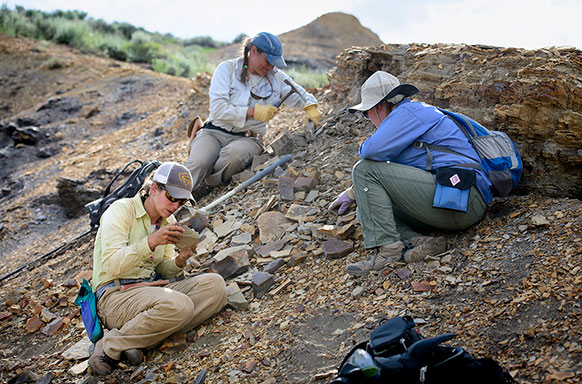
UW researchers Ellen Currano, Regan Dunn and Kymbre Skersies excavate plant fossils in the Hanna Basin in 2015. Their work is a big part of a new scientific paper -- published today in the journal Science -- that reconstructs the forest canopy of 56 million years ago, during a massive and abrupt emission of carbon into the atmosphere during the Paleocene-Eocene Thermal Maximum. (UW Photo)
For more than a decade, University of Wyoming botany Professor Ellen Currano has been
collecting fossilized remnants of trees and plants that thrived about 56 million years
ago in what is now Wyoming.
The work of Currano and a dozen UW undergraduate and graduate students in the Big
Horn and Hanna basins has helped paint a picture of a much different landscape than
exists today, showing that the forests of ancient Wyoming teemed with giant dawn redwood
trees overlooking sycamores, alders, palms and other subtropical and tropical plant
species.
Now, Currano’s findings are part of a new scientific paper -- published today in the
journal Science -- that reconstructs the forest canopy of 56 million years ago, during a massive
and abrupt emission of carbon into the atmosphere during the Paleocene-Eocene Thermal
Maximum (PETM). For the first time, the authors of the study used fossilized leaf
cells to reconstruct the tree canopy of the PETM, Earth’s most recent period of abrupt
climate change.
“I love telling my undergraduate classes that Wyoming has the best fossil record in
the world, and this work is another demonstration of that. Understanding how forest
structure changed during the PETM is really important, because it tells us about how
plant growth, biomass and productivity are affected by adding a lot of carbon dioxide
to the atmosphere,” Currano says. “It turns out that too much carbon dioxide is a
bad thing for forests, because the accompanying warming and drying stresses the trees
and kills many of them.”
As a graduate student at Penn State University, Currano studied plant fossils from
Wyoming’s Big Horn Basin, which provided the first record of how plant composition
changed before, during and after the PETM.
“Unfortunately, we did not have the right types of fossils in the Big Horn Basin to
be able to reconstruct how the structure of the forests changed,” Currano says. “Lucky
for me, the right types of fossils to do this are found in the Hanna Basin, just 90
minutes from the University of Wyoming campus.”
“What’s unique about the Hanna Basin is that it’s a coal-forming basin. So, you have
all these organic-rich rocks, like lignites and coals, that are lacking in other places
where the PETM interval is well-known, such as the Big Horn Basin in northwestern
Wyoming,” says lead author and paleobotanist Regan Dunn, assistant deputy director
and associate curator of the Samuel Oschin Global Center for Ice Age Research at La
Brea Tar Pits and the Natural History Museum of Los Angeles County (Calif.). “Contained
within these organic-rich rocks are the leaf fragments we need to reconstruct the
ancient forest canopy.”
Quantifying the Canopy
How do you rebuild a forest from more than 50 million years in the past? With the
fossilized fragments of leaves called leaf cuticles.
Introducing an entirely new method, the authors used leaf cuticle fragments to calculate
leaf area index (LAI) for the first time. LAI is a measure of how much of the sky
is filled by leaves, giving researchers a way to quantify the density of a forest
canopy. The research team calculated the LAI of a variety of modern forests in South
and Central America by setting up a camera with a fish-eye lens on a tripod pointed
upward and collecting leaf cuticles in soil samples directly beneath it.
“What excites me about LAI is that it lets us move beyond somewhat subjective descriptions
of vegetation, like ‘open forest’ or ‘woodland.’ Instead, the leaves themselves provide
a quantitative estimate of canopy structure, allowing us to compare ecosystems using
an objective, reproducible metric,” says Dunn, who received a master’s degree in geology
and conducted postdoctoral research at UW.
Assigning a numerical value lets researchers more accurately measure changes over
time.
Dunn’s earlier work used phytoliths -- microscopic silica-filled plant cells -- to
measure LAI, but a new calculation was needed for leaf cuticle fragments to account
for preservational biases of the different fossil types. To get the fuller picture
of how trees responded to the explosion of carbon dioxide during the PETM, Dunn turned
to the cuticle fragments preserved in the organic-rich sedimentary rocks from Wyoming.
The shape of a leaf’s epidermal cells reflects its exposure to sunlight, whether it’s
a shade leaf further down the tree with less access to sunlight, or a canopy leaf
near the top of a tree, fully exposed to the sun’s rays. Dunn discovered that the
shape of the leaf cells is highly correlated to the density of the vegetation (LAI).
“Leaves that grow in denser forests -- in shadier habitats -- have cells with higher
aspect ratios, or more elongate and skinny cells than leaves receiving more sunlight,”
Dunn says. “This is the shade response of plants: They lengthen the leaf by lengthening
each cell.”
Picture each cell stretching itself to get sunlight, compared to a fat and happy cell
bathed in full sunlight.
“Once the leaves fall from the tree, and begin to break down in the soil, the cell
shapes preserved in the fragments can tell us how dense the canopy was where the leaf
originally grew,” Dunn says.
LAI was calculated from photographs, while Dunn, Currano and colleagues measured thousands
of epidermal cells from leaf fragments recovered from the soils, then compared their
measurements with the LAI values.
Changing Landscapes
The Paleocene and Eocene (66 million-34 million years ago) periods were times of numerous
rapid and extreme warming events. These rapid warming events, known as “hyperthermals,”
were caused by the release of carbon into the atmosphere. During the PETM, carbon
dioxide levels at least doubled, causing a temperature increase of about 8-degrees
Fahrenheit.
The authors of the new study found that the PETM was marked by a widespread browning
of Earth’s landscapes. There also was a nearly complete change in vegetation, as plant
species migrated northward and canopy cover declined, accelerating erosion and disrupting
the terrestrial water cycle, as previous work by Currano documented.
There also was an observable increase in the diversity of insect herbivore damage
traces observed on fossil leaves from the PETM, as well as an increase in the amount
of leaf area consumed by insect herbivores.
After the PETM, both floral composition and insect herbivory returned to pre-PETM
states.
“Another point that I like to get across is how different the forests of ancient Wyoming
were from our present-day ecosystems. Today, the Hanna Basin is predominantly sagebrush
steppe, and trees are rare. Sixty million years ago, there were dense forests, like
what you might see in the southeastern U.S.,” Currano says. “Before and after the
PETM, giant Metasequoia (dawn redwood) trees flourished, alongside palms and broad-leaved
trees like sycamores and alders. At the start of the PETM, the landscape became more
open, with abundant ferns and palms. Next, we see plants from dry tropical regions
in central and south America. Finally, after the PETM, once temperatures cool and
humidity increases, we see similar forests to what we saw before.”
Implications for Today
Dunn and her colleagues’ findings suggest that continued climate warming could push
Earth’s forests toward the kind of widespread browning observed during the PETM. Unlike
the ancient world, however, today’s forests are confronting multiple human-driven
pressures simultaneously. In addition to rapidly rising atmospheric carbon dioxide
and warming temperatures, deforestation, increasingly frequent and severe wildfires,
habitat fragmentation, invasive species, and land-use change are reducing forest resilience
and limiting their ability to recover.
“Trees are awesome. All those forests are taking up hundreds of millions of tons of
carbon for us every day,” Dunn says. “But, when you start losing the forests, then
you’re losing those critical carbon sinks. The PETM reminds us that, when forests
decline, the consequences ripple through the climate system.”
“Our work shows that, during the PETM, forest canopies became more open, with fewer big trees, and this change affected climate, nutrient cycling, weathering and, of course, the animals that inhabited the forests,” Currano says. “We are starting to see similar changes to forests occurring today, particularly in the Amazon, and the Wyoming plant fossil record gives us insight into where Earth might be headed.”

The University of Wyoming has earned its Research Level 1 (R1) status from the Carnegie Classification of Institutions of Higher Education, placing Wyoming's only four-year university with the top research universities in the United States.