
UW’s Machine Learning for High School Teachers Workshop Enriches Classrooms
Published August 07, 2026
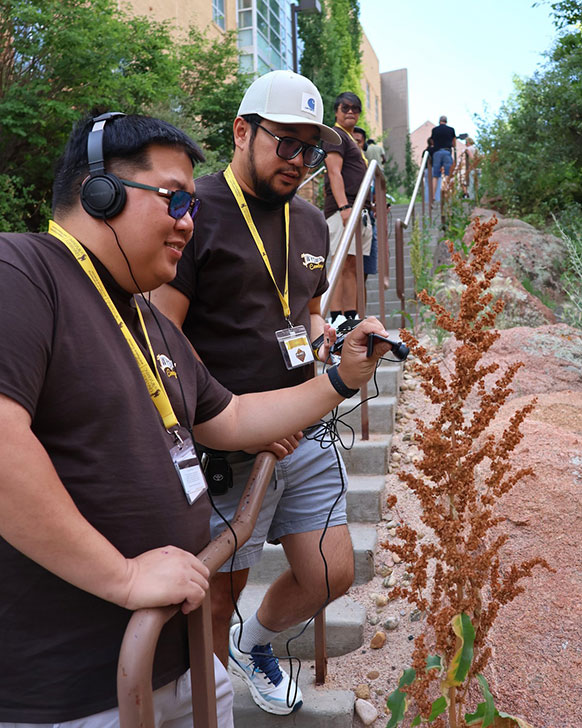
Participants use an artificial intelligence interface to identify plants in the Machine Learning for High School Teachers workshop, which took place July 13-16 on the University of Wyoming campus. (Janna Urschel Photo)
If you were on the University of Wyoming campus the week of July 13-16, you may have
noticed a group of people intently talking to the plants. No, it was not UW’s new
plant communication program, but rather an innovative module in the annual Machine
Learning for High School Teachers (ML4HST) workshop.
Among the many hands-on machine learning and artificial intelligence (AI) activities
offered throughout the week at ML4HST, participants programmed and tested large language
models (LLMs), including one designed to identify plants using a small camera with
a microphone interface for voice commands.
ML4HST is led by Suresh Muknahallipatna, a professor in the UW Department of Electrical
Engineering and Computer Science, with support from a team of undergraduate and graduate
students and teacher mentors Adrienne Unertl, a district assistive technologist and
K-12 online coding instructor, and Colin Wilson, a high school computer science teacher,
both of Evanston.
The workshop aimed to train teachers in grades 8-12 on incorporating machine learning
and AI activities -- including coding and training some popular robotic units -- into
their classrooms.
Highlights of this year’s workshop include collecting data and working with datasets
to train sensors for muscles and gesture recognition, which were used with the popular
MechDog and SpiderPi robots, as well as running object detection and plant identification
with PictoBlox. In addition, participants trained TurboPi wheeled units for the detection
of walls, lights and paths to navigate mazes.
Most of the 32 participants in this year’s workshop were teachers, but seven high
school students joined the workshop as well. Participants spent four days learning
the intricacies of block coding and Python with KNIME and PictoBlox, as well as receiving
an introduction to LLMs.
In their feedback, participants repeatedly expressed their appreciation for Muknahallipatna's
grounding of AI and machine learning in historical contexts. This gave teachers a
better understanding of both the limits and best applications for the technologies,
especially in the classroom.
“Now that algorithms are a major part or our daily lives, having even a basic understanding
of how they work is a must,” says Gina Carroll, a computer science teacher at Sheridan
Middle School. “This training helped me to feel confident in what I already knew and
set a foundation for growth in the areas of machine learning that were completely
new to me. I love how this course allows for all levels of learners to come in and
be equally challenged and successful.”
Maria Fatima Solijon, a high school English teacher from Wiley, Colo., appreciated
discussions about ethics and how to use AI in ways that support human creativity and
control, rather than replace it.
“Raspberry Pi introduces students to computer science concepts such as coding, hardware,
sensors, data collection, automation and problem-solving,” Solijon says. “It shows
students that technology is not just something they consume but something they can
create, design and understand.”
The greatest value of ML4HST, Unertl says, is hands-on learning.
“It allows us to experience the same issues our students will, and ask some of the
same questions, so we can better help them understand what AI truly is instead of
just generative AI,” Unertl says.
To help teachers integrate lessons on machine learning and AI in their classrooms,
ML4HST maintains a library of robotics units which schools in the state can check
out to use in their curricula.
To learn more about ML4HST, visit www.uwyo.edu/ceps/resources/outreach/programs/machine-learning.html.
Participants, listed by hometown, were:
Bozeman, Mont. -- Lindy Hockenbary.
Casper -- Shari Shaw.
Cheyenne -- Gabriele Brennan.
Dakar, Senegal -- Papa Touty Traore.
Deming, N.M. -- Reynaldo Belen and John Valdes.
Denver, Colo. -- June Abergos.
Espanola, N.M. -- Ace Lyn Miranda.
Evanston -- Brooke George, Amber Martines, Adrienne Unertl and Colin Wilson.
Hanna -- Rachel (Kim) Yung.
Indianapolis, Ind. -- Lindsay Lewis (Kinker).
Laramie -- Boa Byeon, Diane Cook and Sheila Monteith.
Lower Brule, S.D. -- Rezty Gapuz.
Monte Vista, Colo. -- Mary Ann Labadan.
Mountain View -- Lindsay Kiefer.
Ocala, Fla. -- Daren Johnson.
Orem, Utah -- Aimee Alsop.
Riverton -- Jennifer Hammock.
Saratoga -- Donald Murray.
Sheridan -- Gina Carroll.
Sumter, S.C. -- Mae Bonifacio, Adam Che and Reynand Dumala-on.
Syracuse, Kan. -- Kim Alilin and Ranie Para.
Westfield, Ind. -- David Abdelmaseih.
Wiley, Colo. -- Maria Fatima Solijon.
UW student teaching assistants, listed by hometown, were:
Casper -- Josiah Adwalpalker and Kalel Brubaker.
Cheyenne -- Aidan Cabrera, Sully Fagan and Josh Vann.
Chugwater -- Rebecca Geary.
Cody -- Chase Livingston.
Gillette -- Jaden Mahoney and Shantel Smith.
Gorkha, Nepal -- Sonu Dhakal.
Izmir, Turkey -- Umur Atan.
Lander -- Tessa Livingston.
Laramie -- Teddy Hart.
Johnstown, Colo. -- Mikkhi Sedey.
Mahaboudha, Kathmandu -- Pratik Shrestha.
Mysore, India -- Varun Bharadwaj.
Salt Lake City, Utah -- Drew Crouch.

The University of Wyoming has earned its Research Level 1 (R1) status from the Carnegie Classification of Institutions of Higher Education, placing Wyoming's only four-year university with the top research universities in the United States.