
UW Biodiversity Gallery Features Linocut Prints Celebrating Rocky Mountain Wildlife
Published September 09, 2026
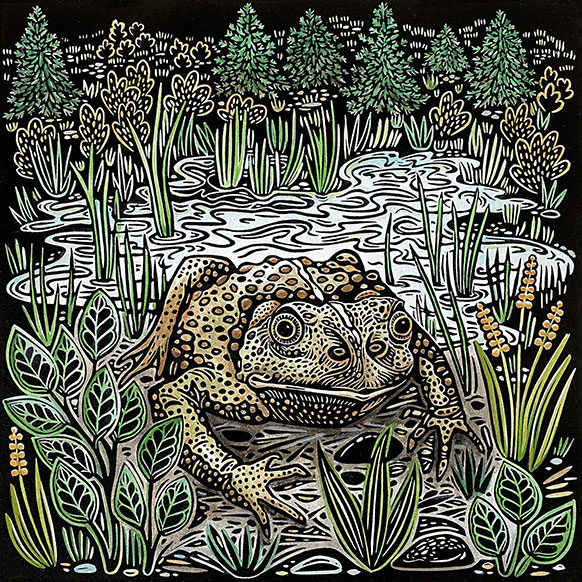
The University of Wyoming Biodiversity Institute is featuring “Rocky Mountain Wildlife,” an exhibition by Wyoming-born artist Jill Bergman, in the Berry Biodiversity Center’s Biodiversity Gallery through Tuesday, Oct. 13. (Jill Bergman Photo)
The University of Wyoming Biodiversity Institute is featuring “Rocky Mountain Wildlife,” an exhibition by Wyoming-born artist Jill Bergman, in the Berry Biodiversity Center’s Biodiversity Gallery through Tuesday, Oct. 13.
Bergman, a printmaker based in Steamboat Springs, Colo., has spent the past 20 years creating artwork inspired by the wildlife of the Rocky Mountains. Her detailed linocut prints begin with carving an image into artist linoleum using fine tools -- a process that can take days or weeks. During that time, Bergman researches the animals she depicts, including their habitats, migration patterns and ranges, interactions with other species, mating behaviors and methods of raising young.
Originally from Laramie, Bergman grew up around UW’s Department of Zoology and Physiology in the 1970s and 1980s, surrounded by professors, staff, graduate students, biologists, researchers and other people who shared a deep connection to the outdoors. That early exposure has continued to influence her work.
“Rocky Mountain wildlife helps define the wild nature of the West but are often taken for granted,” Bergman says. “In fact, animals face many challenges, and some iconic species are endangered or threatened.”
Her work highlights the connections between wildlife and the ecosystems they inhabit, while drawing attention to challenges such as habitat loss, reduced connectivity, drought and wildfire. Bergman’s goal is to share the importance of natural systems -- including wildlife -- in maintaining healthy environments where both people and nature can thrive.
Bergman’s linocut process emphasizes line, texture and movement. After carving the image into linoleum, she rolls ink over the raised surface and uses an etching press to create the print. Some of her pieces also incorporate hand-painted elements. Her work is influenced by Western landscapes, rivers, wildlife and folk art.
The Biodiversity Gallery was created as a space where art and biodiversity can intersect, giving visitors an opportunity to consider scientific and conservation topics through creative work. The Biodiversity Institute welcomes artists working in many different forms, including painting, photography, sculpture, printmaking, film, fiber arts, and even outdoor or yard artwork, as long as the work connects to biodiversity or conservation.
Since the gallery launched, interest from artists has grown quickly. The 2026 and 2027 exhibition calendars filled soon after applications opened, and the Biodiversity Institute is currently looking ahead to its 2028 exhibition season. Artists interested in sharing their work in the gallery are encouraged to apply, and selected artists also may organize an opening reception to introduce their work to the community.
Located in the lobby of the Berry Biodiversity Center, the gallery provides a public-facing setting for artwork that encourages conversations about the natural world. Exhibitions are open for the public and UW students to view during regular Berry Center business hours from 8 a.m.-5 p.m. weekdays.
For more information about the Biodiversity Gallery or to inquire about exhibiting in 2028, go to the UW Biodiversity Institute website at www.wyomingbiodiversity.org/index.php/outreach/exhibition.

The University of Wyoming has earned its Research Level 1 (R1) status from the Carnegie Classification of Institutions of Higher Education, placing Wyoming's only four-year university with the top research universities in the United States.