
UW Chemistry Professor Receives Prestigious George C. Pimentel Prize
Published September 03, 2026
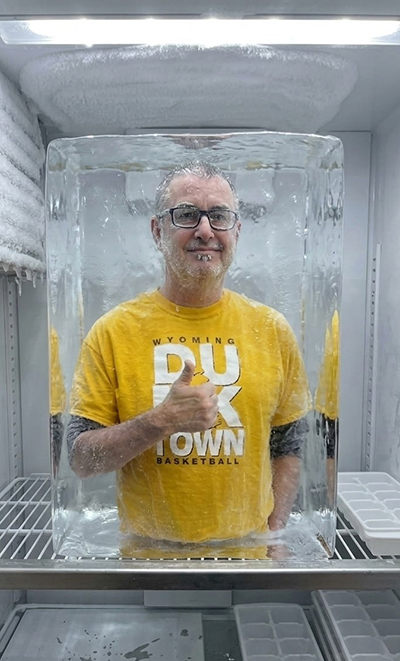
David T. Anderson, a UW chemistry professor, works with very low temperature hydrogen molecules. He recently was awarded the George C. Pimentel Prize for Advances in Matrix Isolation. (UW Photo)
David T. Anderson, a University of Wyoming chemistry professor, was awarded the prestigious George C. Pimentel Prize for Advances in Matrix Isolation at the Chemistry and Physics at Low Temperatures conference Aug. 2-6 at Ruhr University in Bochum, Germany.
The biennial international award recognizes outstanding, career-defining contributions to matrix isolation spectroscopy. It was established in 2005 to honor George C. Pimentel, the pioneer of the matrix isolation method. Pimentel was a preeminent physical chemist, University of California-Berkeley professor and inventor of the chemical laser whose work revolutionized the study of chemical bonding.
Matrix isolation spectroscopy makes it possible to study reactive molecules, which have otherwise proved resistant to characterization in their gaseous phases, by trapping them in very low temperature solids (minus 423-452 degrees Fahrenheit) to extend the lifetime of these reactive species so that they can be characterized spectroscopically.
Anderson’s research focuses on reactions that take place in hydrogen ice that have pronounced nuclear quantum effects. In particular, he and his students are conducting chemical reactions of atoms and molecules trapped in hydrogen ice to better understand quantum effects in low-temperature chemistry.
“The details involved in the breaking and forming of chemical bonds for reactions that take place in the presence of a solvent are still highly elusive,” says Anderson, whose research has revealed spectroscopic “peaks” that are used to study the time dependence of chemical reactions at very low temperatures that occur primarily by quantum tunneling.
“Our research has a variety of applications that range from the development of hydrogen as a green fuel to the chemistry that occurs in interstellar and planetary ices,” Anderson says.
Anderson, who has always held Pimentel as a professional role model and admired his legacy as an intensely dedicated educator, expressed surprise and deep gratitude upon receiving the prize.
Anderson, whose nomination for the prize received an overwhelming majority vote from conference attendees, was presented with the honor at the conclusion of the conference following his presentation, “Nuclear spin conversion of symmetric molecules confined in quantum solids.”
Reflecting on the career milestone, Anderson notes he was overcome with emotion thinking about the many students he has mentored throughout his 26 years of teaching at UW.

The University of Wyoming has earned its Research Level 1 (R1) status from the Carnegie Classification of Institutions of Higher Education, placing Wyoming's only four-year university with the top research universities in the United States.