
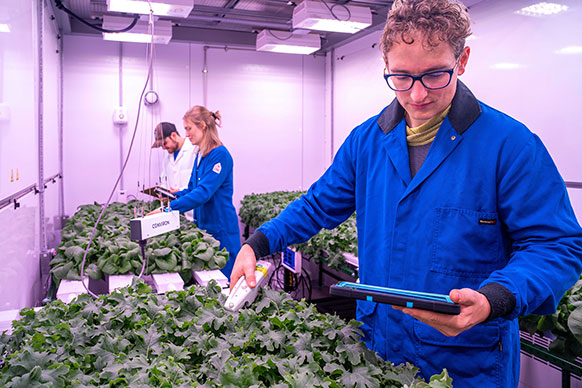
UW doctoral student Benjamin Romanjenko, right, and colleagues Caroline Hansen and Jack McKinley work in the Conviron walk-in chamber in the Plant Growth and Phenotyping Facility in UW’s Science Initiative Building. The chamber is designed to support advanced studies in light manipulation, nutrient uptake and plant-environment interactions. (UW Photo)
A new walk-in growth chamber at the University of Wyoming’s Plant Growth and Phenotyping
Facility will allow UW researchers to advance photobiology, a rapidly growing subfield
in plant science that explores how light quality influences plant growth, development
and resource-use efficiency.
Funding from the state of Wyoming enabled the addition of the Conviron walk-in chamber,
designed to support advanced studies in light manipulation, nutrient uptake and plant-environment
interactions.
Unlike older chambers with fixed broad-spectrum lighting, the new system allows researchers
to adjust red, blue and far-red wavelengths, opening new avenues for studying photosynthetic
efficiency, morphogenesis and metabolic responses.
“Our facility is a result of shared commitment between the university and the state
to research, innovate and spur cross-disciplinary discovery,” says Carmela Rosaria
Guadagno, the director of the UW Plant Growth and Phenotyping Facility as well as
the Center for Controlled Environment Agriculture. “With tunable lighting, the possibilities
for discovery are endless.”
The Plant Growth and Phenotyping Facility, on the fifth floor of UW’s Science Initiative
Building, is a 6,400-square-foot research hub designed to accelerate discovery in
controlled environment agriculture and plant science. The facility reflects Wyoming’s
growing investment in agricultural research and the university’s vision to integrate
interdisciplinary innovation under one roof.
Although the facility officially opened in 2024, its roots trace back to an earlier
greenhouse project with a handful of growth chambers. As interest in controlled environment
agriculture and phenotyping expanded across campus, the need for a more customizable
research environment became clear.
The new walk-in chamber offers flexibility and scalability for experiments requiring
precise control of environmental factors. Planned applications include automated imaging
systems for high-throughput phenotyping; a hydroponic system for controlled nutrient
studies; and multi-spectrum, tunable lighting for photobiology research.
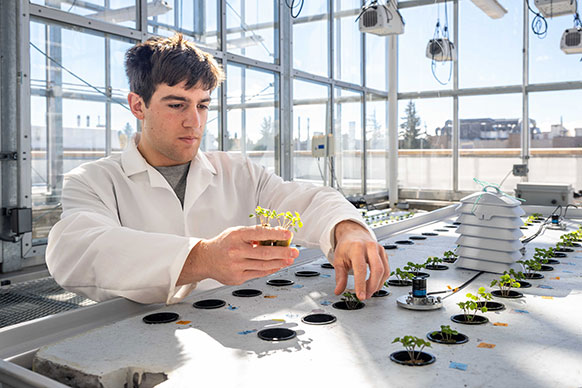
UW graduate student Lucas Payne works in the Plant Growth and Phenotyping Facility in UW’s Science Initiative Building. (UW Photo)
“For us, controlled environment agriculture means tuning the environment to suit the
crop, so the possibilities are broad,” Guadagno says. “In the past year, we’ve grown
everything from strawberries and tomatoes to eggplant, okra, leafy greens, pine seedlings
and native Wyoming plants. The growth chambers and greenhouse can support nearly any
system or species, and it’s all about configuring the environment for the research
goal.”
About the Plant Growth and Phenotyping Facility
UW’s Plant Growth and Phenotyping Facility combines state-of-the-art, Argus-controlled
greenhouses, the Conviron walk-in growth chamber and laboratory spaces to support
a continuum of plant research -- from molecular studies to applied crop production.
The greenhouse complex includes 12 bays equipped for precise environmental control
of temperature, relative humidity, irrigation, carbon dioxide and lighting. An adjacent
research penthouse houses advanced growth chambers and instrumentation for phenotyping
and physiological analysis.
The facility is led by Guadagno and Michael Baldwin, an assistant research scientist
and the facility manager. Together, they oversee a platform designed for diverse applications,
including plant physiology, photobiology, hydroponics and robotics, enabling researchers
to explore how plants respond to environmental variables in controlled settings.
While plant science is at the core, the facility fosters collaboration across engineering,
genetics, microbiology and even business. Engineering teams, for example, contribute
to sensor development and automation systems, integrating technology with plant biology
to optimize controlled environments.
The facility also serves as a hands-on learning platform, integrating growth chambers
and greenhouses into coursework and research training. Students gain hands-on experience
with environmental control systems, sensor technologies and phenotyping tools, preparing
them for careers in agriculture technology, plant research and controlled environment
agriculture industries.
To learn more about the Plant Growth and Phenotyping Facility, go to www.uwyo.edu/science-initiative/plant-facility/index.html.

The University of Wyoming has earned its Research Level 1 (R1) status from the Carnegie Classification of Institutions of Higher Education, placing Wyoming's only four-year university with the top research universities in the United States.