
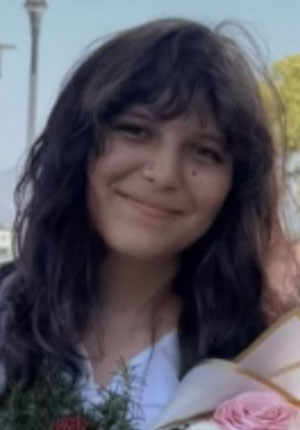
Lily Millan
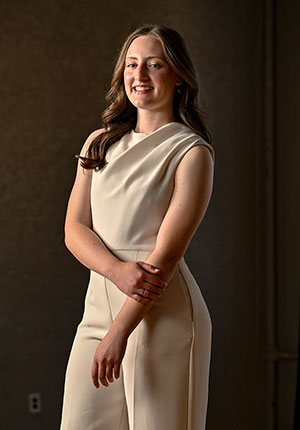
Ellu Pannell

Adelaine “Addie” Schneider
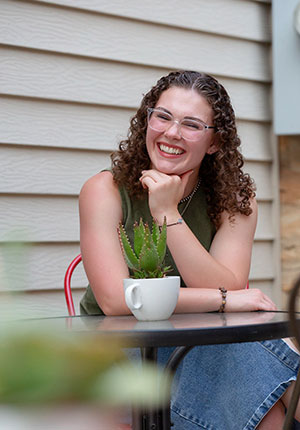
Eleanor “Ella” Tippin
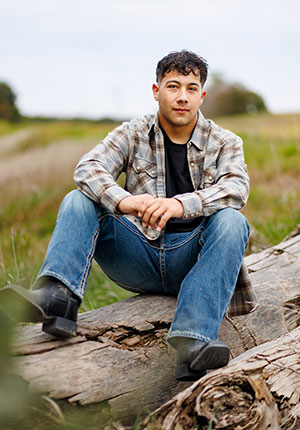
Chez Vigil
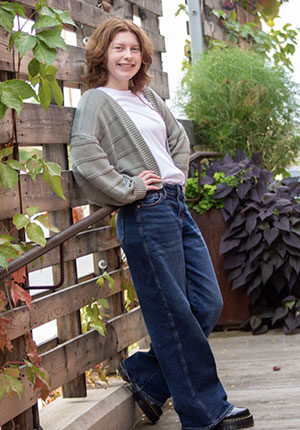
Devyn “Frenchie” Chaney
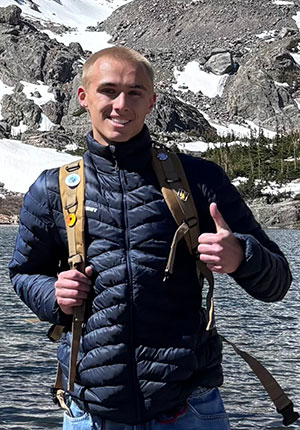
Ethan Nocella
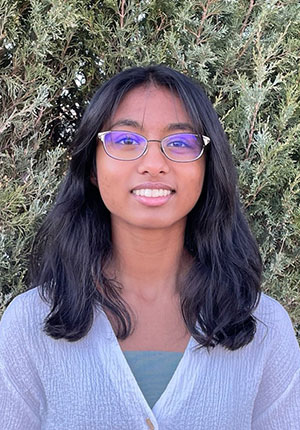
Mrunal Patil
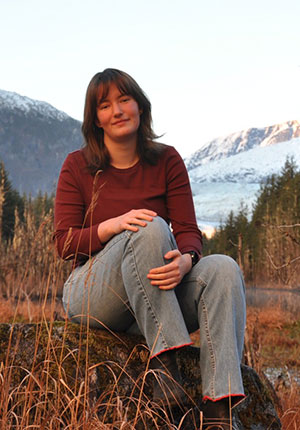
Miranda “Randy” Stichert
Nine incoming University of Wyoming undergraduate students who are associated with
UW’s Haub School of Environment and Natural Resources have been selected for the prestigious
Tomé Scholars to Fellows Program, which provides transformational experiences for
future leaders in the field of environment and natural resources.
The latest recipients will receive full-ride scholarships and additional support for
one or more unique experiences, such as international field courses and community
service. The program was established at UW in 2021 by a major gift from the Tomé Foundation.
The sixth class of Tomé Scholars, listed by hometown and area of planned studies,
is:
Casper -- Devyn “Frenchie” Chaney, environmental systems science/European language,
literature and film studies. She hopes to share her love of environmental stewardship
and inspire positive change in her community.
“My heart’s mission is to help the planet by integrating D. radiodurans and other such bacteria and fungi into sustainable architecture in urban areas,”
Chaney says. “To achieve this goal, I will need to pursue three avenues of study:
the science of environmental systems, microbiology and design.”
Casper -- Mrunal Patil, environment and natural resources/microbiology. She aims to
explore the intersection of pathogens and disease in relation to the greater ecosystem.
“I’m excited to grow from a student who’s simply curious about microbes into someone
who can take on real-world infectious disease problems with scientific knowledge,
environmental awareness and a genuine drive to serve my home state,” Patil says.
Cheyenne -- Adelaine Schneider, environment and natural resources/psychology, minor
in early childhood education. She hopes to better understand Earth’s ecosystems and
humans’ relationship with the natural world.
“I want to do research that helps close the gaps in welfare currently facing our plants
and animals and encourage others to see the environment as the ever-changing, living
system that it is, the same way I was encouraged to see it,” she says.
Juneau, Alaska -- Miranda “Randy” Stichert, environment and natural resources/wildlife
and fisheries biology and management. She is deeply connected to Alaska’s public lands,
with her freezer and cupboards stocked with locally sourced fish, meat and more.
“Wyoming and Alaska have a lot in common: Both are big states with small populations
and huge amounts of public land,” she says. “With an education in natural resources
and wildlife biology, I want to work with landowners to show that conservation and
development don’t have to be at odds.”
Laramie -- Ellu Pannell, environment and natural resources/political science/international
studies. She hopes to use her education to protect Wyoming’s landscapes while navigating
the policy decisions that will define the state’s future.
“I am deeply interested in issues surrounding self-governance -- specifically, how
we can evolve and improve our governmental structures to protect the natural world
while continuing to foster human flourishing during a period of tremendous change,”
she says.
Lemoore, Calif. -- Lily Millan, environmental systems science/geology. Her long-term
plans include a Ph.D. in entomology, researching the environmental impacts of chemical
pesticide use.
“I grew up in Central California with chickens, a garden and pests I had to deal with
by hand, which is how I learned integrated pest management before I even knew what
to call it,” Millan says. “That childhood is where my love of entomology started.
This scholarship will let me study it seriously and eventually give back by helping
reduce harmful pesticide use in agriculture.”
Louisville, Neb. -- Chez Vigil, environment and natural resources/wildlife and fisheries
biology and management. Growing up on a family farm, he has a deep appreciation for
land and stewardship.
“A trash grabber can fix a simple mess, but studying environmental science can fix
the deeper, broken connection between my community and the land,” Vigil says. “My
goal isn’t just to pick up after the mistakes we’ve made; it’s to restore habitats,
protect wildlife and help build a future where our ecosystems are healthy and respected
for generations to come.”
Sheridan -- Eleanor “Ella” Tippin, environment and natural resources/pre-pharmacy.
She plans to explore the relationship between healthcare and the natural world.
“For as long as I can remember, I’ve been justice minded. Back in second grade, I
was passionate about helping people gain access to clean drinking water, and that
early interest grew into a broader passion for healthcare accessibility,” Tippin says.
“Today, I want to make an impact on the world through environmental and natural resource
sciences, used alongside healthcare rather than separate from it.”
Westminster, Colo. -- Ethan Nocella, environment and natural resources/environmental
systems science. He grew up in Colorado, exploring the trails and mountains from a
young age. These experiences influenced his decision to study environmental science
at UW.
“I want to be part of the effort to better understand and protect the ecosystem services
we so often take for granted,” Nocella says. “Over the years, I’ve watched urbanization
creep closer to the natural spaces I love, and that’s only deepened my drive to find
work that keeps me outside, giving back to the places that shaped me.”
John Koprowski, dean of the Haub School, led the process to select a diverse group
of students whose major areas of educational focus include a connection to environment
or natural resources.
About the Tomé Scholars to Fellows Program
Tomé Scholars bring ambition, intelligence, drive and tenacity to their UW educational
experience, which is designed to elevate their career opportunities to impact the
world through expertise and leadership, Koprowski says. They also have access to a
network of other Tomé Scholars across the country and will build a relationship with
Carol and Ramon Tomé themselves. Following graduation, the students become Tomé Fellows,
a community of Tomé Scholars.
The latest scholars make up the 2030 Tomé Scholars cohort and join three earlier cohorts
already on campus.
The program exists at seven institutions around the nation and supports opportunities
to bring diverse students to campus whose major area of educational focus is on programs
in science, technology, engineering, arts and/or math, including medicine and nursing.
About the Tomés
The Tomés are both alumni of UW, and Carol is a Wyoming native. At the time of the
gift, the Tomés wanted this program to support a diverse student body to achieve an
education that will make a difference in the lives of others.
The Tomés have given generously to UW since 1995. Their previous gifts include establishing
the Carol and Ramon Tomé Student Admissions Center, located within the Marian H. Rochelle
Gateway Center. Additionally, they have contributed to the Mick and Susie McMurry
High Altitude Performance Center and the UW Alumni Association.
Carol serves as the CEO of UPS. Ramon worked as an environmental specialist for the
Georgia Department of Natural Resources Air Protection Branch.
For more information, email the Haub School at haub.school@uwyo.edu.

The University of Wyoming has earned its Research Level 1 (R1) status from the Carnegie Classification of Institutions of Higher Education, placing Wyoming's only four-year university with the top research universities in the United States.