
UW Physics Professor Receives Grant to Develop Next-Generation Quantum Materials
Published October 09, 2026
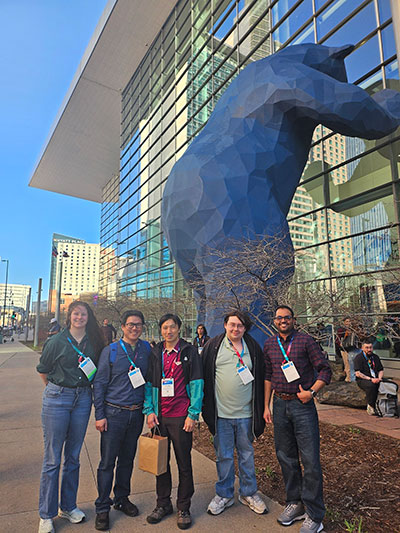
Yu-Tsung “Rem” Tsai (pictured, second from left), an assistant professor in the UW Department of Physics and Astronomy, is working on new materials that could raise the bar for quantum computing and sensing technologies with the assistance of a $993,674 U.S. Department of Energy EPSCoR (Established Program to Stimulate Competitive Research) grant. His team, pictured from left, are Maggie Estagin, a UW senior from Derby, Kan., and a research assistant in the Tsai lab; Chih-Wei Luo, a professor in the Department of Electrophysics at National Yang Ming Chiao Tung University, Taiwan; and Scott Orr, a UW master’s student from Cheyenne, and Sri Kodikara, a UW Ph.D. student from Kandy, Sri Lanka, both research assistants in the Tsai lab. (UW Photo)
Smarter, faster and more efficient. These are the gold standards driving modern technological
development.
Yu-Tsung “Rem” Tsai, an assistant professor in the University of Wyoming Department of Physics and Astronomy, is working on new materials that could raise the bar for quantum computing and sensing
technologies with the assistance of a $993,674 U.S. Department of Energy EPSCoR (Established
Program to Stimulate Competitive Research) grant.
Tsai’s expertise lies in the creation of two-dimensional materials with great potential
for applications in quantum computing and sensing.
“Everything in a crystal is vibrating and, in certain ultra-thin materials, those
vibrations twist in a corkscrew pattern instead of simply rocking back and forth,”
Tsai explains about these materials. “That twisting motion carries a form of rotation
that can be handed off to electrons, which points toward a future generation of electronics
that run on light and on the magnetic character of electrons rather than on electrical
current alone.”
Technology of this nature, however, will need to operate at very cold temperatures
under strong magnetic fields, and no one has yet documented how those twisting vibrations
will behave under the required real-world conditions.
This is what Tsai is set to undertake in the EPSCoR-funded project titled “Investigating
Axial Chiral Phonons for Opto-Spintronic Control in Quantum Materials.” The four-year
project will operate in partnership with Los Alamos National Laboratory starting in
2027.
During the first stage of the project, Tsai’s team will grow layered sheets of tungsten-based
material only a few atoms thick and conduct a first round of optical measurements
in Wyoming.
The samples will then be shipped to Los Alamos, where project members Andrew Jones
and Prashant Padmanabhan will submit the materials to imaging and ultrafast measurement.
To do this, they will shine laser light on the material and “read” the light that
comes back. The Los Alamos team also will map and probe the samples with microscopes
capable of resolving features billionths of a meter across with lasers fast enough
to catch a vibration in the act, on the scale of trillionths of a second.
The results of these analyses will be shared with Tsai’s team at UW to make improvements
in subsequent batches to increase optimization of the new material.
“The work is exciting because it turns something usually treated as background noise
-- the vibration of atoms -- into a control knob that light can turn,” Tsai says.
The grant includes funding for a UW postdoctoral researcher and a Ph.D. student, both
of whom will spend three years at Los Alamos National Laboratory and one year at UW
to galvanize efforts between the two locations. The grant also provides funding for
a UW undergraduate student.
“For Wyoming, the project brings close to a million dollars of federal research funding into the state; trains three people at different career stages in skills that quantum and semiconductor employers are actively hiring for; and builds a durable working relationship between UW and a national laboratory,” Tsai says. “The longer-term payoff, if the science holds up, is computing and sensing hardware that does more while drawing far less power.”

The University of Wyoming has earned its Research Level 1 (R1) status from the Carnegie Classification of Institutions of Higher Education, placing Wyoming's only four-year university with the top research universities in the United States.