
UW Professor Leads Study Advancing High-Performance Membranes for Precise Separations
Published October 06, 2026
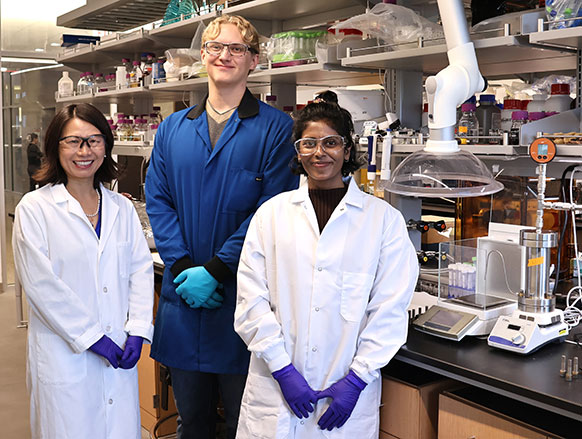
From left, UW Professor Katie Li-Oakey, UW undergraduate student Caleb Johannesmeyer and UW postdoctoral researcher Jasasmita Das are co-authors of a paper published last month in the highly selective Journal of the American Chemical Society. (UW Photo)
The production of many everyday essentials -- including fuels, chemicals and medicines
-- depends on the ability to separate desired products from the mixtures in which
they are produced. However, many conventional separation methods are energy-intensive
and costly. Membrane-based separation offers a promising alternative that can significantly
reduce energy use and cost.
A membrane is a thin, semipermeable barrier, just like Saran Wrap in your kitchen
or the reverse osmosis (RO) membrane used in a water purification system, that allows
certain molecules or ions to pass through while blocking others. Recent research led
by Katie Li-Oakey, a professor in the University of Wyoming Department of Chemical
and Biomedical Engineering, demonstrates a new membrane platform that could enable
more efficient and precise separations.
Li-Oakey’s co-written study, titled “Membranes Incorporating 2D Single-Crystalline COFs for Superior Separation Performance:
3D Image-Informed Reactive Force Field Modeling and Scalable Mixed-Matrix Systems,” was published recently in the prestigious Journal of the American Chemical Society.
The study advances new technology that may open the door to next-generation, high-performance
membrane materials that are scalable, energy-efficient and cost-effective for applications
in biomedical, chemical, environmental and industrial sectors. Li-Oakey is enthusiastic
about her research team’s findings and is working with the team to further tailor
the COF membranes for critical-mineral separations, with a particular focus on recovering
rare-earth elements from Wyoming mineral resources.
The use of membranes, especially polymeric membranes, for separating and purifying
products can be both more energy-efficient and cost-effective than conventional heat-based
separation methods. However, current membranes are often limited by the so-called
selectivity-permeability tradeoff: Membranes that allow molecules to pass through
quickly tend to be less effective at distinguishing between them, while membranes
that separate molecules more precisely tend to have slower flow rates.
Covalent organic frameworks (COFs) are crystalline, porous polymers with well-defined
pores that can be chemically tailored for specific separations, giving them significant
potential to help overcome the selectivity-permeability tradeoff and substantially
reduce the energy required for many separation processes.
Despite this potential, COF membranes often suffer from defects and brittleness, making
large-area manufacturing challenging and, in turn, limiting their widespread use in
industrial applications.
Li-Oakey’s new research addresses these challenges by combining highly ordered, single-crystalline
two-dimensional COFs, which are inherently brittle, with a flexible polymer matrix.
The resulting membrane allows liquids to pass through extremely quickly while effectively
blocking unwanted molecules. The combination of high flux and high selectivity has
long been considered a “holy grail” of separation technology because it could enable
a cleaner separation in fewer steps.
Moreover, the research team developed a “digital twin,” a computer-based model that
simulates the COF membrane and molecule transport process through the membrane and
showed that its predictions agree well with the experimental results.
The work was supported by a U.S. Department of Energy grant, led by Li-Oakey as principal
investigator (PI), with co-PIs at Pennsylvania State University and Northwestern University.
Co-authors of the paper include Jasasmita Das and Caleb Johannesmeyer, also from UW; Yun Kyung Shin and Adri van Duin from Pennsylvania State University; and Beatrice Bartolomei, Gabriel dos Santos, Michael Barsoum, Roberto dos Reis, Vinayak Dravid and William Dichtel, all from Northwestern University.

The University of Wyoming has earned its Research Level 1 (R1) status from the Carnegie Classification of Institutions of Higher Education, placing Wyoming's only four-year university with the top research universities in the United States.