
UW Professor Receives Grant for Collaborative Research Investigating Novel Method for Producing Nanomaterials
Published October 23, 2026
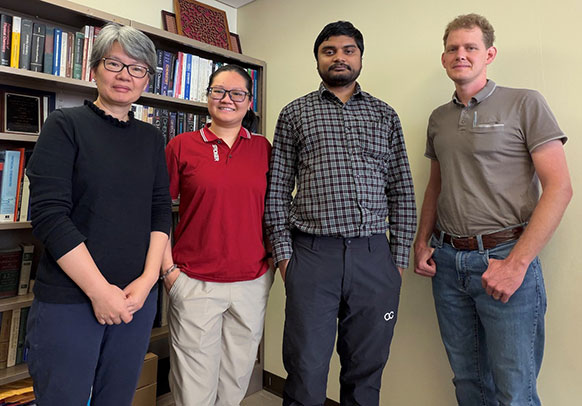
The research group of Jing Zhou, a University of Wyoming professor of physical chemistry, is investigating the science behind the growth of novel nanomaterials, which could lead to better properties and performance. Pictured, from left, are Zhou; Rosa Virginia Melinda, a Ph.D. student in physical chemistry from Surabaya, Indonesia; Nishan Paudya, a Ph.D. student in chemistry from Kathmandu, Nepal; and David King, a postdoctoral researcher in physics from Springville, Utah. (UW Photo)
Jing Zhou, a professor of physical chemistry at the University of Wyoming, has received
$299,078 from the National Science Foundation to conduct collaborative research into
the science behind the growth of novel nanomaterials, which could lead to better properties
and performance.
In addition to the UW funding, the grant, titled “Collaborative Research: Elucidation
of the Effect of Dopant in CeO2(111) on the Nucleation and Growth of Metal Clusters through STM and Theory,” provides
a similar amount -- totaling close to $600,000 -- for Zhou’s collaborator, Ye Xu,
of Louisiana State University (LSU). Xu is the Leon M. Pliner Distinguished Professor
in LSU’s Cain Department of Engineering.
“Our group is excited about this synergistic collaboration that bridges experimental
results with theory from Professor Xu’s studies,” Zhou says.
Nanomaterials are substances sized at the scale of the nanometer and can exhibit special
optical, electronic, thermophysical, chemical or mechanical properties. They are used
in many critical sectors today, including in electronic devices and gas sensors and
for heterogeneous catalysis.
A common class of nanomaterials is composed of metal nanoparticles that adhere to
oxides. Conventional methods of producing this class of nanomaterials involve assembling
or depositing metal atoms directly on an oxide. However, nanoparticles formed in this
way often lose adhesion to the oxide when exposed to high temperatures and reactive
chemicals.
The ability to better anchor nanoparticles to oxides would produce better nanomaterials
with much greater capacity and utility. Zhou and Xu’s research will investigate a
process known as substitutional doping, in which some of the existing metal cations
in an oxide are replaced with a different metal.
The team postulates that doping an oxide with metals provides a pathway to the formation
of strongly bound metal nanostructures and control over their size, density and chemical
state. Specifically, the team will examine substitutional doping of ceria (CeO2) with reactive base metals, including iron, cobalt and nickel. Ceria is a versatile
functional material that is widely used in catalysis and energy applications and is
one of the major rare-earth minerals produced in Wyoming.
The UW-LSU team is uniquely positioned to produce doped CeO2 materials that are well-suited for characterizations using advanced spectroscopy and
microscopy tools and large-scale computational modeling. This enables understanding,
at the atomic level; how the structure of ceria is modified by the metal dopants;
and how nanoparticles interact and evolve from dopants.
Graduate and undergraduate students will be involved in the research project, working
at the intersection of chemistry, materials science and computational modeling and
will gain preparation for in-demand careers.
Zhou and Xu’s research stand to have an impact on important economic sectors.
“The findings of this research will help design stable nanoparticles on oxides that are important for cutting-edge technological devices and chemical manufacturing processes,” Zhou says.

The University of Wyoming has earned its Research Level 1 (R1) status from the Carnegie Classification of Institutions of Higher Education, placing Wyoming's only four-year university with the top research universities in the United States.