
UW Researchers Find Exercise in Mice Lowers Risk of Alzheimer’s Disease
Published October 08, 2026
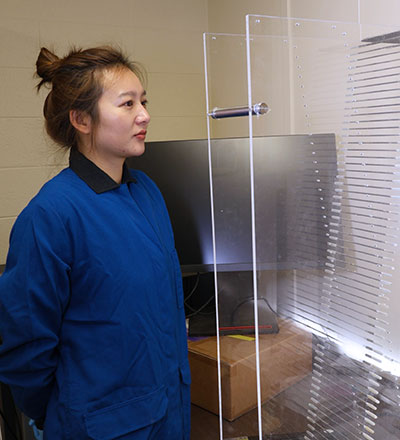
Mingming Yang, a doctoral student in the University of Wyoming Biomedical Sciences Program, stands beside the ladder used to train mice in climbing. Yang was part of a UW research team that discovered that mice that exercised lowered their risk for contracting Alzheimer’s disease, a finding that could prove promising in helping humans lower their risk of the disease that causes progressive cognitive decline. Yang was the lead author of a paper on the study that appeared in the journal Molecular Brain Oct. 7. (UW Photo)
University of Wyoming researchers discovered that mice that exercised lowered their
risk for contracting Alzheimer’s disease, a finding that could prove promising in
helping humans lower their risk of the disease that causes progressive cognitive decline.
Alzheimer’s disease is the most common cause of dementia and gradually robs people
of their memory, thinking abilities and independence. While new medications that target
amyloid plaques have shown some promise, their benefits are often modest, and they
can cause serious side effects. As a result, researchers are actively exploring safe,
non-drug approaches that may help slow the progression of the disease.
This study examined whether regular physical activity could improve brain health in
a mouse model of Alzheimer’s disease. Older mice with Alzheimer’s-like symptoms participated
in a six-week exercise program that combined treadmill running -- similar to aerobic
exercise -- with weight-bearing ladder climbing, similar to resistance or strength
training. The researchers then tested the animals’ memory, learning and social behaviors,
and examined their brains for signs of Alzheimer’s disease.
“The results showed that mice that completed the exercise program performed better
on tests of memory, spatial learning and social interaction than mice that did not
exercise. Brain analyses also revealed fewer harmful protein deposits, reduced inflammation
and healthier brain cells in areas important for memory and cognition,” says Yun Li,
an associate professor of neuroscience in the UW Department of Zoology and Physiology. “Importantly, exercise appeared to protect a specific group of nerve cells that
are particularly vulnerable in Alzheimer’s disease, suggesting that physical activity
may help preserve critical brain functions.”
Li was a corresponding author of a paper titled “Forced treadmill running and ladder climbing physical activity attenuates cognitive
decline and protein aggregates in aged 3xTg-AD mice” that was published Oct. 7 in Molecular Brain, the official journal of the Association for the Study of Neurons and Disease. The
journal publishes studies involving the use of a wide range of modern techniques in
molecular biology, genomics, proteomics, imaging, electrophysiology and theoretical
modeling.
Mingming Yang, a doctoral student in the UW Biomedical Sciences Program, was the paper’s
lead author. Other contributors were Sishir Guatam, a doctoral student in the UW Neuroscience
Program; and former undergraduate students Malique Singleton and Viyaleta Davydzenka,
who both graduated from UW in May. Xiaosen Ouyang and Jianhua Zhang, both professors
of molecular and cellular pathology at the University of Alabama-Birmingham, also
were involved with the study.
Although monoclonal antibody therapies targeting amyloid-β have received Food and Drug Administration approval, they have limited clinical benefits and severe side effects. Physical activity has emerged as a promising nonpharmacological intervention for Alzhemier’s disease, with both aerobic and resistance exercise showing benefits in preclinical studies, according to the paper. However, the effects of different types of physical activity remain insufficiently understood.
“This study supports the importance of lifestyle changes as a nonpharmacological prevention
and intervention strategy for cognitive decline associated with aging and Alzhemier’s
disease,” Li says. “It is worth noting that aging is often accompanied by declines
in muscle mass and strength. Therefore, this study highlights the beneficial effects
of combined aerobic and resistance exercise training for middle-aged and older populations.”
During the study, 20 male and female mice with 3xTG-AD, or triple-transgenic Alzhemier’s
disease, initially were given cognitive tests, including the novel object recognition
(NOR) test, a Y-maze test and a social behavior test.
The NOR test was used to assess recognition memory and capitalize on the rodents’
innate tendency to preferentially explore novel objects over familiar ones. This ability
is largely dependent on hippocampal and cortical integrity of the brain, according
to the paper.
The Y-maze test was conducted to evaluate spatial working memory, as it relies on
the rodents’ natural inclination to explore unfamiliar environments. This test probes
the rodents’ hippocampal and prefrontal cortical function, the paper says.
And, finally, the social behavior test was used to assess sociability and social novelty
preference, an innate ability that also is heavily dependent on hippocampal and cortical
integrity. This test provides important insights into social cognition, an area commonly
impaired in Alzheimer’s disease.
The mice were then randomly divided into two experimental groups, with the physical
activity group put through a six-week exercise program of treadmill running and ladder
climbing. The sedentary control group was maintained with routine husbandry care.
Researchers observed that the mice in the physical activity group experienced improved
cognitive functions as well as a significant reduction in body weight. The study demonstrated
the physical activity modulated age-associated cognitive declines in spatial working
memory, recognition memory and sociability. The mice tested were 13-14 months old,
which is equivalent to 45 in human years, Li says.
“These 13-14-month-old 3xTg-AD mice in the physical activity group -- after a six-week
combined exercise regimen -- displayed improved spatial working memory, improved object
recognition memory and preserved sociability,” Li says. “Besides these behavioral
changes, pathological studies demonstrated that they display reduced misfolded protein
aggregates in the cortex and reduced reactive gliosis in both the hippocampus and
cortex.”
Misfolded protein aggregates are clumps of abnormal proteins that have failed to fold into their correct three-dimensional
shapes. When genetic mutations, cellular stress or aging errors disrupt this process,
proteins can adopt an incorrect shape. Reactive gliosis is a response in the central
nervous system that involves the growth, division and changes of support cells called
glial cells -- specifically astrocytes and microglia. Reactive gliosis is triggered
by damage from trauma, stroke, infections or brain diseases.
According to the paper, these findings provide additional evidence that regular physical
activity could be a promising nonpharmacological intervention for modulating gliosis
and protein aggregate pathology in aging and Alzheimer’s disease.
“3xTg-AD mice carry three human mutations in amyloid precursor protein, presenilin
1 and tau,” Li says. “They display Alzheimer’s disease-relevant hallmarks and, therefore,
are a good model for preclinical studies on Alzheimer’s disease.”
The research was funded through several National Institutes of Health grants.

The University of Wyoming has earned its Research Level 1 (R1) status from the Carnegie Classification of Institutions of Higher Education, placing Wyoming's only four-year university with the top research universities in the United States.