
UW SER Research Highlights Coal Char’s Potential to Support Carrot Production and Soil Health
Published October 15, 2026
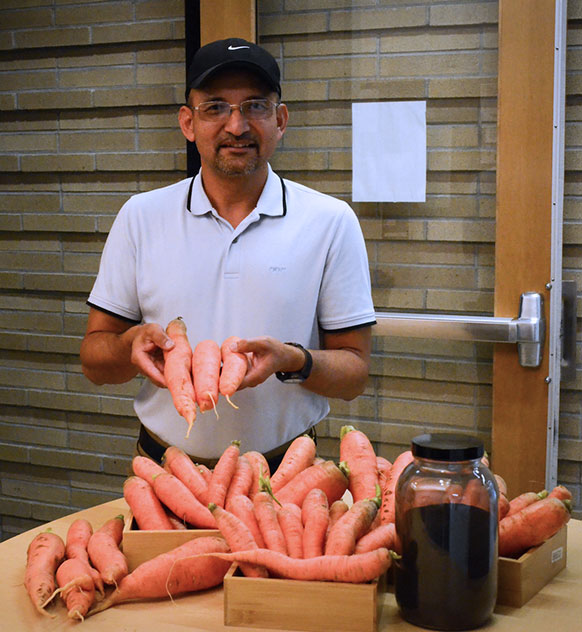
Resham Thapa, an associate research professional in the University of Wyoming School of Energy’s (SER) Center for Carbon Capture and Conversion, poses with a table full of large carrots. An SER research initiative that explores novel uses for Wyoming coal has hit a tangible milestone: harvesting large carrots using pyrolyzed coal (coal char) as a soil amendment. The ongoing study is evaluating how coal char influences root crop production and soil physical properties in both greenhouse and field environments. (Christine Reed Photo)
A research initiative at the University of Wyoming School of Energy Resources (SER)
that explores novel uses for Wyoming coal has hit a tangible milestone: harvesting
large carrots using coal char as a soil amendment.
The ongoing study, titled “Carrot yield enhancement using coal char as a soil amendment
in Wyoming soil,” is evaluating how pyrolyzed coal (coal char) influences root crop
production and soil physical properties in both greenhouse and field environments.
Funded by the Wyoming Department of Agriculture and the United States Department of
Agriculture (USDA) under the Specialty Crop Block Grant Program, the project is led
by Resham Thapa, an associate research professional in SER’s Center for Carbon Capture
and Conversion (CCCC). The initiative is designed to enhance the competitiveness of
specialty crops, including fruits, vegetables, tree nuts, dried fruits, horticulture
and nursery crops.
Thapa recently completed the project’s first-year major field harvest, yielding large
carrots that highlight the potential benefits of the soil treatment.
“The goal of this project is to develop scientifically based, practical measures for
using pyrolyzed coal in agroecosystems,” Thapa says. “By applying coal char as a soil
amendment, we hope to enhance soil health and significantly boost yields for specialty
crops, such as carrots and radishes. The carrots we harvested are showing improvements
in size, while fully retaining their optimal flavor profile and moisture content.”
The field trial is being conducted at the James C. Hageman Sustainable Agriculture
Research and Extension Center, a UW Agricultural Experiment Station facility located
in Lingle. Over a three-year period, the project aims to provide actionable insights
for farmers, agricultural producers and industry stakeholders across the region.
The trial builds upon a broader suite of UW soil amendment projects that have explored
coal char across diverse applications, including land reclamation, field monitoring
in dryland environments and traditional agriculture. A growing body of scientific
publications and data resulting from these studies continues to support the significant
soil-enhancement benefits of coal char, from improving soil physical properties and
soil moisture retention to boosting crop performance.
Beyond its benefits for agricultural productivity, the research holds broader economic
implications for the state. Developing agricultural applications for coal char creates
a potentially high-volume market for Wyoming coal, supporting economic diversification
and opening new avenues for employment within the state’s energy and agricultural
sectors.
“Collaborating closely with the College of Agriculture, Natural Resources and Life
Sciences on these test projects allows us to combine expertise in energy technology
and soil science to deliver real-world solutions,” says CCCC Director Trina Igelsrud
Pfeiffer. “This initiative directly bridges Wyoming’s two largest economic sectors
-- energy and agriculture. By finding high-value agricultural applications for coal
products, we can enhance crop productivity for local producers while simultaneously
opening new markets for our state’s energy resources.”
Results from the ongoing greenhouse and field trials will continue to be collected and analyzed throughout the remainder of the study.

The University of Wyoming has earned its Research Level 1 (R1) status from the Carnegie Classification of Institutions of Higher Education, placing Wyoming's only four-year university with the top research universities in the United States.