
UW Student Hunts, Finds Elusive ‘Ice Crawler’ Insect in Yellowstone
Published October 14, 2026
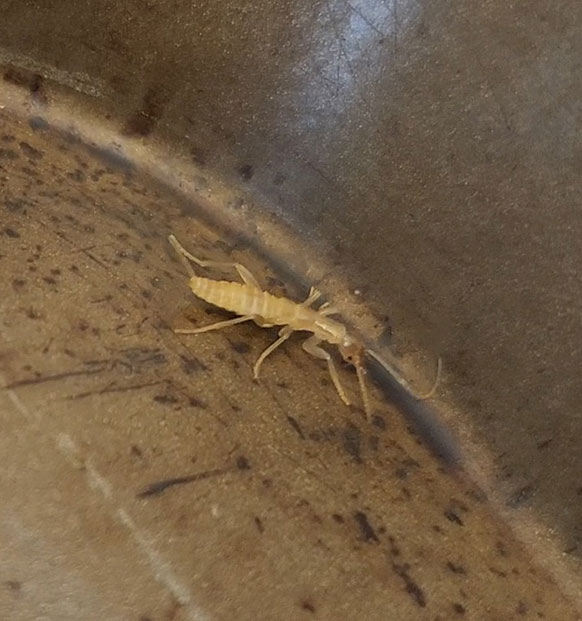
A Grylloblattodea, or ice crawler, was found in Yellowstone National Park on three occasions this past summer by Will Anderson, a UW junior from Casper majoring in biology. One of the rarest orders of insects in the world, ice crawlers only have 35 described species. (Will Anderson Photo)
The phrase “trying to find a needle in a haystack” comes to mind with reference for
what Will Anderson has been searching.
Anderson, a University of Wyoming junior from Casper majoring in biology, has been
on the hunt since 2025 for a tiny and rare insect, known as Grylloblattodea, or the ice crawler. One of the rarest orders of insects in the world, ice crawlers
only have 35 described species. Many species are known only from single localities.
While Anderson had no luck finding the insects in Yellowstone National Park during
2025, his fortunes changed this year when he recently located three ice crawlers in
two park locations.
“I am interested in this insect because there is so much not known about them, with
their life history, habitat and distribution all not being fully understood,” says
Anderson, who is in the Wyoming Research Scholars Program (WRSP). “I also am passionate
about and interested in their alpine habitats, which are understudied.”
The order Grylloblattodea is only found in small pockets of northeastern Asia, Siberia and the western United
States and Canada, Anderson says. In North America, their populations are usually
restricted to small, disconnected areas in mountain ranges and caves in California,
Oregon, Washington, Idaho and Montana, as well as British Columbia and Alberta, Canada.
Some of the few species are known only from single localities in the mountains and
ice caves of the West Coast.
“The specimens I collected in Wyoming are so far identified to the species Grylloblatta campodeiformis, which is the most widespread North American species, having populations in Montana,
British Columbia and Alberta,” Anderson says.
Ice crawlers are extremophiles that live at temperatures as low as minus 6 degrees
Celsius in humid alpine environments. During the day, ice crawlers are found under
cool rocks around snow and ice. At night, they scavenge for food, which includes other
insects.
“They are opportunistic feeders, mostly shown to eat other invertebrates, but stomach
contents also have shown plant material in their diets. When temperature conditions
allow, they are known night scavengers of insects that blow onto the snow,” Anderson
says. “But little is known of their diet when they are more permanently under the
snow and in the soil during the summer and winter temperatures. I briefly kept two
specimens alive, but I couldn’t tell if they were feeding on the dead insects and
plant matter that I gave them.”
On the Hunt
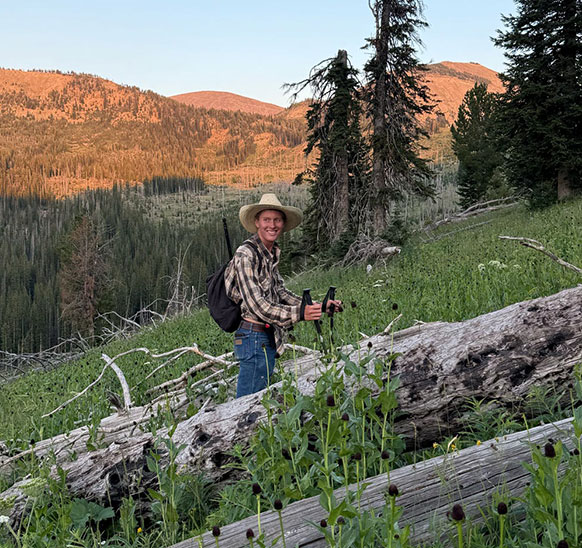
Will Anderson takes a break from looking for ice crawlers in Yellowstone National Park. Anderson and other UW students were on their way back from surveying a rock glacier near Mount Holmes. (James Sims Photo)
When it came to hunting ice crawlers, Anderson wasn’t on his own. He joined a UW student
colleague already conducting her own research.
Audrey Lindsteadt, a UW third-year Ph.D. student in the Program in Ecology and Evolution
in the lab of Lusha Tronstad, was studying Yellowstone’s rock glaciers as her Ph.D.
project. Rock glaciers are similar to alpine glaciers, but the ice in rock glaciers
is covered in rock and debris. This insulates and protects the permanent ice more
than alpine glaciers. Researchers have identified 58 rock glaciers in Yellowstone
National Park, but they have never been visited or studied before this project, Lindsteadt
says.
“Will came to us already knowing he wanted to study insects and soon came up with
the idea to search for the mysterious Grylloblattodea while he helped me with my field work,” says Lindsteadt, who is from St. Joseph,
Mo., but now lives in Laramie. “Despite the close proximity to their known distribution
and the plentiful suitable habitat, Gryllos have never been found in Wyoming. Therefore,
Will hypothesized the rock glaciers and nearby snowfields that we are studying could
have Gryllos.”
Finding the rare insects required patience and even proved to be a bit dangerous in
one instance involving a run-in with a mama grizzly bear and her cub.
However, the search for ice crawlers began in an uneventful fashion. The two spent
the 2025 field season in the Red Mountains next to Heart Lake in southwestern Yellowstone.
Lindsteadt and Anderson started in late July of that year and surveyed 14 rock glaciers.
By then, most snowfields had already melted. Additionally, there were fewer glaciers
in that particular location, and most were small and/or inactive, Lindsteadt says.
“These less-than-ideal conditions gave us a bit more hope for 2026 because we would
be able to start our field season earlier; there were about twice as many glaciers;
and we would be closer to the known ice crawler record in Montana,” Lindsteadt says.
“Will also searched both rock glaciers and snowfields, as well as deployed overnight
traps for the insects.”
Anderson found the rare insects on their first backpacking trip of the season -- a
cold and snowy six-day excursion in late June and early July. While flipping rocks
on top of a large rock glacier near Antler Peak in northwest Yellowstone, he discovered
two ice crawlers.
In mid-July, Anderson found another ice crawler near Grey Peak. But not without obstacles.
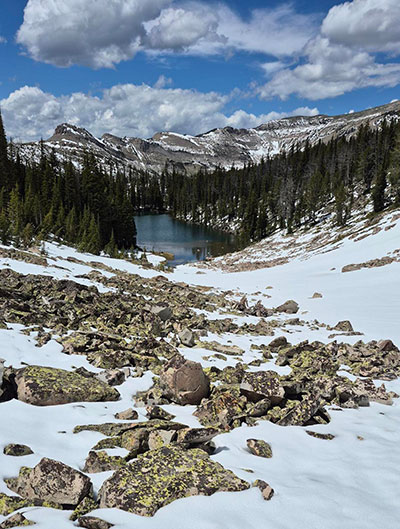
While flipping rocks on top of a large rock glacier near Antler Peak (pictured) in northwest Yellowstone National Park, Will Anderson discovered two ice crawlers. (Audrey Lindsteadt Photo)
“On this specific day, our original plans were actually hindered by an angry mother
grizzly and her two-year-old cub that bluff-charged us,” Lindsteadt recalls. “Instead
of going toward the rock glaciers we originally planned to survey -- which also happened
to be where the bears went -- we scrambled up Grey Peak and slid down the mountain
to its two rock glaciers. Which led to Will finding another one of the rare insects.”
Anderson quickly became an expert in identifying the best substrate and microhabitats
for these insects, she says. In addition to rock glaciers in Yellowstone, Anderson
also searched several alpine glaciers in Grand Teton National Park this past August.
While he found a lot of ideal habitats for the insects, he did not locate any more
ice crawlers.
Anderson and Lindsteadt walked about 170 miles during their surveys this summer. The
two plan to survey 17 rock glaciers in eastern Yellowstone, as well as revisit some
of the other rock glaciers in the park, next summer.
“Ice crawlers probably play a small part in these ecosystems due to their rarity but,
still, are included in the food chains and nutrient cycles of their extreme habitats,”
Anderson says. “More importantly, we can use ice crawlers to better understand how
these ecosystems work and be more effective managers of them.”
Anderson gives credit to the WRSP and the National Park Service for making this project
possible.
He will present his results at the Entomological Society of America’s 74th annual
meeting in Columbus, Ohio, Nov. 8-11. Anderson also is working on a paper he hopes
to have published in leading scientific journals.
“We are in the very early stages, but we think we could target alpine journals or entomological journals with this brief but exciting result,” Lindsteadt says. “I believe we are currently hypothesizing ice crawlers prefer rock glaciers to non-glacial talus fields or snowfields because they are colder, more humid and more permanent. Obviously, with just three species detections, we cannot confidently identify their habitat preferences. But they at least point us in a promising direction.”

The University of Wyoming has earned its Research Level 1 (R1) status from the Carnegie Classification of Institutions of Higher Education, placing Wyoming's only four-year university with the top research universities in the United States.