
UW Students Participate in SER’s Second Field Course on Natural Hydrogen Exploration
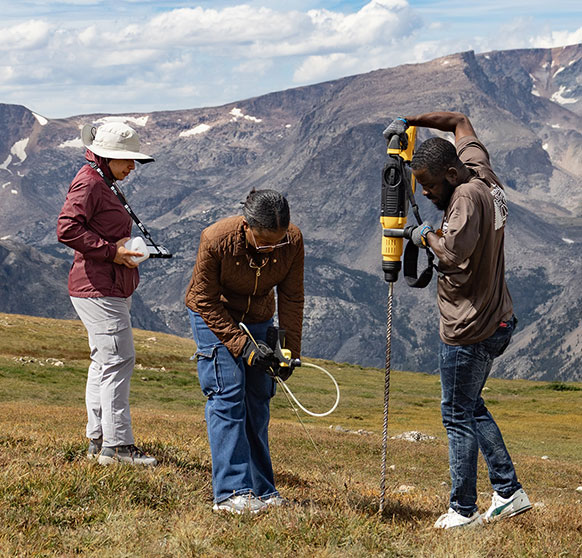
University of Wyoming students Gisella Mena Teran (left), Taiye Idahor and Fred Gyasse take samples in the field during UW’s School of Energy Resources’ summer field course dedicated to natural geologic hydrogen exploration Aug. 22-28. (Sara Buckhold Photo)
Building on the success of its inaugural offering, the University of Wyoming School
of Energy Resources (SER) recently hosted its second summer field course dedicated
to natural geologic hydrogen exploration.
The hybrid course, which took place Aug. 22-28, provided students with hands-on training
in combining foundational geoscience with cutting-edge machine learning techniques
to identify and analyze natural hydrogen occurrences.
The course forms a key educational pillar of the broader Wyoming Geohydrogen Exploration
Initiative led by SER’s Hydrogen Energy Research Center (H2ERC), supported in collaboration
with industry partner Hestia Energy Corp. and matched through a Wyoming artificial
intelligence (AI) state matching appropriation.
The project aims to establish robust models for natural hydrogen formation, migration
and trapping across Wyoming’s unique geological basins.
“We are excited to build on the foundation laid during last year’s inaugural course,”
says Sarah Buckhold, H2ERC assistant research professional and leader of the course.
“Geologic hydrogen represents a promising frontier in clean energy. By equipping students
with a digital-first approach that combines physical field observation with machine
learning models, they are, hopefully, leaving the course fluent in both traditional
structural geology and the data science methods needed to process complex geophysical
signals in the field.”
The one-credit course was co-led alongside Stuart Farris, Hestia Energy co-founder
and chief technology officer. Farris also is an SER adjunct professor.
The curriculum blended intensive classroom instruction with a six-day immersive field
experience. Participants explored how to pair traditional field methods, such as geologic
mapping and advanced continuous subsurface sensing, with data-driven analytics and
AI to map and evaluate potential natural hydrogen reservoirs.
Throughout the week, seven UW students gained direct experience learning how to recognize
tracking markers for how hydrogen behaves over a specific geological region and to
strategically measure data over those features.
“Field opportunities like this are invaluable for our students, giving them the chance
to translate complex classroom concepts directly into real-world applications,” Buckhold
says. “Simultaneously, this practical coursework directly advances crucial energy
research and supports Wyoming’s broader economic and industry goals by developing
real solutions right here in our state’s unique geologic basins.”
Participating students included Jose Andrade of Powell; Frederick Gyaase of Drobo, Ghana; Gisella Mena Teran of Quito, Ecuador; Thi Thi Trang Nguyen of Tien Giang Province, Vietnam; Alexandria Shinkle of Gillette; Prince Duah of Wuhan, China; and Jaineth Youwe of Jakarta Barat, Indonesia.

The University of Wyoming has earned its Research Level 1 (R1) status from the Carnegie Classification of Institutions of Higher Education, placing Wyoming's only four-year university with the top research universities in the United States.