
UW Economics Doctoral Student Invited to Join International Beijer Young Scholars
Published November 18, 2026
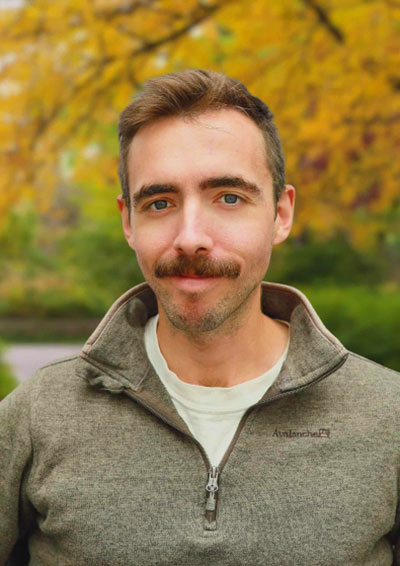
Finbar Curtin
Finbar Curtin, a third-year University of Wyoming economics Ph.D. student, has been
invited to join the fifth cohort of the Beijer Young Scholars, an international network
of early-career researchers hosted by the Beijer Institute of Ecological Economics
at the Royal Swedish Academy of Sciences.
Membership to the Beijer Young Scholars is by invitation only. Beijer Institute board
members and fellows nominate candidates, and past cohorts have included 17-20 doctoral
students, postdoctoral researchers and young faculty members from around the world.
Recent members came from Stanford University; Princeton University; the University
of California, Berkeley; McGill University; and the University of Oxford.
The Royal Swedish Academy of Sciences, founded in 1739, selects the Nobel laureates
in physics and chemistry and the recipients of the Sveriges Riksbank Prize in Economic
Sciences in Memory of Alfred Nobel.
“I am thrilled about the invitation,” says Curtin, who is from Washington, Vt. “The
multidisciplinary setting should be a great opportunity to better understand how other
fields study climate change and planetary futures, and I also am eager to share the
unique approach economics takes to these issues.”
The Beijer Institute launched the young scholars program in 2012 to build networks
that cross disciplines and borders in response to global sustainability challenges.
Each cohort meets in weeklong workshops in Stockholm and the Stockholm archipelago
over three years -- guided by senior researchers -- and members collaborate on joint
research between meetings.
“These dialogues over the next three summers should allow me to build an international
research network, which will hopefully germinate into future, productive collaboration,”
Curtin says. “At the very least, I want to walk away with a deeper perspective that
will pay dividends as I develop my early-career research agenda.”
“The Beijer Institute has pioneered research on how people shape the natural world
and how it shapes their lives,” says Jason Shogren, the Stroock Chair of Natural Resource
Conservation and Management at UW and a foreign member of the Royal Swedish Academy
of Sciences. “Its workshops bring together economists, ecologists and other scientists
from around the world to tackle a shared question: How can economies thrive while
sustaining the ecosystems they depend on?”
Curtin is the third Beijer Young Scholar from UW’s economics doctoral program. Kevin
Berry, who earned his doctorate at UW, is now a professor of economics at the University
of Alaska Anchorage, and João Vaz, who earned his doctorate in 2020, is a researcher
at Nova School of Business and Economics in Portugal.
“My three decades with the Beijer Institute as a fellow, member of its Scientific
Advisory Board and outside program evaluator reflect the University of Wyoming Department
of Economics’ international reputation for leadership in environmental and natural
resource economics,” Shogren says.
Curtin studies where macroeconomics meet the environment, climate change, development
and energy. In his second year, he and his adviser, Matt Burgess, an associate professor
of economics, released a working paper titled “The Empirically Inscrutable Climate-Economy
Relationship.”
“Finbar’s work is careful and rigorous, but he also is unafraid of asking big questions
and challenging paradigms -- a rare combination in any scholar, but especially unusual
for a third-year Ph.D. student,” Burgess says. “His second-year paper shows that the
methods economists have been using to measure global economic damages from climate
change are not reliable, and damages are fundamentally uncertain.”
Curtin gave an invited talk on the paper to World Bank and International Monetary
Fund climate research groups in September and is scheduled to speak to the European
Central Bank and the American Economic Association in early 2027. The paper has been
covered by outlets including The Wall Street Journal, Foreign Policy and the economics
blog Marginal Revolution. The paper also was cited in an amicus brief to the U.S.
Supreme Court in the ongoing Suncor v. Boulder County case. His next project asks
how policymakers can best make major climate and energy decisions under deep uncertainty.
“The UW Department of Economics pairs its long-standing strength in environmental
and resource economics with growing expertise in behavioral and experimental economics,
development, energy, industrial organization and international trade,” says David
Finnoff, the Wyoming Excellence Chair in Economics, a McMurry Fellow and the department’s
director of graduate studies. “Our Ph.D. students, such as Finbar, receive rigorous
training in theory and econometrics and the freedom to specialize, work across fields,
join faculty research and develop their own, so they’re ready to compete with the
best.”
Curtin grew up on a maple syrup farm in Vermont. Before starting his doctorate at
UW, he received a bachelor’s degree in electrical engineering from the University
of Virginia; worked as a banking analyst at Capital One; captained a sailboat from
Vermont to the Caribbean; cycled from Armenia to Ireland; and taught high school science
and math at a ski academy. At UW, he also teaches monetary theory.
The fifth cohort of Beijer Young Scholars is expected to meet for the first time in Stockholm in summer 2027.

The University of Wyoming has earned its Research Level 1 (R1) status from the Carnegie Classification of Institutions of Higher Education, placing Wyoming's only four-year university with the top research universities in the United States.