
UW Ph.D. Student Wins Best Paper Award at International Energy Conference
Published November 03, 2026
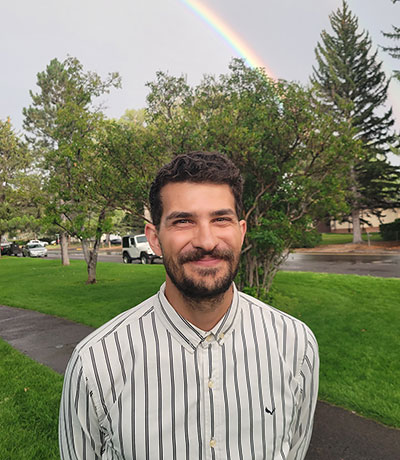
Jehad Hedel, a Ph.D. student in the University of Wyoming Department of Electrical Engineering and Computer Science, was recently recognized with the Best Paper Award at the 10th International Conference on Power Energy Systems and Applications in Munich, Germany. (Aasia Khan Photo)
University of Wyoming Ph.D. student Jehad Hedel received the Best Paper Award at the
10th International Conference on Power Energy Systems and Applications (ICoPESA 2026) held in Munich, Germany, in July.
Hedel’s peer-reviewed paper, “Physics-Based Modeling of Transmission Conductor Dynamics
and Vegetation Clearance Under Wind Loading,” looks at how wind moves overhead power
lines and brings them closer to nearby trees.
This research is critical since electricity can jump from power lines to nearby vegetation
when lines get too close, potentially causing outages or fires. To address this issue,
Hedel’s research team developed a computer model to estimate how far a power line
moves under both steady wind and wind gusts.
“Our results show that gusts can cause much more movement, so accounting for them
matters when estimating the space needed between power lines and trees,” Hedel says.
Hedel’s research could help utility companies decide where tree trimming is most needed
and how much clearance to maintain around power lines. It also could help identify
locations that may become unsafe during strong winds and support severe-weather planning.
“The long-term goal is to reduce outages and wildfire risks while making the electricity
supply safer and more reliable,” Hedel says.
Hedel’s work was supported by team members across fields and institutions and conducted,
in part, with funds from a National Science Foundation Advanced Sensing and Computation
for Environmental Decision-Making grant.
Hedel is thankful for the support received from adviser Nga Nguyen in the UW Department
of Electrical Engineering and Computer Science (EECS) as well as co-authors Dongliang
Duan in EECS; Thomas Minckley and Jacqueline Shinker in the UW Department of Geology
and Geophysics; and Qiuhua Huang in the Department of Electrical Engineering at Colorado
School of Mines.
ICoPESA brought together experts from academic, industry and business sectors from
around the world to “showcase the latest research achievements in power energy systems,
discuss current challenges and explore future trends,” according to the ICoPESA website.
The best paper award was selected based upon its originality, significance to the
field, technical quality, clarity, organization and experimental or theoretical validation.
“Winning this award means a lot to me,” Hedel says. “It is encouraging to see our
work recognized and to know that others see value in the problem we are trying to
solve. Research takes time, patience and many revisions. So, this recognition motivates
me to keep going.”
In the wake of the award, Hedel, who is from Irbid, Jordan, plans to continue conducting
research that makes power systems safer and more reliable.
“One thing I hope people take away from this work is that reliable electricity also depends on understanding what happens around power lines, including wind and nearby vegetation,” Hedel says. “Bringing together knowledge from different fields can help us better understand these risks and find practical ways to address them.”

The University of Wyoming has earned its Research Level 1 (R1) status from the Carnegie Classification of Institutions of Higher Education, placing Wyoming's only four-year university with the top research universities in the United States.