
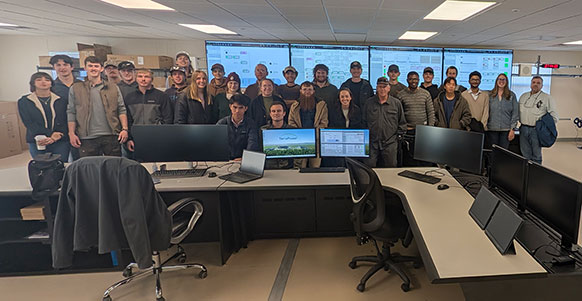
UW students and employees visit TerraPower’s Natrium advanced nuclear project as part of a two-day nuclear energy field experience across southwest Wyoming. (School of Energy Resources Photo)
University of Wyoming faculty members and students enrolled in nuclear-related coursework
recently completed a two-day nuclear energy field experience across southwest Wyoming,
bridging classroom instruction with regional industry operations, emerging technologies
and workforce development.
Spearheaded by Madeleine Lewis, an associate lecturer in UW’s School of Energy Resources
(SER), the trip was offered to give participants direct access to energy operations
and experts in the region, complementing the Nuclear Energy Science Certificate Program
within SER and the College of Engineering and Physical Sciences.
“This trip grew out of an idea in the Law and Technology Nuclear course to give our
students a real-world learning opportunity about one of the most innovative reactor
developments in the country, which just happens to be a few hours from Laramie,” Lewis
says. “We are excited to give our students an opportunity to become acquainted with
TerraPower and, while we were at it, learn about other critical industries in southwest
Wyoming.”
During the visit, participants met with representatives of multiple industry partners
to learn about opportunities and advances in subsurface energy, power generation and
accompanying energy resources.
Meetings were arranged with Western Wyoming College -- a collaborative partner of
SER -- and centered on current and emerging nuclear energy credentials and workforce
development programs. The college also served as the host site for visits from Vero3,
where students explored carbon capture and storage alongside emerging subsurface energy
projects tied to the Rock Springs Uplift -- as well as with Tata Chemicals, where
the group evaluated how the facility plans to transition away from coal-fired power
by partnering with BWXT to deploy advanced modular nuclear reactors.
Academic discussions further enriched the experience. SER uranium geologist Robert
Gregory provided insights into Wyoming’s uranium reserves and their role in the broader
nuclear sector.
The tour also highlighted traditional energy operations paired with next-generation
innovation. At the Kemmerer Operations coal mine, students examined active surface
mining operations. This experience provides a foundation they will build upon in class
when evaluating processes to convert coal into nuclear-grade graphite, a research
program housed in SER’s Center for Carbon Capture and Conversion.
Finally, the group visited TerraPower’s Natrium advanced nuclear project nearby, to
apply classroom theory with one of the largest nuclear development initiatives in
the state.
“The site visits to TerraPower and Kemmerer Operations provided a wide look into the
changes of the Wyoming energy industry and the bright future we are headed toward,”
says Chevy Stanton, of Green River, an energy resource management and development
student with a concentration in professional land management. “This provided an amazing
opportunity for me and my fellow peers to experience the excellent programs provided
here at the School of Energy Resources.”
Other students who went on the trip, listed by hometown, are:
Casper -- Ben Griner, Zoe Magee, Amber Ordiway and Jacob Studer.
Cheyenne -- Caden Bogus, Liam Devine, Chauncy Hendon, Michael Lindman and Thomas Osterli.
Douglas -- Cadence Vollman.
Fort Bridger -- Paxton Dolezal.
Laramie -- Emmanuel Asante, Austin Quillinan and Oliver Smith.
Longmont, Colo. -- Gunner Treblik.
Mountain View -- Race Carr and Tyler Stoddard.
Pine Bluffs -- Hattie Lerwick.
Saratoga -- Burgan Campbell.
Tacoma, Wash. -- Dylan Fernholz-Hartman.
Thermopolis -- Seth Needham.
Whittier, Calif. -- Nicholas Webster.
Funding for the trip was provided by the Rita Meyer Nuclear Energy Excellence Fund
as well as the Christine A. Barry Nuclear Energy Student Enrichment Fund. These funds
support educational opportunities inside and outside the classroom, helping students
build nuclear energy expertise through collaborative programs developed by SER.
“The hands-on exposure our students gained on this two-day experiential learning trip
is exactly what Rita Meyer and Christi Barry envisioned their funds were designed
to support,” says SER Senior Assistant Dean Kami Danaei. “We are so grateful for the
financial support that facilitated this experience, as well as the industry leaders
who generously opened their doors to enrich the educational experience of our students
interested in nuclear energy.”
Other UW staff and faculty members participating were Joseph Graves, Mike Norato and
Prince Sharma.

The University of Wyoming has earned its Research Level 1 (R1) status from the Carnegie Classification of Institutions of Higher Education, placing Wyoming's only four-year university with the top research universities in the United States.