
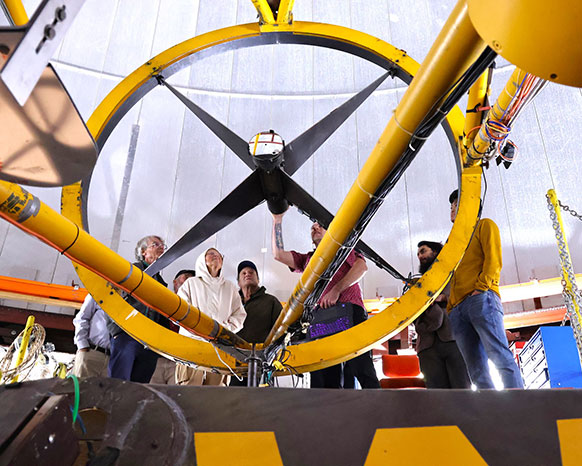
WIRO Engineer Thomas Mazzetti demonstrates features of WIRO’s telescope to attendees of the facility’s 50th anniversary celebration during a tour Oct. 2. (UW Photo)
In 1972, the world’s largest infrared telescope was using a mirror about 60 inches
in diameter. Then-University of Wyoming professors Robert “Bob” Gehrz and John Hackwell
thought they could get even better resolution and clarity for their astronomical observations
with emergent technologies in mirror design and manufacturing. So, they set out to
create the world’s largest infrared telescope and place it on Jelm Mountain, a 55-minute
drive from Laramie.
In the early 1970s, Gehrz and Hackwell worked tirelessly to secure $625,000 from the
National Science Foundation (NSF). The two won their lobby to the Wyoming Legislature
in 1975 for an additional $975,000 by a margin of a single vote, overcoming skepticism
from both within the university and the state government by the power of their conviction
that WIRO would put Wyoming on the map for top-level science for decades to come.
Not only did Gehrz and Hackwell secure Jelm Mountain as the new observatory site,
but they also designed what would become the largest infrared telescope in the world,
at 2.3 meters (92 inches), and built much of its instrumentation in-house.
Celebrating 50 Years
This October, nearly 50 years after the Wyoming Infrared Observatory (WIRO) achieved first light in 1977, Gehrz and Hackwell returned to UW to share their stories
with others who had been integral players in WIRO’s success across its five decades
of operation.
The 50th anniversary celebration of WIRO took place Oct. 2 on the UW campus. The event
was hosted by the Department of Physics and Astronomy and organized by Chip Kobulnicky,
a professor in the department and associate dean of graduate education for the College
of Engineering and Physical Sciences.
“I enjoyed it a lot, and it was good to see John Hackwell again. I hadn’t seen him
in quite a while. It was maybe 17 years, 18 years,” Gehrz says of the celebration.
“We went out to dinner together on successive nights. So, we had a good chance to
talk … That’s something we hadn’t done in quite a long time.”
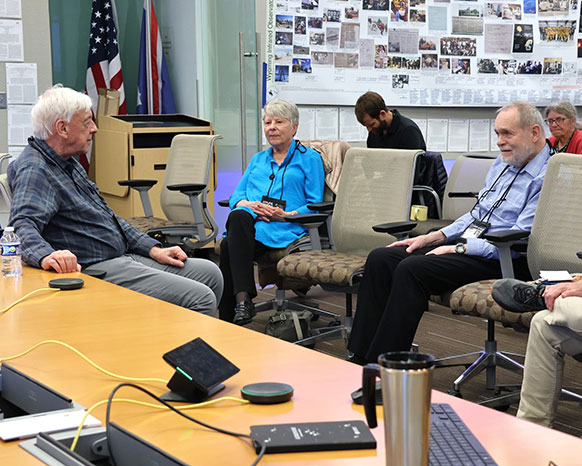
WIRO co-founders John Hackwell (left) and Robert “Bob” Gehrz (right) catch up during WIRO's 50th anniversary celebration at the University of Wyoming Oct. 2. Sue Gehrz, Bob's wife (middle), also is pictured. (UW Photo)
In addition to founders Gehrz and Hackwell, attendees spanned roles and decades of
involvement with WIRO. Other speakers included Barney Magrath, a WIRO staff member
in the 1970s; Tom Williams, a UW student and research associate from 1980-85; Randy
Shaw, a WIRO staff member from 1974-1990; Bill Ketzeback, NSF Research Experiences
for Undergraduates Program student and a UW graduate student from 1994-96; Harley
Thronson, a UW faculty member from 1981-1996; Greg Madison, who worked in UW purchasing
from 1971-79; Chick Woodward, a UW faculty member from 1987-2000; Nancy Silbermann,
a UW graduate student in the 1980s; Gerard van Belle, a UW graduate student in the
1990s; James Weger, a WIRO staff member from 1992-2020; Danny Dale, interim dean of
the College of Engineering and Physical Sciences; Mike Pierce (retired in 2025) and
Mike Brotherton, both UW professors of physics and astronomy; and Jordan Stone, a
UW assistant professor of physics and astronomy.
Presentations covered the gamut of experience at WIRO, from the highly technical to
the nitty gritty of daily life. Madison, for example, shared the journey behind the
process of obtaining funding for the project. He explained how Gehrz and Hackwell
managed to make it so comparatively affordable by securing separate bids for each
component and acting as project managers themselves, thereby also assuming all the
risk.
Shaw shared details about misadventures with the observatory plumbing and a particularly
wily prank played on Gehrz, which involved adding blue dye to the observatory’s water
system.
Pierce went into detail about the improvements he made to the camera system, and many
others, including Magrath and Ketzeback, shared historical photos and the stories
behind them from their time at the observatory.
A consistent theme across memories and presentations was the ways in which WIRO students,
staff and faculty rolled up their sleeves and made things happen from the ground up
-- from digging trenches for the building’s foundation to innovating advances in imaging
and cameras designed and built in-house specifically for WIRO.
“The remarkable characteristic of working at UW was that you got to be a self-starter
and take a task and push it through to the end,” Thronson said in his address during
the anniversary gathering.
“It was a very exciting environment,” Woodward says of the atmosphere Gehrz and Hackwell
created at WIRO’s inception. “We were a tight-knit community kind of living off the
grid.”
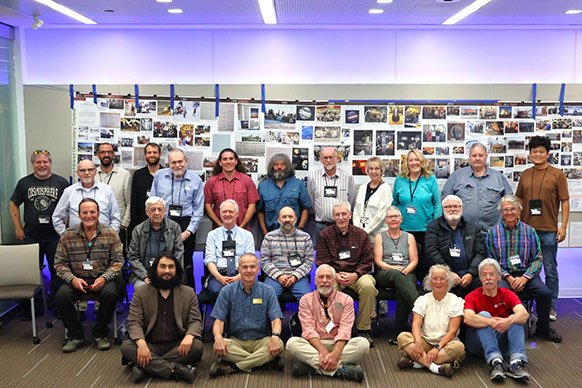
WIRO’s 50th anniversary celebration was held Oct. 2 on the University of Wyoming campus. Attendees spanned decades of involvement with WIRO and were invited to sign their names on a large timeline poster displayed on the wall behind them. (UW Photo)
Following the anniversary gathering, Matthew Greenhouse, integrated science instrument
module project scientist at the National Space Administration, delivered a lecture
on the Webb Space Telescope, which took inspiration from some of the innovations first
made at WIRO. Greenhouse was a graduate student who worked with WIRO in the 1980s
and received his Ph.D. from UW in 1989.
To end the day, guests were invited on a field trip up Jelm Mountain to visit the
telescope. Guests compared notes, reminisced on their contributions to the existing
facility and instrumentation and heard from WIRO Engineer Thomas Mazzetti about recent
and forthcoming upgrades.
WIRO’s Astronomical Impact
This fall, Mazzetti completed an upgrade of the telescope’s control system, equipping
it for a new generation of students and science programs. WIRO can be used by students
and faculty every clear night of the year remotely from the UW campus.
In addition to briefly holding the title of world’s largest infrared telescope, WIRO
also lays claim to being the world’s first fully computer-controlled infrared telescope,
the second-highest professional observatory in the continental United States at 9,650
feet altitude and the largest telescope owned and operated by a single institution.
“The Wyoming Infrared Observatory has served as the linchpin for UW astronomy for
five decades,” says Dale, the Carrell Family Interim Dean of Engineering and Physical
Sciences and Harry C. Vaughan Professor of Astronomy at UW.
“The power of its light-gathering 2.3-meter diameter mirror, coupled with its continually
evolving instrumentation, such as wide-field cameras and high-resolution spectrographs,
have enabled cutting-edge science and attracted many outstanding students, faculty
and staff to UW,” Dale says. “We are fortunate to continue to reap the benefits put
in place by the state Legislature, the National Science Foundation and the original
founders of the observatory -- former UW professors Bob Gehrz and John Hackwell.”
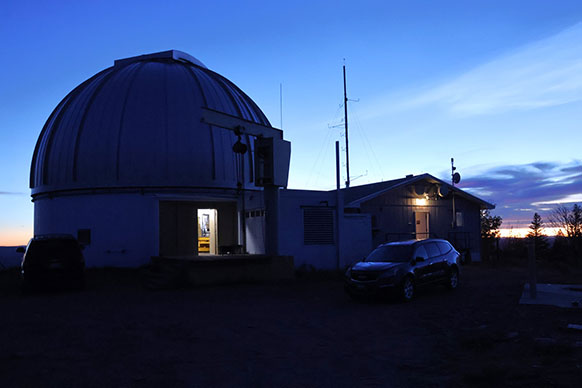
The Wyoming Infrared Observatory is located at 9,650 feet altitude at the top of Jelm Mountain, located west of Laramie. (UW Photo)
Gehrz and Hackwell stayed on at UW for more than a decade following WIRO’s completion
and contributed many significant findings to the field of astronomy with the new technology.
“We learned a lot about nova explosions, which produce chemicals that are building
blocks of planets and life,” Gehrz says. “We learned how they make dust. We learned
how they form some other interesting abundances of chemicals like neon and oxygen.
So, that’s been an important part of understanding the chemical evolution of the universe.
And that’s the stage for a lot of things that we’ve been doing with NASA’s more advanced
space observatories.”
Following their early careers at UW, Hackwell went on to a distinguished career in
the aerospace industry, spearheading many major advancements in astronomy at NASA.
Gehrz spent the rest of his career at the University of Minnesota, where he has been
a professor of physics and astronomy, now emeritus, since 1985. He also has served
as director of the University of Minnesota Observatories; was founding director for
the Minnesota Institute for Astrophysics; chair of the University of Minesota Department
of Astronomy; and contributed to numerous projects for NASA and global observatory
initiatives.
As van Belle tracked in his presentation, Hackwell and Gehrz were just the first of
a long list of astronomers involved with WIRO who have made significant contributions
to the field, including at top institutions across the world. Many of those present
at the celebration, including Magrath and Hayward, credit their time at WIRO with
launching their future careers in astronomy.
“WIRO enabled more than $14 million in grants and contracts and has resulted in the
publication of over 120 scientific articles, 40 dissertations, master’s theses and
undergraduate theses, and provided training for hundreds of students,” Kobulnicky
says. “Its capabilities attract graduate and undergraduate students to the university.
We use it today to do all kinds of research on planets around nearby stars to distant
galaxies and quasars halfway across the visible universe.”
WIRO Looks to the Future
While WIRO is no longer one of the larger telescopes in the world, it is the only
one owned and operated by a single university and continues to be of significant value
for research, teaching and public outreach, including through annual open house tours.
As WIRO closes out its first 50 years and looks forward to the next 50, some of the
exciting plans in the works for WIRO’s future include using the telescope to “feed
the giants,” as Stone put it.
In his presentation during the celebration, Stone laid out his vision of the Astrophotonic
Spectrograph and Imager in the Near-Infrared project, as one example, to assist in
larger collaborative projects by helping to winnow down lists of target study objects
to verify what is worth investigating further.
Stone also praised WIRO’s incomparable value as a teaching facility where students
can obtain hands-on experience not available anywhere else; as a testing site for
new instrumentation; and as an excellent location for long-term surveys, as most facilities
have tight restrictions on allowed observation time by any single entity at a time.
“The future is for whoever has the most telescope time,” Kobulnicky says. “And that
is Wyoming.”
To learn more about WIRO and its history, including through an oral history narrated by Gehrz, go to www.uwyo.edu/physics/observatories/wiro.html. To support student research at WIRO, go to https://www.givecampus.com/campaigns/85732/donations/new.

The University of Wyoming has earned its Research Level 1 (R1) status from the Carnegie Classification of Institutions of Higher Education, placing Wyoming's only four-year university with the top research universities in the United States.