
Wyoming Infrared Observatory Welcomes Public During Open House
Published November 05, 2026
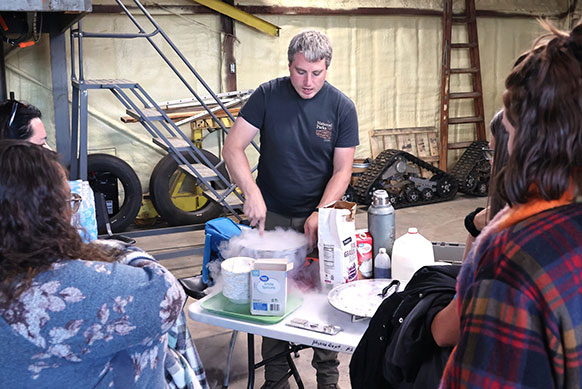
Noah Cowper, lab coordinator in the University of Wyoming Department of Physics and Astronomy, makes liquid nitrogen ice cream for guests while they wait for tours of the Wyoming Infrared Observatory (WIRO) Oct. 9. (UW Photo)
The evening of Oct. 9 proved crisp, clear and dark, the Milky Way trailing overhead
and the lights of Laramie twinkling far away down the valley. It was an ideal night
for the University of Wyoming Department of Physics and Astronomy to host its annual
open house at the Wyoming Infrared Observatory (WIRO).
WIRO is located on the top of Jelm Mountain, 45 minutes west of Laramie, where the
sky in this remote corner neighboring the Snowy Range is actually still dark and the
atmosphere at 9,650 feet impressively arid -- both conditions necessary for performing
infrared astronomy.
When WIRO’s telescope achieved first light in 1977, it was the largest infrared telescope
in the world and has since laid claim to also being the first fully computer-controlled
optical/infrared telescope; the second-highest professional observatory in the continental
United States; and the largest telescope owned and operated by a single institution.
These achievements have made WIRO hugely influential in the world of astronomy and
put Wyoming on the map for cutting edge-science, especially for students who have
come to UW for the opportunity to get hands-on experience in the kinds of observations
WIRO has made possible.
As opposed to optical telescopes, which detect the visible light spectrum -- from
red through violet – which are familiar, infrared telescopes detect long wavelengths
of radiation, below red on the light spectrum, and which are undetectable by human
sight.
Infrared telescopes, therefore, make it possible to see through interstellar dust
clouds to otherwise hidden stars and reveal the activity inside stellar nurseries
and galactic centers. Infrared telescopes also make it possible to observe cool and
faint objects, such as brown dwarfs and planets, revealing new dimensions to our known
universe.
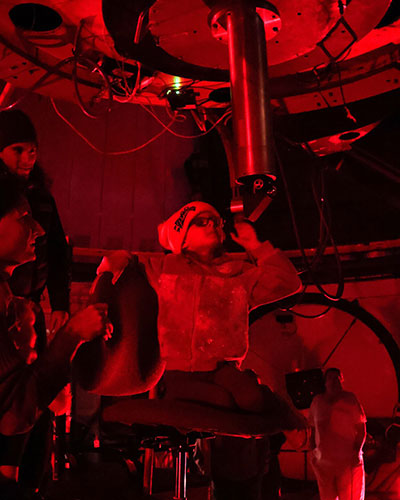
Maria Pinello, age 7, from Laramie, observes the star Vega through the eyepiece of the WIRO telescope at the facility’s open house. (UW Photo)
In 2023, WIRO suffered a lightning strike which disabled many of its electronic systems.
This year marks its return to operational status. Open house guests were treated to
an open dome and a view through the eyepiece of different celestial bodies throughout
the night, including Vega, Messier 56, the Cat’s Eye Nebula and Saturn.
The tour slots for the open house are highly coveted and fill quickly, with 127 guests
registered this year. Some guests reported stalking webpages for the announcement
months ahead of the event and feeling privileged to get a spot this year.
Tour groups for the open house met at the snowcat shed at the base of the mountain,
where the department’s snowcat for winter road access and other heavy machinery are
housed. Here, guests were treated to physics demonstrations and made-to-order liquid
nitrogen ice cream by lab coordinator Noah Cowper, who “kept everyone engaged,” according
to one anonymous guest survey. “It was really fun,” the guest added.
Undergraduate students Amelia Myers from Boise, Idaho; Natalie James from Laramie;
and Cristina Welch from Cheyenne facilitated viewing through smaller, portable optical
telescopes while guests waited for their departure times.
The tours to visit the observatory ran like clockwork from 6-10 p.m., with groups
of 14 leaving every half-hour in two-vehicle caravans up the serpentine, one-lane,
washboard road to the top of Jelm Mountain.
“Our driver had a lot of great facts about the facility and research and was able
to answer many questions going up and down,” one guest commented in an anonymous survey.
“Thus, the ride wasn’t just downtime. It was part of the experience.”
At the observatory, guests first gathered in the observatory’s living quarters to
learn about WIRO’s history and mission from Jordan Stone, a UW assistant professor
of physics and astronomy. Next, Michael Brotherton, WIRO’s director and a UW professor
of physics and astronomy, demonstrated the telescope’s technology and how observations
are made from the control room. Finally, guests were treated to a tour of the dome
and the opportunity to make a direct observation through the telescope’s eyepiece,
facilitated by WIRO engineer Thomas Mazzetti.
“The nighttime tour has you realizing how vast our universe is. We were very happy
to have been a part of this tour,” one guest commented in the survey.
While observations are now largely made remotely with the assistance of computers,
Chip Kobulnicky, a professor in the Department of Physics and Astronomy and associate
dean of the College of Engineering and Physical Sciences, says, “This is a very rare
chance to see with your own eyes through an eyepiece on a telescope of this size.”
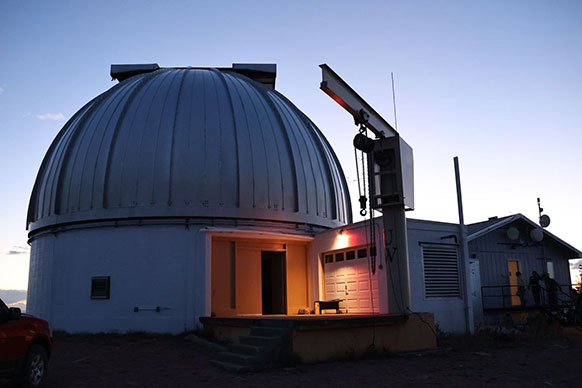
The Wyoming Infrared Observatory sits at 9,650 feet atop Jelm Mountain, 45 minutes southeast of Laramie. (UW Photo)
The 26 students, faculty and staff members who assisted with the event fielded questions
throughout the night across the range of what it means to do astronomy, from how many
people the living quarters’ bedrooms could house to why there are different colors
of stars and what they mean.
“We are so glad our friends couldn’t go and swapped their tickets to us,” one guest
commented in the survey. “What a neat facility and program. Our ninth-grade son wants
to go into astronomy, and it was really informative for him.”
Mazzetti is entering the final phase of WIRO’s repairs.
“Last week, we mounted the long-slit spectrograph and are starting final precision
calibrations before resuming scientific observation,” he says.
As WIRO wraps up its first 50 years and moves into the next 50, it remains invaluable
as a one-of-a-kind site for hands-on student learning, new instrument testing and
as an accessible venue for public astronomy outreach, including the annual open house.
To learn more about WIRO, go to https://www.uwyo.edu/physics/observatories/wiro.html. To also support student research at WIRO, visit https://www.givecampus.com/campaigns/85732/donations/new.

The University of Wyoming has earned its Research Level 1 (R1) status from the Carnegie Classification of Institutions of Higher Education, placing Wyoming's only four-year university with the top research universities in the United States.