
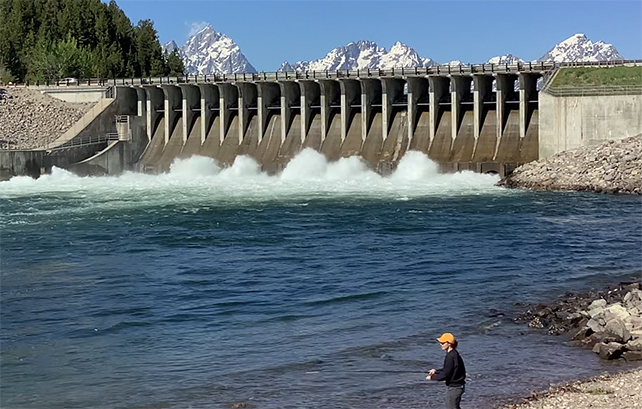
What Jackson Lake dam releases mean for anglers
Patrick Hofstedt
Published May 05, 2026
I'm a PhD student in the Hydrologic Science program, formerly a master's student in the Agricultural Economics program. I've been a part of the WyACT project for about 3 years. My current work ties in with that of another WyACT team member: Bryana Funk, also in UW’s Hydrologic Science and Ag Econ program, is currently developing a dam-release model for Jackson Lake. It focuses on optimal dam releases with consideration given to trout populations and Idaho Compact requirements. This model also needs a recreation component, and that's where I come in.
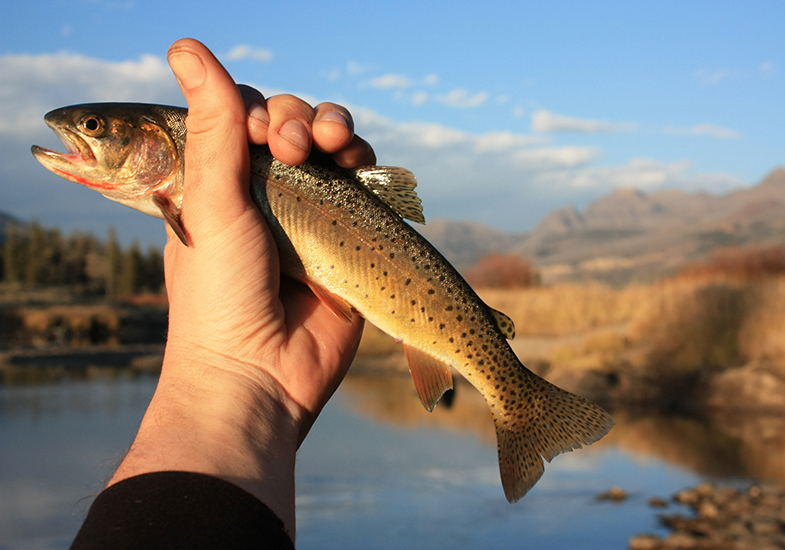
We want to know: How do Jackson Lake dam releases impact angler welfare on the Snake River? Welfare, in basic form, is an economic value related to a specific trait, usually of a non market good. In this case, it is associated with Yellowstone cutthroat trout abundance. We're asking, how does water from a Jackson Lake dam release impact angler welfare? A so-called trout production function helps quantify this. “Productivity” here means the rate of production of new abundance from a specific species over a given time.

Two sides of a model
This is a bio economic model that looks at the relationship of management actions – dam releases – to fish abundance and subsequently angler welfare. The model we are putting together to string dam releases to angler welfare integrates biological systems and economic principles.
The economic side of the model reflects the change in probability of somebody taking an angling trip, based on a feature of that trip changing, in our case related to climate factors. I ran an angler survey earlier this year. Respondents chose between two different trips, or they could choose not to take a trip at all. If we get a large enough sample size, we can discern from those choices what are the most important deciding factors to whether or not anglers will take a trip.
We also get a payment parameter estimate that tells us how much respondents are willing to pay for certain attributes of a fishing trip that may be under threat. Willingness to pay leads us to our welfare estimates. We'll be looking at Yellowstone Cutthroat Trout abundance as the measure of economic benefit and tying that eventually through welfare estimates to the bio side of the bioeconomic model.
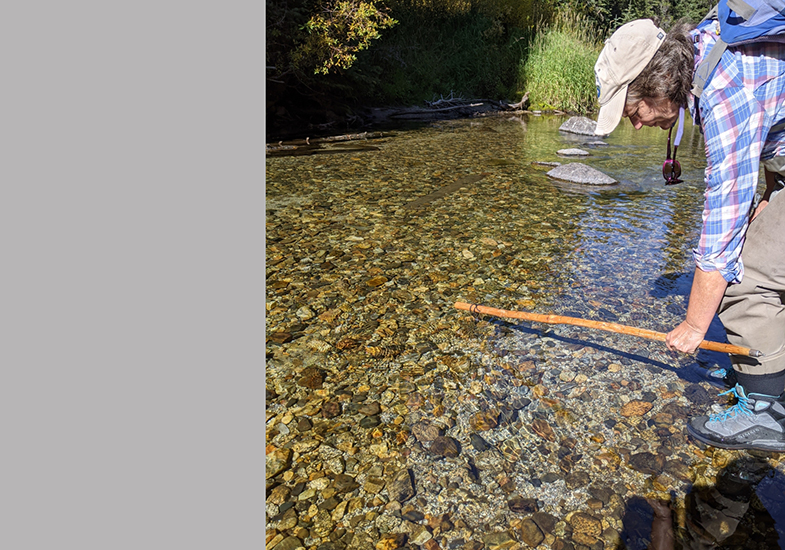
This second model component is a so-called Ricker function built by Dr. Jeff Baldock, a former WyACT member. A Ricker function predicts population productivity and redd counts. Redds are the gravel spawning ground for our trout (see third image in slider above this paragraph). This is the basis for connecting welfare to dam releases, connecting people's preferences towards catching Yellowstone cutthroat trout with trout populations and subsequently with dam releases. We integrate multiple aspects of a dam release schedule, flows and timing, as well as air temperature data for a productivity projection. This productivity projection shows us the impact of flow regimes on trout production, on new trout abundance based on the previous year's abundance.
The second projection we get from the Ricker function focuses on redds. This model
accounts for redd density and it only has population-specific effects. It's difficult
to compare redd productivity across the different streams that are shaped by many
factors besides dam releases, and there's different populations of fish in each. We
can see the impact of flow regimes on trout abundance, using redd projections as a
proxy: Based on these redds, we project how the trout population is doing in specific
areas.
Looking back at my master's thesis, the survey was missing a few things. We did the resurvey in order to shore up economic measures and to get accurate welfare estimates. It's looking good so far! Our bioeconomic model will, when it is formed, connect dam releases to welfare to add a recreation component to the numerical simulation dam release model.
Watch Patrick Hofstedt's 3-minute thesis

The University of Wyoming has earned its Research Level 1 (R1) status from the Carnegie Classification of Institutions of Higher Education, placing Wyoming's only four-year university with the top research universities in the United States.