
Young filmmakers immerse themselves in science communication
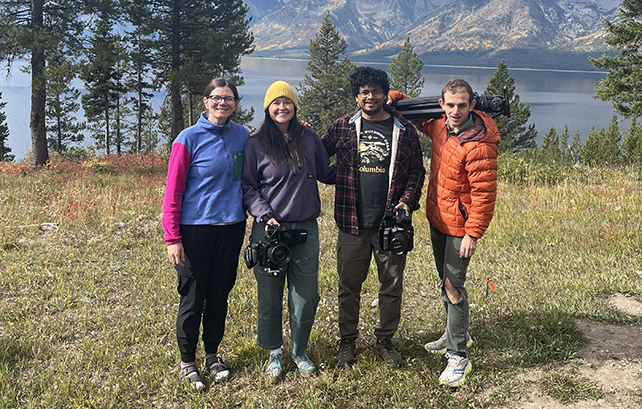
Photo: Meredith Journey (left) with Madison McKay, Sumeet Kulkarni, and Daniel Shaykevich
Published December 02, 2025
The short documentary “Plankton at the Peak” features UW’s Meredith Journey’s research in Wyoming’s alpine lakes. What can scientists expect when they collaborate with filmmakers? A peek behind the scenes.
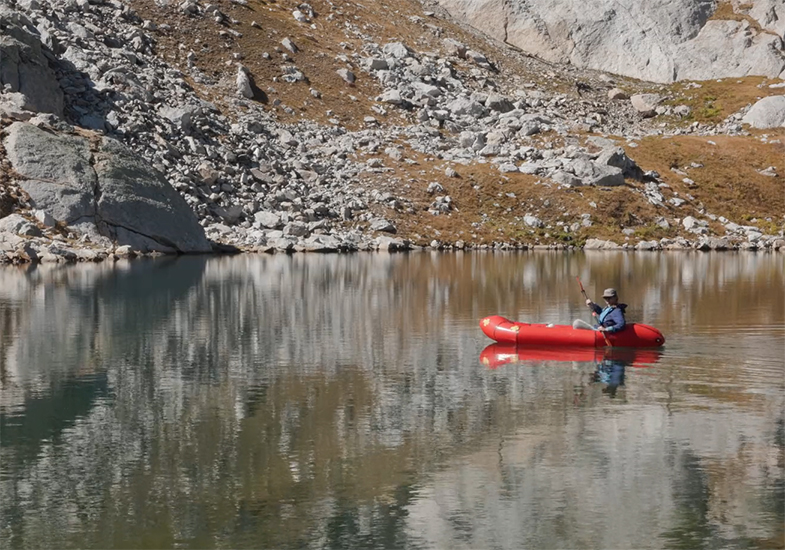

Making a science documentary can be hard work. Three young filmmakers experienced this first-hand when they accompanied Wyoming researcher Meredith Journey in her efforts to study plankton in an alpine lake: They had to walk 10 miles roundtrip to the lake and back, carrying cameras, lenses, and tripods. Daniel Shaykevich, Sumeet Kulkarni, and Madison McKay, who all have a science and communications background had scored some of the competitive slots of the Jackson Wild Media Lab. They formed one of three teams participating in this year’s intensive nine-day filmmaking workshop created for emerging filmmakers and science communicators. Their timeline was extraordinarily short – from concept via shooting and editing to finished film in just over a week.
Still, before breaking out the cameras, the team spent several hours with Meredith to better understand her work and getting to know her. From this, they extracted the story they wanted to tell and drafted a list of footage they hoped to capture in the field: Meredith getting to and working on the lake taking water samples, including underwater shots. Daniel explains: “You have to think about what part of a research study you want to convey in the film. These projects are usually quite complex and can be difficult to explain, so really consider which elements audiences must understand and how that can be represented visually.”
What they didn’t do was writing a script. Rather, they captured Meredith’s spontaneous replies to their prompts. Meredith was surprised: “I thought I would have the questions in advance. But their way made the responses more authentic”.
Sumeet stresses the importance of spending as much time as possible (while recording) following a day in the life of the researcher. The filmmakers kept the microphones running continually, which allowed them to use birdsong and other ambient sound. The first day of filming was spent around – and in – the water. The team lowered an underwater camera into the lake to show the important plankton sampling process. Sumeet, an astrophysicist and astrophotographer: “I had actually never seen plankton before, but having seen these vibrant little critters swimming against the backdrop of an alpine lake, I now find them totally endearing”. Daniel was likewise struck by the difference in scale from huge mountains and the miniscule zooplankton and their interaction.
Day two of filming zoomed in further with microscopic images of plankton in the lab and Meredith discussing her work at the AMK Ranch, UW’s research facility in Grand Teton National Park. Taking turns with cameras and sound, they enjoyed what Sumeet called “a really picturesque setting”.
But with the deadline looming, the team had to hurry to the cutting room and edit all the footage down to a story less than 5 minutes long. On September 30, “Plankton at the Peak,” along with the other two documentaries made during the previous week, was shown at the Jackson Wild Summit. That was the first time Meredith saw the finished product, not having been involved in the editing.
What's next?
The agreement between filmmakers and researcher states that both parties can freely use the video. Meredith plans to show it as a conversation starter at science cafés and other outreach events as well as on the Biodiversity Institute’s social media. In the Grand Teton ecosystem, which houses iconic species like moose, grizzly bears, and wolves, she wants to shine a spotlight on the tiny organisms that can be important indicators for ecosystem health.

Jackson Wild Media LaB
More about the Jackson Wild Media Lab: https://www.jacksonwild.org/media-lab

The University of Wyoming has earned its Research Level 1 (R1) status from the Carnegie Classification of Institutions of Higher Education, placing Wyoming's only four-year university with the top research universities in the United States.