
3 times 3: WyACT grad students on their research
Andrea Hagadorn, Julia Olson, Ashley Babcock
Published May 22, 2026
snow, water, and learning in the west
Two PhD and one master student summarized their ongoing research work in the a "three-minute thesis" format, with one slide and talking no longer than three minutes. Transcripts of their short talks can be find below - if you prefer to listen rather than read, use the button to the right to access the recordings.
navigating scientific uncertainty in high school science classrooms: a case study
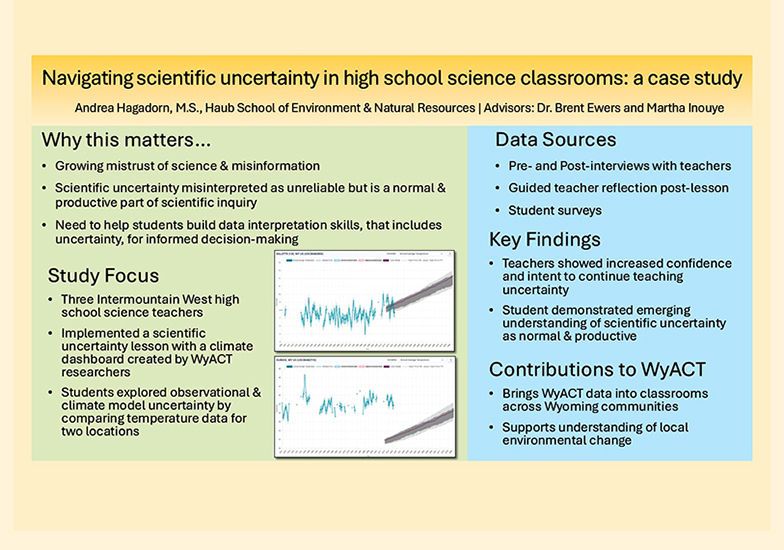
My name is Andrea Hagadorn. I'm a second-year master student supporting the Teacher Researcher Knowledge Exchange (TRKE) within WyACT. My research responds to the growing mistrust of science and misinformation, specifically regarding scientific uncertainty.
Scientific uncertainty, an inherent and normal part of scientific inquiry, is often
interpreted by media and the public as unreliable. Because of this, there is a need
to help students build data interpretation skills that include understanding scientific
uncertainty so they can make informed decisions about complex socio-scientific issues.
To explore this, I conducted a multiple case study with three high school science teachers in the Intermountain West who had been part of the TRKE. Each teacher implemented a lesson designed to engage students with both observational uncertainty, such as limitations in data collections, and climate model uncertainty, where assumptions and estimations of Earth's complex climate systems introduce uncertainty. The lesson used a climate dashboard developed by WyACT researchers that allowed students to compare temperature data across two locations, where one location showed historical data and modeled data relatively in line and another location where they were not aligned. Through engagement with the dashboard and discussion, students made sense of sources of uncertainty in data.
Data sources for this study included pre- and post interviews with teachers, guided written reflections post-lesson, and student surveys. Findings suggest teachers increased their confidence in explicitly teaching scientific uncertainty and expressed interest in continued integration of uncertainty into their instruction. Students also demonstrated emerging understanding of scientific uncertainty as a normal and productive part of science. This work brings place-relevant data into classrooms and communities across Wyoming. By supporting students in interpreting data about their own environments, this research helps build understanding of local environmental change and contributes to more authentic science learning.
snowtography
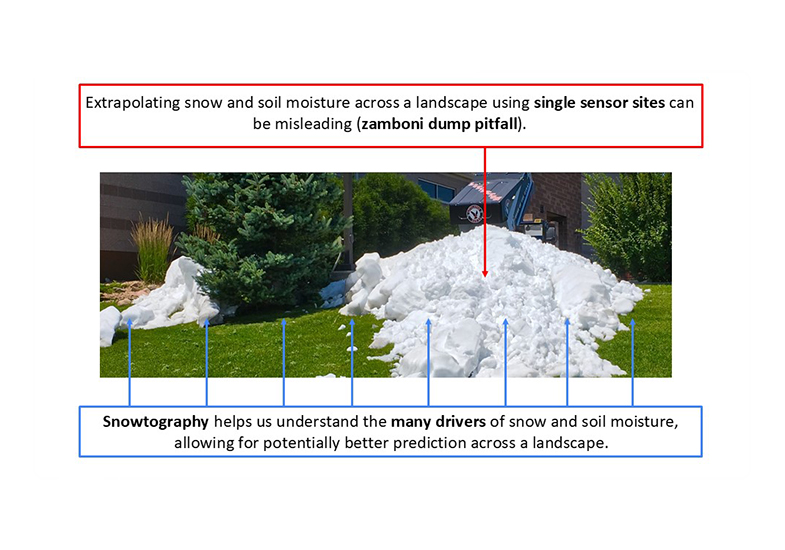
I'm Julia, a PhD student in Hydrologic Science. Growing up, I played ice hockey, and even in the middle of the summer, when I was sweating and my popsicle was melting and the rest of the landscape was hot and long snow free, there was a pile of snow outside of my local rink left by the rinks zamboni. If you measured snow depth and soil moisture only under and around the zamboni pile, you'd be forgiven for thinking that all of Boston was coated in 6 ft of rapidly melting snow. Drought solved! In reality, of course, the area outside of the rink had a unique driver, the zamboni dumpings, allowing it to stay snowy and the soil moist even through hot and dry times.
While we don't have giant zambonis dumping snow across our natural landscapes in Wyoming,
our landscapes nonetheless have a variety of snow and snow water storage differing
at foot to many mile scales.
I'm studying meteorological, ecological, and topographical drivers of snow and water
storage on landscapes across Wyoming using a method called snowtography. Snowtography
measures snow depth, snow water equivalent, and soil moisture along transects across
different vegetation settings accompanied by a meteorological data collection station.
Snow depth data is collected using camera images of depth stakes, hence snowtography.
The snow and soil moisture at each stake is naturally subject to different drivers.
For example, at one site, snow may always form drifts at vegetation or melt more quickly
on south facing slopes. So, the transect format helps us understand the influence
of each driver on snow and soil moisture.
So far, I've examined simple relationships between drivers and snow and soil moisture. But I look forward to creating a Bayesian model to better understand the influence of each driver on snow depth and soil moisture and perhaps to allow us to make predictions about snow and soil moisture on our landscapes. By collecting many data points with a variety of drivers across a variety of ecosystems through snowtography, we get a truer picture of where snow and moisture stays on a landscape and why and avoid zamboni-dump pitfalls that accompany single sensor measurements. Further, as Wyoming becomes warmer and drier, understanding these drivers can help us manage our landscapes to hold more snow water. I look forward to continuing this research,
changes and controls on the hydrology of the snake river headquarters
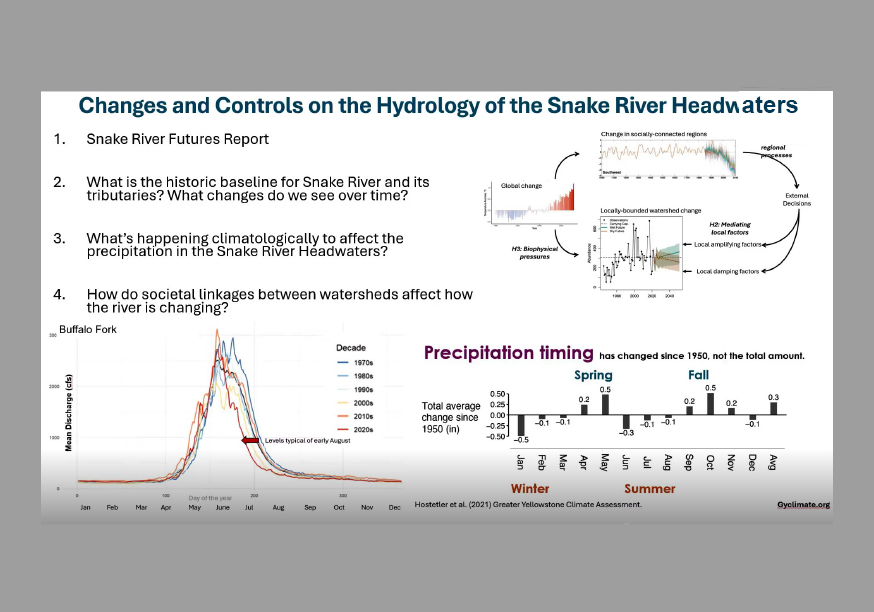
My name is Ashley Babcock. I'm a PhD student in the hydrologic science program and I'm a WyACT student studying changes and controls on the hydrology of the Snake River Headwaters. Part of my role is to help coordinate and write the Snake River Futures Report where we're envisioning the next 25 to 40 years in the Snake River Headwaters. We're addressing the general public and our agency and NGO partners.
The first part of my dissertation is going to be incorporated into the report where I talk about the historic streamflow baseline for the Snake River headwaters with the goal of understanding the historic baseline of the river and its tributaries. We want to know what changes we see over time, specifically with peak flow timing and quantity, base flow and extreme events. Our hypothesis is that we'll see similar trends that we're seeing across the west, anticipating seeing earlier day of peak flow and reduced peak flow volumes. So far preliminary results do suggest that these trends are occurring. We're doing a decadal analysis where we're seeing the rising limb of the hydrograph kind of staying the same throughout the decades, but we're seeing earlier drop off indicating steeper runoff curves. We're also seeing interesting patterns with the managed part of the Snake River below Jackson Lake Dam, based on the management regimes.
My next chapter is going to look at the regional atmospheric circulation of this area. We're hoping to understand larger-scale shifts that are taking place and potentially driving these hydrologic shifts. We specifically want to know why spring and falls are getting wetter and winter and summers are getting drier. We expect to see the shifts in the atmospheric circulation that are driving these changes.
Lastly, my third chapter is going to address regional linkages between the Snake River headwaters and the downstream Snake River Valley that's heavily agricultural. We want to quantify the human effect, specifically from the management of the Jackson Lake Dam and the Palisade Dams and how that's impacting the hydrograph.
The Snake River is a case study, but we think this might be a pattern throughout the West. The bigger question of how human activities in the distant parts of watersheds can translate into the effects of climate change, specifically drought from one region to another. We expect to see that drought in Idaho will get propagated or transferred to upstream Wyoming because of the management regimes. We'll analyze temperature, precipitation, snowfall, and soil moisture.