
2026 STEM Carnival

University of Wyoming President Shane Reeves
- invites you to the 5th Annual -
STEM Carnival & Wyoming's Natural Landscapes and Ecosystems
Friday, September 11, 2026
10 am - 2 pm
Berry Biodiversity Conservation Center
Laramie, WY • UW Campus
Hosted by the UW Top-Tier Science Initiative
Discover the exciting world of science, technology, engineering, and math at the UW STEM Carnival through a wide variety of interactive demonstrations and hands-on activities presented by UW faculty, students, campus programs, and local entities. This year’s carnival highlights Wyoming’s Natural Landscapes and Ecosystems, offering unique opportunities to explore concepts of wildlife, habitats, watersheds, environment, and beyond. Get an up-close look at Wyoming’s open spaces through interactive activities and demonstrations. Whether you’re a curious thinker, a hands-on learner, or eager to explore, there’s something for everyone.
Questions? Please reach out to stemcarnival@uwyo.edu!
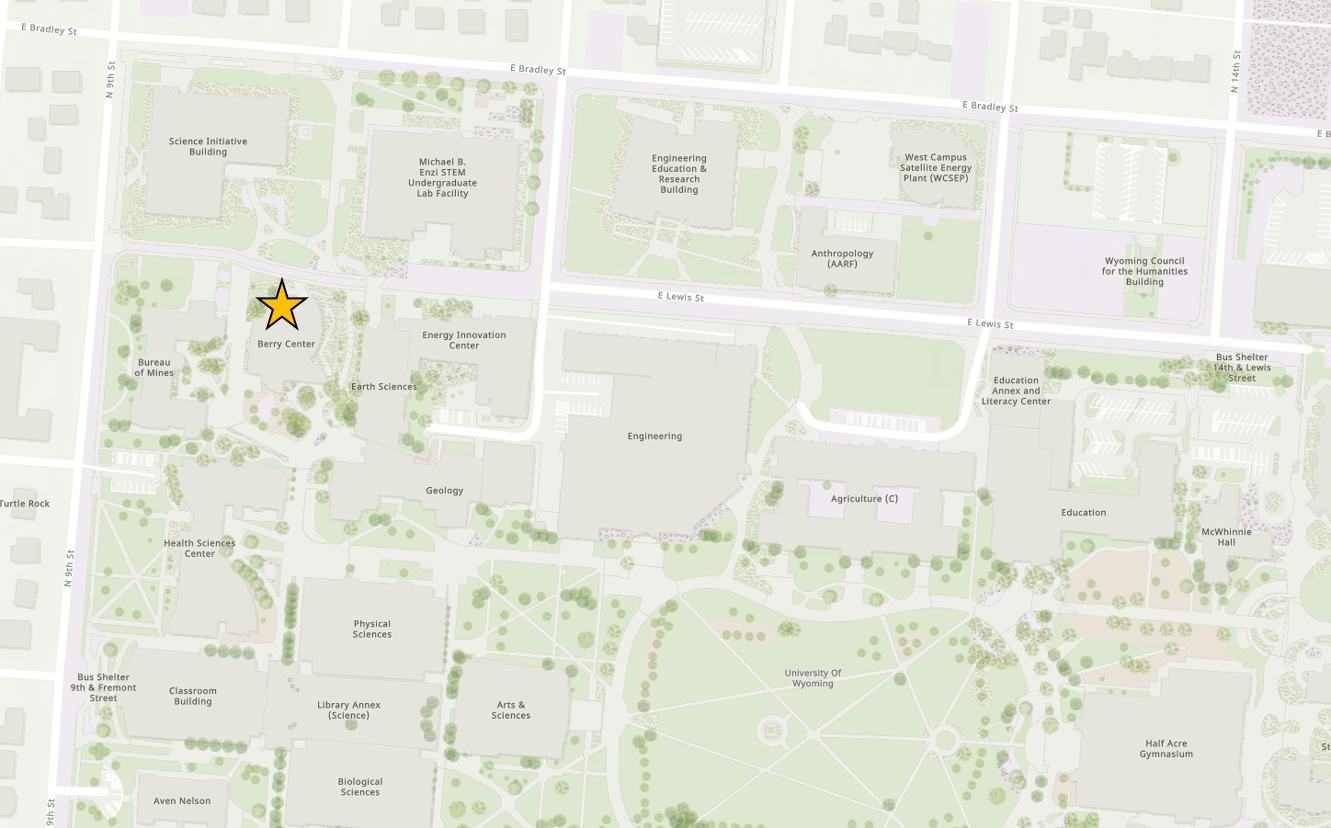
Location noted by star on map above.
SCHEDULE
- 10 am: Carnival Begins
- 10-2 pm: Explore the 50 hands-on STEM tables inside and outside the Berry Biodiversity Conservation Center
- 10:30 am: Workshops featuring Wyoming's Natural Landscapes and Ecosystems
- 11:00 am: Workshops featuring Wyoming's Natural Landscapes and Ecosystems
- 11:30 am: Workshops featuring Wyoming's Natural Landscapes and Ecosystems
- 12:00 pm: See physics in action with the watermelon drop from Science Initiative Building!
- 12:30 pm: Workshops featuring Wyoming's Natural Landscapes and Ecosystems
- 1:00 pm: Workshops featuring Wyoming's Natural Landscapes and Ecosystems
- 1:30 pm: Workshops featuring Wyoming's Natural Landscapes and Ecosystems
- 2 pm: Carnival Ends
WORKSHOPS
Fire, Fire Safety, and Wildfire Prevention (Wyoming State Parks and Historic Sites): In this workshop, we will demonstrate the fire triangle, the impacts of moisture content on fuel, and the ways in which participants can mitigate the risks inherent in fire building. Participants will have the opportunity to practice building different kinds of fire structures, and view several demonstrations of fire behavior.
The Wild Poet Society: Observation, Curiosity, and Creative Writing in Nature (Wyoming Game and Fish): Observing nature is one of the most important tools scientists use to understand the world. In this workshop, science meets creativity as naturalists of all ages slow down, notice the details of nature, and transform their observations into creative poetry.
Plan Your Wyoming Adventure (Jay Kemmerer WORTH Institute): Kids become trip planners. Using a simplified Wyoming map and "adventure cards" (Yellowstone, Snowy Range, Flaming Gorge, etc.), they pick a destination, match the right gear and clothing to the ecosystem, and plot a one-day itinerary. Take-home: a stamped "Wyoming Adventure Passport" with their plan inside.
Tourism Dollar Journey (Jay Kemmerer WORTH Institute): Each child gets $20 of play money representing a visitor's spending. Children will be walked through several stations where they can "spend" their money (lodging, outfitter, restaurant, gas station, etc). They will watch their money be spent by businesses in the community. This workshop reinforces why having healthy landscapes can contribute to the economic health of communities. Each child will be able to take home their play money with stamps from each stop.
Cornhole and Critters: Exploring Wyoming's Food Chain at the Atomic Level (Stable Isotope Facility): Ever wondered how scientists figure out where an animal fits in the food chain? Join us for this hands-on, interactive workshop to find out! Become a certified Iso-lope when you learn what atoms are, explore the fascinating world of isotopes, and discover how these tiny clues help scientists study the Wyoming ecosystem. Then, put your new knowledge to the test with a game of Isotope cornhole to determine where you would fit in the Wyoming food web—as a plant, insect, herbivore, or top predator!
Bighorn Sheep Adaptations (National Bighorn Sheep Center): Join us to learn about bighorn sheep adaptations! In addition to touching and experiencing cool bighorn sheep adaptations like hide, hooves and horns, you will learn about their physiological processes, including digestion and the rut. Bighorn sheep have unique behavior, ecology and biology - Come experience it all!
Beavers: Nature's Engineers (Wyoming Wildlife Federation): Learn about how beavers impact our Wyoming ecosystems and how their engineering prowess affects species up and down the food chain. An interactive lesson where you get to put on your beaver thinking cap and see how your work on the landscape changes the whole picture.
Bird Biodiversity (Biodiversity Institute/Haub School): An interactive birding activity where students will be involved with locating, identifying, and gathering data on birds around campus, including (depending on weather) our local Turkey Vulture Roost. No experience is necessary and binoculars will be provided!
Outdoor Cooking (Outdoor Recreation and Tourism Management, Haub School of ENR): Come join us for some outdoor cooking fun! In this hands on session, you'll get a chance to be part of the cooking process and help whip up a tasty snack, all out in the open air. You'll see how a camp stove works, lend a hand with the cooking, and enjoy a treat you helped make yourself. Come ready to get outside, participate, and savor the fun of cooking up something delicious outdoors.
Survival in the Wyoming Wilds: Plant Design Challenge (Rocky Mountain Herbarium): Students become plant designers as they work together to create one-of-a-kind plants adapted to survive in Wyoming's iconic and diverse landscapes and ecosystems. By selecting from among different types of roots, leaves, stems, flowers, and other adaptations, students will explore how plant structures help plants survive challenging environments.
Big Game Migration Simulation: Surfing the Green Wave (Wyoming Migration Initiative): This interactive migration simulation gets students moving as a herd as they seek out food resources during spring migration. Students get a feel for the fence and road barriers and other risks that animals face along the migration trail, including experiencing the difference between navigating a legacy Fence and a wildlife friendly fence. Students will also experience the nutritional outcomes of different migration strategies.
Adapted to Place: Wyoming’s Reptiles (Science Initiative Roadshow): Students compare Wyoming snakes and lizards with non-Wyoming species they can safely touch and observe. They explore how Wyoming’s climate, elevation, and seasonal changes shape reptile physiology and behavior and help animals survive in this unique ecosystem.
Wyoming by Design: How Landscapes Shape Our State (Science Initiative Roadshow): This activity introduces students to Wyoming’s diverse geographic regions and the unique landscapes that shape life across the state. Through hands-on exploration and activities, students investigate how mountains, plains, rivers, deserts, and other landforms influence Wyoming’s communities, wildlife, and resources. Students build geographic awareness while developing an appreciation for the connections between Wyoming’s physical environment and the people who call the state home.
Ancient Wyoming Landscapes (Science Initiative Roadshow): Students will explore Wyoming fossils to discover what fossils can tell us about the plants, animals, and environments that existed here millions of years ago. Through an interactive activity, students will use clues from the past to imagine how Wyoming’s landscapes have changed over time.
PARTICIPATING UNITS
|
|

The University of Wyoming has earned its Research Level 1 (R1) status from the Carnegie Classification of Institutions of Higher Education, placing Wyoming's only four-year university with the top research universities in the United States.