
About the Sculpture Minor
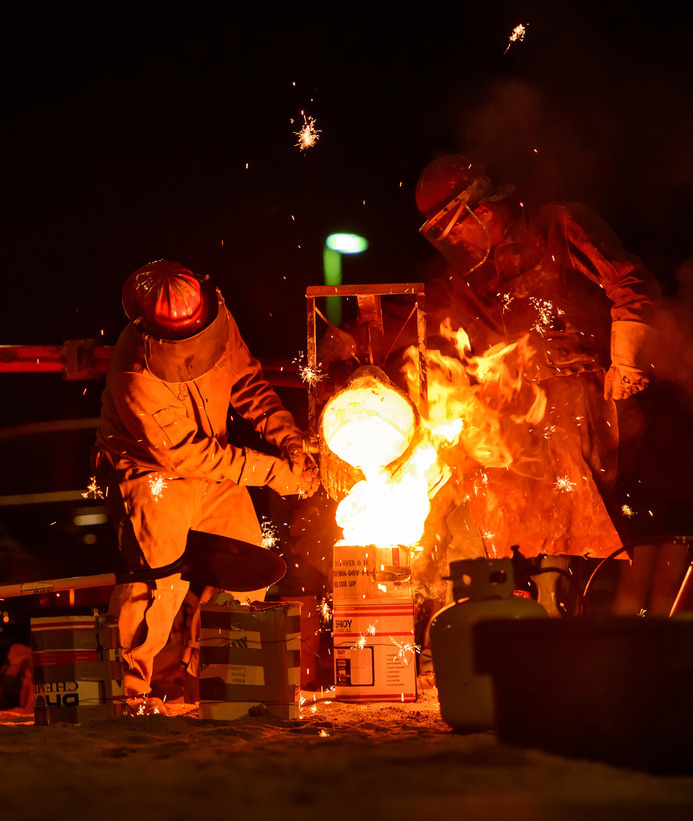
The sculpture minor provides a well-rounded education in sculptural practices, combining technical rigor with conceptual development. Students work in wood and metal fabrication, mold-making, casting and mixed media such as soft sculpture, while also experimenting with installation, performance and digital tools like laser cutting and 3D printing. Guided by notable faculty and supported by best-in-class facilities, students gain an advanced understanding of sculptural techniques and materials. Opportunities to travel to conferences, maker fairs and metal pours further enhance hands-on learning and professional development, preparing students for careers or advanced study in the visual arts and related fields.

Learn more about art offerings at UW and how to become involved in our department by touring the UW Visual Arts facilities!
Students pursuing a B.A. in Visual Arts - Art History Track may minor in a studio discipline. However, students pursuing a B.A. in Visual Arts - Studio Art Track, B.F.A. in Studio Art or a B.A. in Art Education cannot minor in a specific studio discipline. Students should plan on a minimum of five semesters to complete a sculpture minor due to upper-division course prerequisites. Please note that all courses require a minimum grade of C to earn a sculpture minor.
What can you do with a Sculpture Minor?
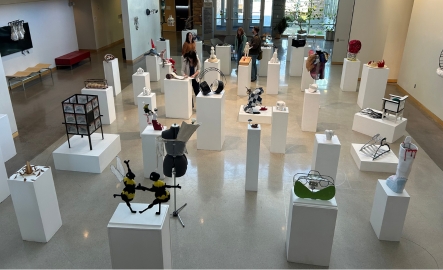
Studying sculpture means mastering the art and science of materials, techniques and equipment. It opens doors to diverse careers like construction, industrial design and fabrication. Sculptors blend STEM with creativity, using modern technology like 3D printing and CNC routing. Math and engineering are integral to crafting our creations. With these skills, one can thrive in fields like film, theater, automotive design and animation. Sculpture isn't just about art; it's about designing a life fueled by creativity.
Some of the titles our graduates currently hold include:
- Sculptor/Artist
- Fabricator
- Welder
- Art Instructor
- Art Technician
- Blacksmith
- Foundry Worker
- Model Maker
- Industrial Designer
- Museum Preparator
UW fine art and art education grads are getting creative at the following places:
- Topo Designs
- University of Hartford School of Art
- Western Confluence Magazine
- University of Wisconsin
- Glassell School of Art
- Art League Houston
Many students pursue additional education after graduation. Sculpture graduates have recently been accepted to the following prestigious programs:
- Virginia Commonwealth University
- Carnegie Mellon
- Arizona State University
- School of the Art Institute of Chicago
You'll learn how to create three-dimensional artworks using a variety of materials such as clay, wood, metal, plaster and found objects. You’ll explore techniques like carving, modeling, casting and assembling, while also studying form, space, balance and texture. Many of our courses also introduce digital tools or contemporary practices, and you’ll gain experience in both conceptual development and hands-on craftsmanship.
No experience is necessary to take sculptural practice courses. Our foundational sculptural practice courses are designed to teach you the tools, processes and safety from the ground up.
Yes! We have a fully functioning foundry and offer opportunities in iron, bronze and aluminum casting. Reach out to ahc1@uwyo.edu if you have a project, we can aid in making it a reality.
Sculpture is one of several core studio areas in the Department of Visual Arts. Many students combine sculptural practice work with printmaking, drawing, digital processes or painting in their B.A. and B.F.A. degrees.
"The way Professor Carlisle teaches sculpture is empowering. I believe that having the confidence to pursue your wildest ideas is the first step. The sculpture facilities at UW offers a wide range of sculptural processes that have pushed me to consider what it means to be a contemporary artist. Through taking sculpture at UW I have built my confidence in materials and myself as an artist. I recommend this program to every young artist because sculpture is a combination of all mediums, it is drawing, painting, printmaking, but in three dimensions."

The University of Wyoming has earned its Research Level 1 (R1) status from the Carnegie Classification of Institutions of Higher Education, placing Wyoming's only four-year university with the top research universities in the United States.