
Record-Breaking Athlete Excels & Graduate Researcher in UW’s Range Program
Brooke Ortel, University of Wyoming Extension
The University of Wyoming’s Division I athletics program is known for nurturing top-tier student-athletes. But most of them aren’t also performing graduate-level research.
When he’s not breaking national records at track and field meets, graduate student Daniel Reynolds studies wildlife movement in Wyoming landscapes.
In other words, this unconventional and high-achieving student has two intense full-time jobs.
Dual passions
A native of Granby, Colorado, Reynolds earned his bachelor’s degree in rangeland wildlife management at Chadron College while competing in the weight throw, hammer throw, and shotput. He graduated early, with several seasons of NCAA eligibility remaining.
Post-graduation, Reynolds eagerly accepted the opportunity to compete on UW’s track and field team while furthering his education as a graduate student in the Rangeland Ecology and Watershed Management Program.
Already a multi-discipline athlete, Reynolds quickly became a multi-discipline researcher. Under the mentorship of Professor Derek Scasta, he took on several projects aimed at allowing wildlife to move more easily across the landscape without interrupting livestock operations.
“Having a grad student who’s also an athlete is very unique,” says Scasta. “Daniel’s [athletics] records are amazing, but he has also run this important research program. He has an incredible work ethic and we’re proud to have him in the college.”
Wildlife-friendly fencing
Reynolds’s first project focused on wildlife-friendly fencing, which allows wildlife to move more easily in areas where migration corridors intersect with human infrastructure.
But most studies have focused on how well this type of fencing facilitates wildlife movement—not on whether it effectively contains livestock.
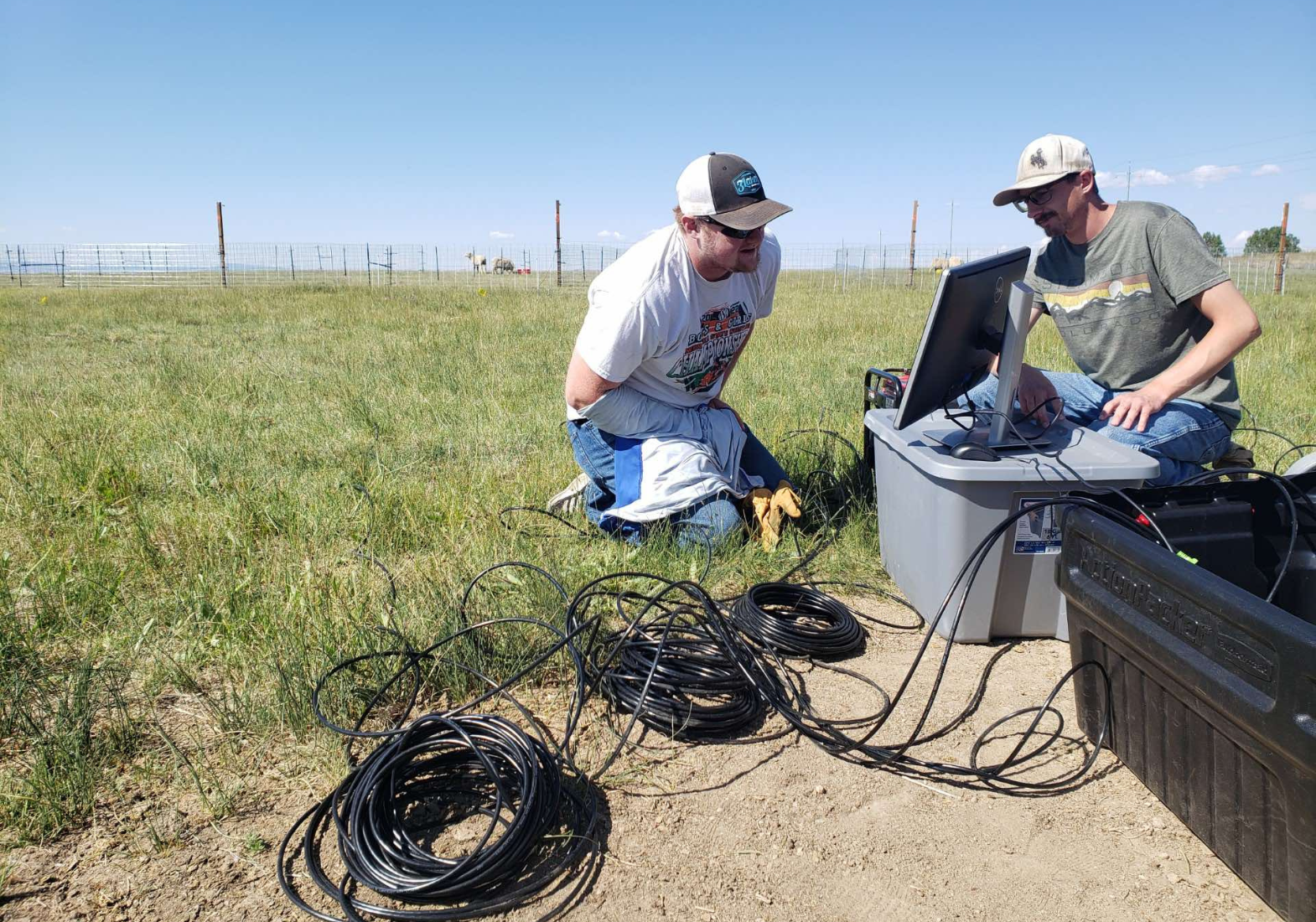
Noticing the gap in existing research, Reynolds set up a series of experiments at the Laramie Research and Extension Center (LREC) to test how well wildlife-friendly fencing contained domestic sheep.
He corralled groups of sheep within nine wildlife-friendly fence designs, then observed whether sheep attempted to cross the fences under different conditions. As sheep grazed down the existing grass, the role of hunger was assessed—could the grass available on the other side of the fence serve as a motivator for crossing?
Overall, most sheep didn’t try to cross the fence, providing preliminary evidence that wildlife-friendly fencing is effective for containing sheep. The one group that did attempt crossing appeared to be motivated by group behavior, not the type of fencing or presence of forage on the other side of the fence.
Perhaps more importantly, the project established a foundation for future studies evaluating how livestock respond to structures intended to aid wildlife movement. Ultimately, this type of research could help producers make more informed decisions about what types of fencing are best suited to their operations.
Aiding pronghorn migration
Wildlife-friendly fencing isn’t the only way to make it easier for ungulates like pronghorn to move across the landscape. Sometimes, Reynolds says, the solution might be as simple as leaving a gate open when a pasture isn’t in use.
“A lot of times, ranchers will bring their cattle in closer in the winter because there’s no forage and water sources freeze,” he explains. “So, there’s often a bunch of gates that could be open that would allow pronghorn to get through a little bit easier.”
But, if the gates were left open, would the pronghorn use these pathways rather than following their usual routes under the fences?
To answer this question, Reynolds set up game cameras near 15 open gates at LREC and 5 open gates at UW’s McGuire Ranch, located northeast of Laramie. Data was collected from December through May, while cattle were not present.
Over the course of two seasons, Reynolds amassed thousands of hours of video footage capturing pronghorn movement.
He found that yes, pronghorn do make use of the streamlined pathways created by open gates. Opening interior gates while pastures are not in use may provide a simple way to aid pronghorn travel, particularly during cold and snowy conditions in the winter.
While Reynolds hadn’t set out to assess predator behavior, his game cameras also captured coyote movement. Video footage indicated that coyotes used fences to entrap pronghorn at night, suggesting that open gates might also help pronghorn escape predators.
Becoming an NCAA champion
In between analyzing data and trekking across snowy, windswept pastures to check game cameras, Reynolds was pushing his limits at the gym.
In 2025, he wrapped up an undefeated indoor season in the weight throw with a first-place finish at the NCAA Indoor Track and Field Championships in Virginia Beach. He also set a new university record for the hammer throw and the shotput. In recognition of his achievements, Reynolds was named the 2025 NCAA Division I Men’s Indoor Track and Field National Field Athlete of the Year.
Scasta attributes at least some of that athletic success to all the hard work Reynolds poured into building infrastructure for his research projects.
As Reynolds wraps up his graduate research, he has continued to train for professional competitions and help coach other student-athletes—in between analyzing thousands of hours of video footage and writing his thesis.
“It’s difficult, but I like to be busy and see what I can handle,” Reynolds comments. “I think there’s a lot of similarities between upper-level education and training. The books are your weights, and every day you put in the work. It’s definitely a challenge, but I enjoy it.”
Photos by UW Athletics, Daniel Reynolds, Nicki Nimlos, and Derek Scasta.