
CALSNR Prepares Students for Success in Wyoming’s Medical School
Brooke Ortel, University of Wyoming Extension
Published September 10, 2026
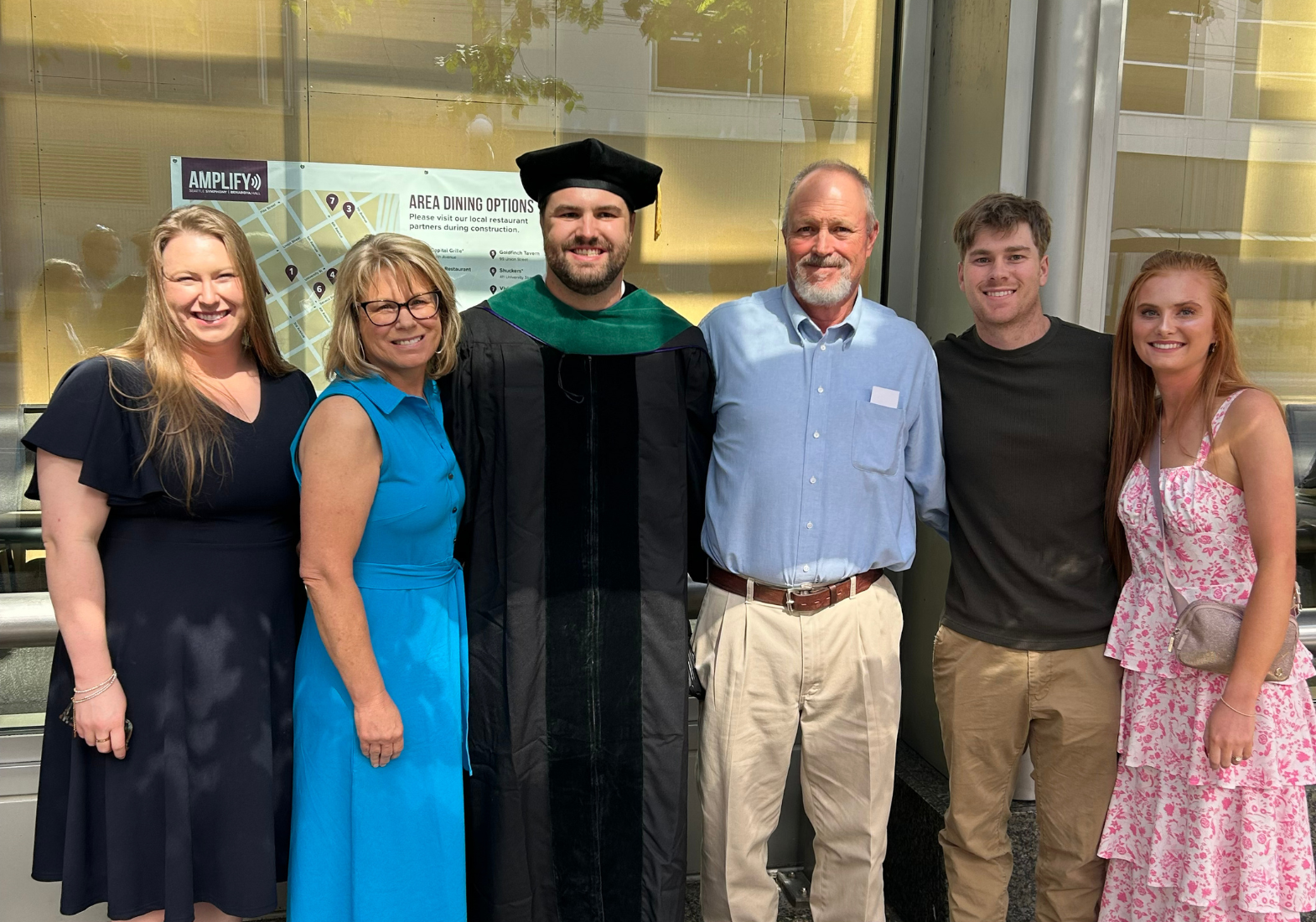
Growing up in northern Wyoming, UW alum Trent Bronnenberg knew early on that he wanted to study medicine.
As a child, he experienced the challenges of rural health care firsthand, including traveling out of state to see specialists. He also showed an early aptitude for doctoring cattle on his grandfather’s ranch.
At UW, Bronnenberg double majored in physiology and molecular biology, both degree programs in the College of Agriculture, Life Sciences and Natural Resources (CALSNR).
After completing a master’s in zoology and physiology, he went on to attend Wyoming’s medical school, the WWAMI Medical Education Program.
What’s WWAMI?
WWAMI, which is short for Washington, Wyoming, Alaska, Montana, and Idaho, is a competitive regional medical program for residents of these five western states.
The WWAMI Medical Education Program is delivered in partnership with the University of Washington School of Medicine, a nationally ranked institution known for preparing students to practice rural medicine.
Each year, a cohort of 20 Wyoming residents are accepted into the Wyoming WWAMI program. Its four-year curriculum includes 18 months of coursework at UW followed by clinical training in locations across the WWAMI region. Students participate in a wide variety of clinical rotations, from small rural clinics to big-city trauma units.
Upon completion of the program, WWAMI graduates receive a Doctor of Medicine (MD) from the University of Washington School of Medicine.
Through Wyoming WWAMI, Wyoming residents can receive a world-class medical education close to home. Many return to practice medicine in their home state, filling critical health care roles in Wyoming communities.
A pipeline to success
Bronnenberg isn’t the only CALSNR alum who has gone on to attend Wyoming’s medical school. In fact, the college plays a key role in preparing Wyoming students to succeed in the WWAMI program.
“When you think about CALSNR, health care education may not be something you initially think about, but we’re a major undergrad pipeline,” says Amy Navratil, head of the Department of Zoology and Physiology and a WWAMI instructor.
Over the past five years, more than 70 percent of the UW graduates admitted into the WWAMI program earned their bachelor’s degree from CALSNR. Some majored in physiology or molecular biology, while others studied nutrition.
“I owe much of my success in medical school to the education I gained in my undergraduate years,” says Avery Potter, a third-year WWAMI student from Casper. “The physiology program gave me an amazing foundation for medical school. Many of my professors during undergrad also teach in the WWAMI program and know exactly what things to teach us in class to set us up for success in graduate programs.”
In addition to teaching undergraduate classes in UW's physiology program, Navratil serves as a block lead for the Wyoming WWAMI program. Each block lead teaches a five- to six-week course during the first 18 months of the program. Of the eight block leads, six are CALSNR faculty members.
Navratil leads the reproduction and development block while colleagues from UW’s physiology, molecular biology, and animal science programs teach courses focused on respiration and regulation; the cardiovascular system; cancer, hormones, and blood; the head, neck, and gut; and the foundations of medical science and research.
“It’s really fulfilling to be able to be a major pipeline for those students, to see them at the undergrad level and then that next step when they’re in professional health programs,” Navratil comments.
Meaningful mentorship
As Bronnenberg knows firsthand, CALSNR faculty like Navratil aren’t just excellent instructors—they’re also invaluable mentors.
“Amy was phenomenal throughout the entire time and even to this day,” Bronnenberg comments. “She’s always been the person I’ve felt confident going to when I had questions. She’s got an open-door policy.”
As a graduate student, Bronnenberg studied how obesity affects female infertility, working with Navratil and Brian Cherrington, Wyoming WWAMI’s respiration and regulation block lead.
Navratil hasn’t just supported Bronnenberg in the classroom and lab, though. During his master’s program, she also helped him find opportunities to gain real-world experience in patient care, including as a member of the Snowy Range Ski Patrol and the local search and rescue team.
These experiences complemented his graduate research and helped solidify his decision to pursue medical school, Bronnenberg notes.
And it’s not just Navratil and Cherrington, WWAMI students report. CALSNR faculty are known for making meaningful connections with their students—and sustaining those connections as students move into new stages of their academic careers.
“I formed a great relationship with several professors in the physiology program…and they have continued to support me along my journey,” Potter shares.
Like Potter, Bronnenberg valued the continuity of working with faculty members he’d already built relationships with. “The networking is huge,” he says. “I felt way more comfortable talking to them and working through problems as they came up because I knew the professors I was talking with.”
Real-world research experience
All Wyoming WWAMI students are required to complete a nine-week research project the summer after their first year in the program.
“The medical accreditation body requires that students complete a scholarly project because we want our future physicians to always be lifelong learners,” says Nellie Bruns, an associate professor in the Department of Zoology and Physiology who serves as Wyoming WWAMI research coordinator and cardiovascular block lead. “Even providers who don’t intend to make research a large part of their practice are going to read literature and continue to engage in scholarship when they’re practicing.”
As research coordinator, Bruns helps students identify research topics and connect with mentors in Wyoming and at other WWAMI sites. She also supports students in communicating their results, including through poster presentations at an annual UW research symposium.
Projects vary widely, ranging from lab experiments to literature reviews. Sometimes students select their project based on a specialized field they hope to enter, while others choose a project because they want to learn a specific technical skill, such as performing ultrasounds.
Bronnenberg built upon his master’s research, studying how medications used to treat autoimmune conditions may affect pregnancies. He collaborated remotely with a faculty member based at the University of Washington.
Potter, on the other hand, conducted a literature review on vaccination in Campbell County. She then partnered with the local public health department to produce materials communicating research-based information about childhood vaccines.
Wyoming’s future physicians
Both Bronnenberg and Potter hope to one day practice medicine in their home state.
In June 2026, Bronnenberg began a five-year residency at the Cleveland Clinic, where he’ll explore different specialties within general surgery. Once he completes his residency and possibly a fellowship, he says, “I will absolutely come back to Wyoming.”
Potter, who is currently in the midst of clinical rotations throughout the WWAMI region, also looks forward to serving patients in the Cowboy State. “As soon as I finish residency, I am so excited to return to Wyoming,” she says.
After all, WWAMI—and CALSNR—prepare future health care professionals from Wyoming, in Wyoming, for Wyoming. “I was drawn to the program because I have always loved Wyoming and the people here, and I want to give back and serve the Wyoming community,” Potter notes.