
Sheep Innovators Exchange Brings Wyoming Ranchers and Educators to New Zealand
Brooke Ortel, University of Wyoming Extension
At first glance, windswept Wyoming rangeland and lush New Zealand pastures don’t look much alike.
But it turns out these wildly different landscapes have something important in common: they’re both sheep country. While their precipitation averages, ranching practices, and economies differ, both locations are home to longstanding sheep industries led by producers with a knack for innovation.
A sheep specialist on sabbatical
Thanks to Whit Stewart, UW Extension’s sheep specialist, a group of Wyoming ranchers and educators traveled around the world to meet and exchange ideas with their Kiwi counterparts in 2025.
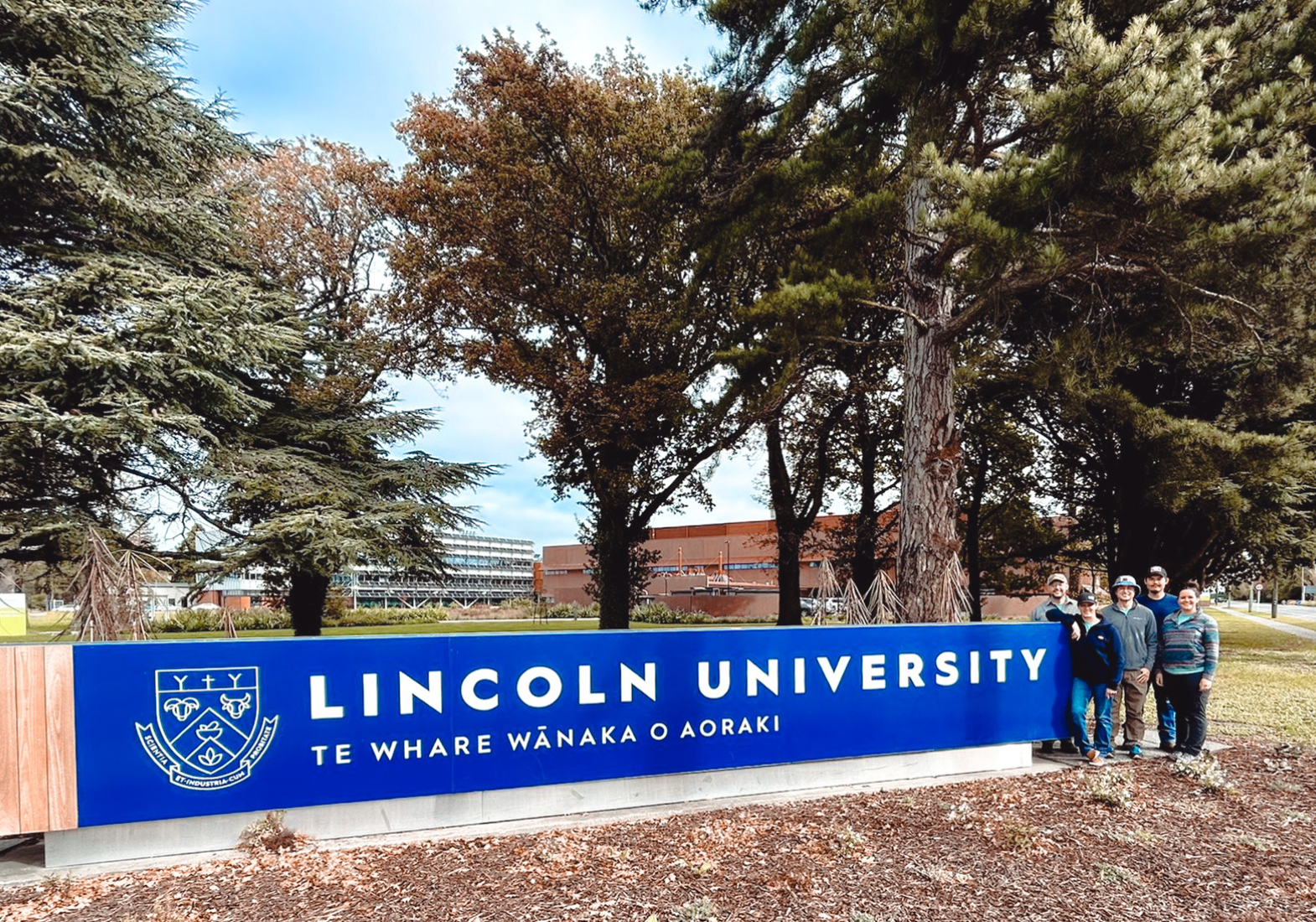
Like many university faculty, Stewart applied for a sabbatical to pursue international scholarship and professional development opportunities. He chose to collaborate with Lincoln University’s sheep program and Beef + Lamb New Zealand, which offers services similar to those provided by university cooperative extension systems in the U.S.
In addition to pursuing his own professional development opportunities, Stewart helped facilitate an exchange program allowing Wyoming ranchers and UW colleagues to visit New Zealand and interact with farmers, industry representatives, and colleagues at his host university.
For Stewart, it was obvious: if he had the opportunity to pursue life-changing educational experiences, shouldn’t he share those opportunities with clientele and colleagues back in Wyoming?
Shared challenges and opportunities
Nine Wyoming producers and five UW faculty members participated in the 2025 Sheep Innovators Exchange.
Kate Harlan, who operates a sheep ranch outside Kaycee, served as co-chair for the exchange, helping coordinate logistics stateside for the producer group. She and her cohort traveled to New Zealand in July 2025 for a five-day tour of Christchurch and South Island, which included visits to working farms and value-added processing facilities.
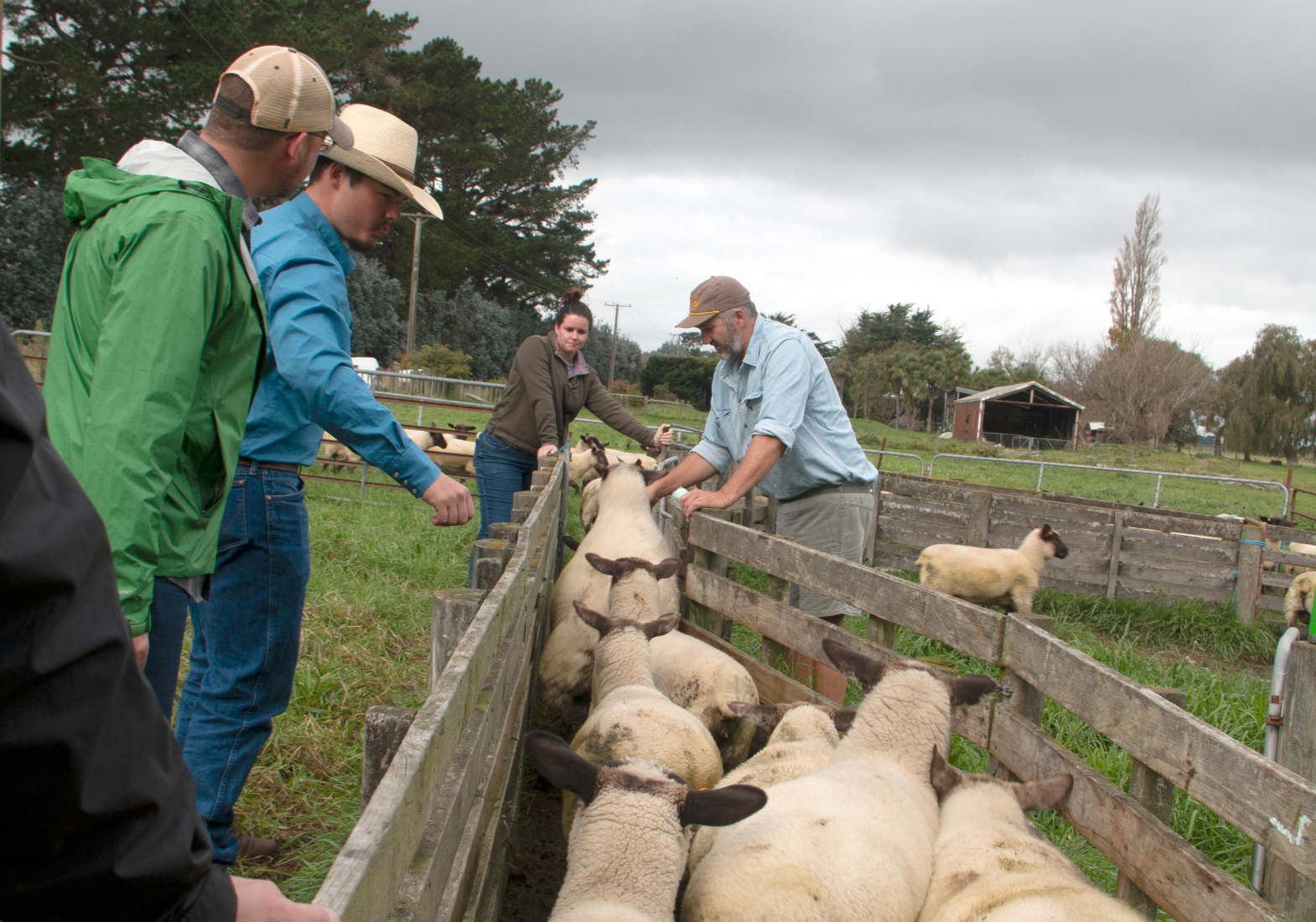
Highlights included touring a permanent shearing barn—a novelty to Wyoming ranchers accustomed to mobile shearing trailers—as well as visiting a cadet training farm.
Harlan was particularly impressed by the cadet farm, which provides a two-year training program for future livestock producers. In addition to receiving hands-on instruction in handling livestock and training stock dogs, students learn bookkeeping and business management.
Harlan thought that the marketing and product consistency modeled by producers certified by companies like New Zealand’s Lumina Lamb could be useful at home as well.
But the trip wasn’t just about learning how things were done in New Zealand. In addition to touring farms and industry sites, Harlan and fellow Wyoming producer Justin Vincent co-led a Q&A session at an annual industry event.
Their audience was amazed to hear about challenges like predator management—a non-issue in New Zealand—and the amount of Wyoming rangeland required to support a relatively small number of sheep.
But, despite the differences in production systems, the Wyoming group found they had much in common with their New Zealand counterparts.
“It’s really easy to point out the differences, but at the end of the day, we’re all sheep producers, we all have the same problems,” Harlan comments.
Micah Most, a UW Extension educator based in Johnson County, agrees. “It was reassuring to know there are challenges everywhere,” he says. “I think it was good to see that there are other people around the world practicing this form of agriculture, making it happen, which is how things work here too.”
Most and his UW colleagues participated in a separate 10-day tour, which included on-farm visits with producers, meetings with Lumina Lamb and the wool broker Zentera, and observation of Beef + Lamb New Zealand programming.
“It’s a good place to go look at what an ideal system could look like,” Most comments. “Now we can apply some of what we learned in a different context and see how we might be able to make big-picture ideas work.”
Producer-to-producer learning
In addition to learning about different production systems, approaches to data collection, and product branding, the UW educators returned with new ideas about how to deliver extension programs.
Like Stewart, who worked closely with Beef + Lamb New Zealand during his sabbatical, the extension educators were struck by the organization’s emphasis on farmer-to-farmer learning.
“So often, we think we have to be the subject matter experts when really we don’t,” Stewart says. “We can plug in the science and clarify some things, but the practice—how people apply certain management practices or resources—is where all the magic is happening. Who’s better to teach than the very people doing it?”
Rather than delivering lectures, Beef + Lamb New Zealand representatives typically serve as facilitators for conversations between producers sharing their experiences.
This approach resonated with McKenna Julian, a UW Extension educator and sheep producer based in Lincoln County. Like Most, she is a founding member of the UW Extension Sheep Task Force.
“Getting down into small intimate conversation with producers, figuring out what’s at the heart of the problem and how we can help—that’s the highlight of my job,” she says.
While Julian recognizes that extension services look a little different in New Zealand, she hopes to work with local ranchers to facilitate more peer learning opportunities at home.
“Having producer-to-producer learning goes way farther than Whit or I just standing up in front of the room,” she notes. “We’ll do some of that, but we want [participants] to talk, bounce ideas off each other, form these connections.”
Expanding international connections
Julian and her extension colleagues were joined on their New Zealand tour by Dylan Laverell, UW alum and former UW Sheep Program assistant.
Prior to serving as an instructor in the Sheep Program, Laverell completed undergraduate and graduate degrees in UW’s animal science department with Stewart as his adviser. Heading into the New Zealand Sheep Innovators Exchange, he’d been considering a few different PhD programs but hadn’t made a final decision about where to pursue his doctorate.
Thanks to Stewart, Laverell met several Lincoln University researchers during the New Zealand tour as well as visiting farms and meeting with industry representatives.
Less than a year later, he moved to Canterbury to become a PhD student at Lincoln, studying grazing systems with diversified forage.
For his part, Stewart isn’t content to organize a one-time international program, declare it a success, and move on. Instead, he’s already scheming about future exchanges, potentially bringing Wyoming ranchers and educators to other countries as well.
“That’s the beauty of working with Whit,” Laverell comments. “He recognizes that extension needs to be adding value back to producers…and when we expand horizons, we’re elevating everyone up with us.”
Harlan, for one, is on board. “Any time you do a trip and any time you go somewhere new, whether it’s next door, or the next state, or the next country, you learn something new to bring back,” she comments.
“The opportunity to go there and be a student again and even challenge some of your preconceived notions is really healthy,” Stewart adds, reflecting on his own time in New Zealand. “You reignite what makes you passionate and it’s the people, it’s the livestock, it’s the continuing a livelihood that is under threat…Yes, the science is important and application of the science matters, but it’s really about relationships.”