
Distinguished Alumni Award: Diane Shober
Published September 23, 2026
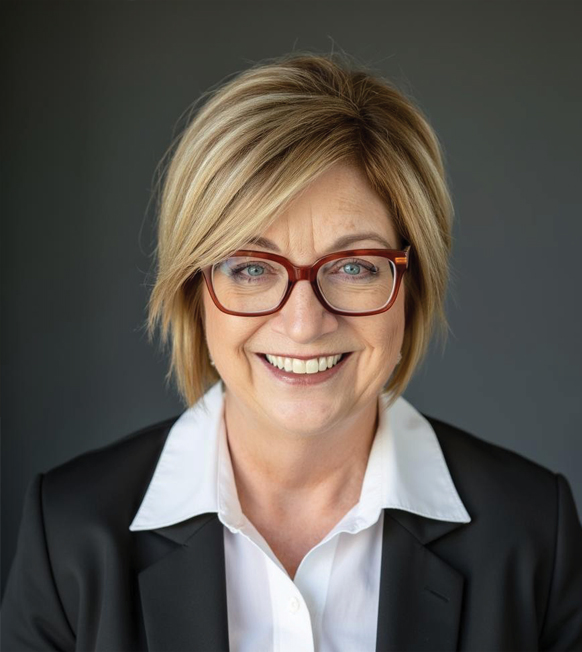
Diane Shober, a Distinguished Alumni Award recipient (Courtesy photo)
By Tamara Linse
The tension that is global reach grounded in a small place defines Diane Shober’s
career.
Shober didn’t start at UW. Like many 18-year-olds with something to prove, she enrolled
out-of-state first, at Montana State. “I was like many students: ‘Oh, we need to get
away and break away,’” she says. After a year, she transferred to UW to finish her
degree, and what she found surprised her — that many of her closest friends from Gillette
were on campus. Not only that but there was a network of people from all over Wyoming
and beyond who also became her closest friends. “Being at UW is not like you’re at
a university — because it’s small and everybody’s so interconnected,” she says. “It
can be as global as you want it to be, and it can be as intimate as you want it to
be.”
Shober grew up in Gillette, the daughter of a World War II bomber pilot who survived
being shot down over the Ploieşti oil fields and spent months as a prisoner of war.
In the early 1970s, her mother walked into a Gillette bank to ask for a business loan,
but the loan officer would only speak to her husband. Through sheer determination,
she was able to get her business loan anyway and went on to run the Flower Hut for
decades. “She never saw herself as a trailblazer,” Shober says, “but she was.” This
quiet and stubborn competence became model for Shober’s own career.
At UW, Shober earned a marketing degree from the College of Business — a versatile
degree, she says. An advanced management course taught by a visiting professor changed
her trajectory. There was no international studies program at the time, but her professor
invited her to apply to a summer program in Manchester, England. She spent a summer
abroad studying international marketing and economics. “That exposure came at a time
that would not have been afforded to me through the University of Wyoming,” she says,
“but it came to me through the University of Wyoming.”
After graduation, her career included pharmaceutical sales in Denver, hotel sales
in Gillette, event marketing at CAM-PLEX, and running a performing arts nonprofit
and working in a convention and tourism bureau work in Chicago. Each stop added what
she calls “arrows in the quiver.” She was eventually drawn back to Wyoming. In 2003,
a tip from friends back home led her to apply for the top job at the Wyoming Office
of Tourism under newly elected Gov. Dave Freudenthal. She got it and stayed for 22
years.
Under her leadership, the Wyoming Office of Tourism’s budget grew from under $3 million
to nearly $20 million annually, and visitor spending climbed to roughly $4.9 billion
a year, making tourism the state’s second-largest industry and supporting more than
30,000 jobs. She built the “That’s WY” brand campaign, helped pass the statewide lodging
tax that gave the office a dedicated funding stream, and represented Wyoming nationally
as a founding board member of Brand USA and president of the National Council of State
Tourism Directors.
People who worked alongside her describe something harder to quantify. Freudenthal
recalled that Shober inherited an Office of Tourism under threat. She had to prove
it or lose it, and that she did — she spent two decades converting skeptics into believers.
Former Gov. Matt Mead said that keeping her on as director was “the easiest question
I ever fielded.” Gov. Mark Gordon called her “synonymous with Wyoming Tourism.”
Shober is good at what she does: selling the state of Wyoming. It takes the same rigor
as any other marketing discipline — data, strategy, a clear sense of audience — applied
to a place she loves. “Once you have it in your blood,” she says, “it’s hard to get
out.”
Shober served on the College of Business Advisory Board. During that time, she and
others asked the question, why didn’t Wyoming’s flagship university have any academic
program connected to its second-largest industry? That advocacy, sustained over multiple
deans and several university presidents, eventually became the outdoor recreation
and tourism management degree and, ultimately, the Jay Kemmerer WORTH Institute —
for which she helped raise an early matching gift and on whose advisory committee
she served for eight years. Now that she’s retired, she’s actively involved in the
relocation efforts to bring the PRCA and the Pro Rodeo Hall of Fame Museum to Wyoming,
work she sees as a direct extension of everything she spent two decades building.

The University of Wyoming has earned its Research Level 1 (R1) status from the Carnegie Classification of Institutions of Higher Education, placing Wyoming's only four-year university with the top research universities in the United States.