
Major Gift Has Major Impact
Published September 23, 2026
Alums Carol and Ramon Tomé built their highly successful lives far from Wyoming, but they never forgot their alma mater, providing one of the largest gifts UW has ever received.
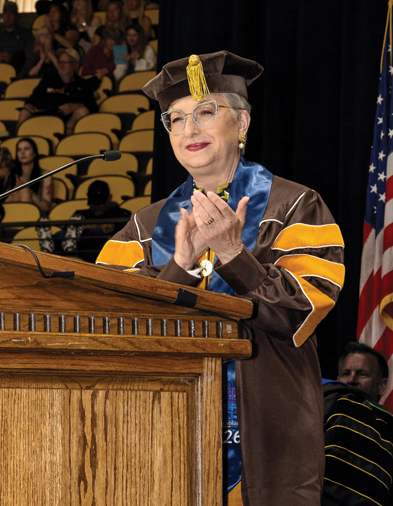
UW commencement speaker Carol Tomé announced a $20 million gift, one of the largest in the university’s history, during the ceremonies. (Photo by UW Foundation)
By Tamara Linse
Last spring, thousands of people filled the seats for the University of Wyoming’s
commencement, an important milestone that marks the transition from students to alumni.
Graduates fidgeted with tassels and programs, families clapped and cheered, and keynote
speaker Carol Tomé, class of 1979, walked onstage to do what commencement speakers
do: offer hard-won advice, make people laugh, and inspire those in the chairs and
in the seats.
Then she surprised everyone — she announced a gift from herself and her husband, Ramon, to UW in the amount of $20 million, the latest in a long line of gifts. It is one of the largest gifts in the university’s history, which will benefit the Tomé Scholars to Fellows Program in the Haub School of Environment and Natural Resources, the creation of which was funded by the Tomés in 2021. The gift also extends the program to the College of Business. Based on current estimates, more than 100 students will receive full-ride scholarships, removing financial barriers and empowering future leaders to pursue their education and career goals at UW.
Carol is the CEO of UPS and former chief financial officer of The Home Depot, and Ramon is a retired environmental specialist with the Georgia Department of Natural Resources Air Protection Branch. They are both proud UW alumni, and Carol jokingly shared in her speech that their lifelong partnership began at a fraternity toga party in Laramie.
This is the story of two people who, years ago, sat in similar seats and are now dedicating
themselves to supporting something they strongly believe in: making sure the doors
that opened for them will stay open for future generations.
The Tomé Scholars to Fellows Program
The Tomé Scholars to Fellows Program began at UW in 2021 with a $600,000 gift from the Tomés through their Tomé Foundation, establishing a scholarship initiative in the Haub School. The program has been expanded twice since 2021. A 2024 gift from the Tomés doubled the number of scholars per cohort and created a new staff position dedicated to recruiting and supporting them.
This year’s $20 million commitment extends the model beyond the Haub School to the College of Business, which will welcome its first cohort in fall 2027.
“The generosity of Carol and Ramon Tomé has already had a significant impact on five previous cohorts of scholars connected to the Haub School of Environment and Natural Resources, UW and our state,” says John Koprowski, dean of the Haub School. “The ability to have our future leaders learning on the wild and working lands of Wyoming and engaging with our natural resources and wonderful citizens provides an incredibly unique experience to understand the opportunities and challenges in the most beautiful living laboratory — the state of Wyoming.”
The idea was to support first-time students with talent and drive in science, technology, engineering, arts and math, including medicine and nursing, and to clear obstacles to their success. Recipients receive 100 percent of tuition, room and board for four years, plus funding for unique experiences such as international field courses, undergraduate research projects, study abroad or other opportunities students may otherwise not be able to afford.
The program does more than just pay tuition. Each cohort works directly with the Haub School dean and faculty throughout the students’ four years on campus, and graduates don’t simply walk away with a diploma — they become Tomé Fellows, joining a national network of scholars and a meaningful relationship with Carol and Ramon that follows them well past commencement.
Tomé Scholars are among the nation’s most distinguished undergraduate students in environmental leadership and problem-solving. Scholars complete immersive fieldwork, faculty-guided applied research, internships and service experiences that prepare them for careers in conservation, policy, business and community leadership. Five cohorts have entered through the Haub School program so far, the first of which graduated in the spring of 2025.
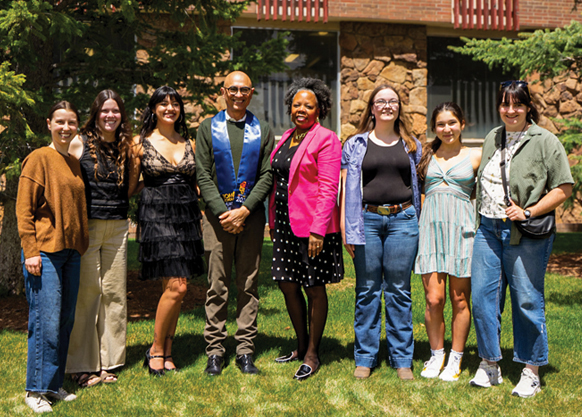
Tomé Scholars Norah McDowell, Gabriella Paterson, Paula Medina, Bailey Yeager, Mariela
Via-Reque and Jennifer Bautz with Ramon Tomé (center) and Tomé Foundation Executive
Administrator Barbara Daniel
(Photo by UW Foundation)
Student Support Means Student Success
Here are the stories of some of these students.
Jennifer Bautz, Lander, Wyo. – Bautz was one of just four students chosen for the inaugural Tomé Scholars cohort in 2021, and now she belongs to the very first UW class of Tomé Fellows, as she graduated in spring 2025 with a degree in environmental systems science. Before the scholarship came through, Bautz had a plan worked out for paying her own way: “I was originally planning to pay for college myself through savings, scholarships and part-time jobs. Piecing together funding for college has been a great challenge, and I welcomed the opportunity presented by this scholarship. Being a Tomé Scholar helped me to focus primarily on learning and spend less time seeking funding.” That shift — from juggling jobs and tuition worries to simply being a student — is, by her own account, what let her use her four years at UW the way she’d hoped: building toward a career devoted to making sure future generations have the same access to Wyoming’s public lands that she grew up with.
Bailey Yeager, Buffalo, Wyo. – Yeager grew up on a multigenerational ranch outside Buffalo, where caring for livestock and land was paramount: “If you don’t care for the land, the land wouldn’t care for you or your livestock. We always spend a lot of time outside with our livestock or doing the various chores that come from having them. We see the land change throughout the years — for the good and the bad. I care about following this legacy.” Yeager is a junior studying rangeland ecology and watershed management at the Haub School alongside environment and natural resources and honors. She’s also candid about why representation matters in a field that has long been underrepresented by women. “Not enough women are in the natural resource field,” she says. “Getting people to take my study choice seriously, as a woman, has been a fight. They don’t see women in natural resources. I want to be one of the people who changes that.”
Benjamin Piña, Houston, Texas – Piña’s path to UW touched three states and two continents
before he ever set foot in Laramie. Born in South Florida to a third-generation Swedish
mother and a Venezuelan father and raised between North Carolina and Texas, Piña arrived
at the Haub School in 2021 as one of the program’s first four scholars, drawn by a
desire to study environment and natural resources and to explore what he calls “human
connections to the natural world.” For Piña, the scholarship was never only about
his own education — it was about his entire family. “Four years of support hugely
relieved financial pressures on my family,” he says. “I joined two other siblings
working through college as we support extended family in Venezuela and across South
America in diaspora from the current crisis.” For him, as for the other recipients,
dollars aren’t the whole story: “Even beyond the financial support, I value the community
and mentorship aspect of close connections with Dean Koprowski, fellow scholars and
donors who believe in me.” Piña graduated alongside Bautz in the program’s inaugural
class of Tomé Fellows in 2025.
What Comes Next
Bautz, Yeager and Piña are three students out of dozens who have come through the
Haub School’s doors as Tomé Scholars since 2021 — and, after this year’s $20 million
commitment, the program is poised to reach a great many more. Former UW President
Ed Seidel called it one of the most consequential gifts the university has ever received
— not just for its size but for what it sets in motion: a chance to prove that the
same model that built leaders in conservation and environmental policy can build leaders
in business and entrepreneurship, too.
Starting in the fall of 2027, this program will include UW’s College of Business, where a new cohort of scholars will pursue business innovation, entrepreneurship and applied research, all with the same full-ride support.
“Carol and Ramon Tomé understand something fundamental about higher education: Talent is everywhere, but opportunity is not always evenly distributed,” says Scott Beaulier, the H.A. “Dave” True Jr. Family Dean of the College of Business. “This extraordinary investment in our students will help the College of Business attract, develop and launch the next generation of leaders for Wyoming, the nation and the world.”
Five cohorts in, the program has become a national model for what applied interdisciplinary learning in the environmental sciences can look like. Tomé Scholars have measured watersheds, monitored wildlife habitat and built sustainable economic development plans for communities across the state.
What the official description of the program doesn’t quite capture is what it means for an 18-year-old in Sheridan or Cheyenne or Denver, who has the drive but not the means, the student who would otherwise have had to balance college with a part-time job and mounting school debt. Instead, they get to measure it against a fieldwork season in the Wind River Range or a summer internship building a business plan for a hometown that needs one. That, more than the amount of the gift, is what the Tomés are supporting.
“We believe deeply in what a University of Wyoming education makes possible,” say the Tomés. “Supporting Tomé Scholars has been one of the greatest joys of our lives, and this commitment is our way of giving back for the many blessings we’ve received. It is an honor to help open doors of opportunity for students who will shape our future.

The University of Wyoming has earned its Research Level 1 (R1) status from the Carnegie Classification of Institutions of Higher Education, placing Wyoming's only four-year university with the top research universities in the United States.