
Research Roundup
Published September 23, 2026
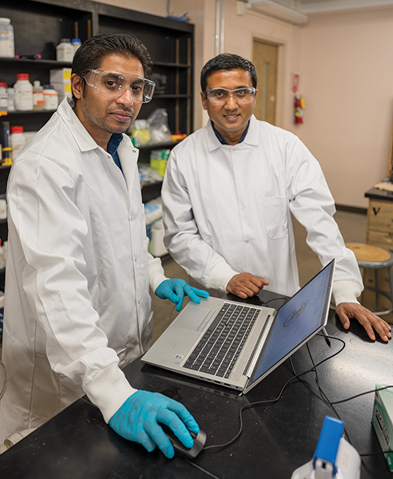
Principal investigator Debashis Dutta works with graduate student Amit Acharzo
The goal of the National Science Foundation’s Seed Translational Acceleration of Research (STAR) Project awards, provided under the Accelerating Research Translation (ART) award, is to build translational research capacity and infrastructure for U.S. institutions of higher education and to enhance their role in regional innovation ecosystems. UW is among the first cohort of awardees. The projects have strong commercial potential and industry support. Read about all the projects.
Three STAR projects:
Higher Accuracy Flu Testing Kits
Infections of influenza, or the flu, are commonly diagnosed using rapid influenza
diagnostic tests that are inexpensive but often produce false-negative results due
to their poor sensitivity, requiring that their outcomes be validated with advanced
tests. In the project “Development of a Sensitive Lateral Flow Immunoassay Device
for Analyzing Nasal Swab Samples Collected on a Dissolvable Surface,” principal investigator
Debashis Dutta, graduate student Amit Acharzo and their team demonstrated a more-than-20-fold
improvement in results using their new test. The proposed method also reduces reliance
on user skills for performing the tests, cutting down variability in test results.
The new test is currently being used at clinics in Laramie. It has the potential to
save $100-$200 per incident in testing costs. It can also improve treatment with reliable
results within 15 minutes.
Turning Liquid Medicines into a Dry State
From vaccines to genetic disorders, RNA-based medicines have applications in many
aspects of human health and disease. However, a major drawback of these new medicines
is the need to keep them frozen, making these medicines reliant on a robust cold chain.
Led by Thomas Boothby and graduate student Tyler Gonzalez — with the company partner
Sigma Genetics — “Cold-chain free Stabilization of RNA-Lipid Nanoparticle Formulations”
looks to keep these new medicines stable in a dry state, making them much less sensitive
to temperature and allowing them to be stored at room temperature. This would allow
these medicines to be shipped and stored more easily as well as to be distributed
to areas with less stable electricity or lack of refrigeration. The researchers hope
to achieve these results by applying techniques used by organisms that can survive
extreme drying, such as tardigrades, and to translate that basic biological knowledge
into a product that enables dry-state stabilization of these sensitive RNA-based medicines.
Healing Diabetics’ Wounds Faster
Because people with diabetes often get wounds that won’t heal due to proteins in their
body, a team led by Sreejayan Nair is studying repurposing a known drug, Odanacatib,
for the treatment of nonhealing diabetic wounds. The project, called “Preclinical
Development of Odanacatib for Diabetic Wound Healing,” has the potential to help solve
an unmet need that affects over 6 million Americans per year. Nair’s team is partnering
with WiTii Pharma on the study. Odanacatib is a bone drug that can stop the proteins
and help skin grow back, closing the wound and preventing infections and amputations.

The University of Wyoming has earned its Research Level 1 (R1) status from the Carnegie Classification of Institutions of Higher Education, placing Wyoming's only four-year university with the top research universities in the United States.