
Snapshots: Tarissa Spoonhunter
Published May 20, 2026
Tarissa Spoonhunter, Liliane and Christian Haub Professor
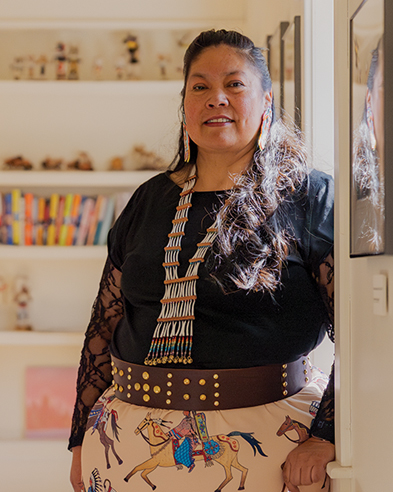
Tarissa Spoonhunter
By Micaela Myers
This past fall, Tarissa Spoonhunter, an assistant professor in the Haub School of
Environment and Natural Resources and the director of UW’s High Plains American Indian
Research Institute, was awarded the inaugural Liliane and Christian Haub Professorship.
The professorship — established through the generosity of philanthropists Liliane
and Christian Haub — is designed to support early-career faculty members in the Haub
School by advancing their research, teaching and outreach while assisting in their
progress toward tenure and promotion. The endowed position will rotate every three
years to recognize a high-performing faculty member, ensuring ongoing support for
extraordinary educators and researchers.
“The Haub Professorship was created to uplift exceptional educators whose work strengthens
both the university and the communities it serves,” Liliane Haub says. “Dr. Spoonhunter’s
leadership and research embody this vision — connecting people, place and purpose
in ways that advance sustainability and respect for our shared environment.”
“It was really a great honor to be named the first Liliane and Christian Haub Professor,”
says Spoonhunter, an enrolled member of the Northern Arapaho Tribe.
Spoonhunter’s research focuses on asserting treaty rights on traditional ceded lands,
while her teaching emphasizes contemporary issues facing tribal nations in resource
management.
“I felt this endowed professorship would really allow the Haub School to make meaningful
connections with the tribes here in Wyoming,” Spoonhunter says.
She explains that there’s a natural connection between the school and tribes, given
that tribes oversee much of the land where oil, gas, water and wildlife are found.
“Environment and natural resources play a big part in tribal nations and how we maintain
our worldview and our connection to our lands,” Spoonhunter says. “Through this professorship,
I have the support to make collaborations happen. It’s been positive for me as well
as my tribal community.”
It’s a natural fit, Spoonhunter says, as the Haub School is all about community. Her
work includes meeting with tribal resource managers to understand the challenges they
face.
“Not only are they dealing with the management of natural resources, but a lot of
times they’re dealing with how to work with ranchers and state and federal agencies
around water, game and fish,” she says. “We want to connect our traditional ecological
knowledge to our conservation, so for me, it’s about how I can support them with community
education and outreach.”
The professorship enables Spoonhunter to increase her impact at UW and beyond while
creating these mutually beneficial relationships with the tribes. Her work includes
educating students and giving them hands-on career experience.
“We are creating that pathway for our students where they can intern for one of our
tribal partners, and now some of our graduates are working for those tribal partners,”
she says. “That’s the biggest thing for our students: helping them stay connected
to their tribal community.”

The University of Wyoming has earned its Research Level 1 (R1) status from the Carnegie Classification of Institutions of Higher Education, placing Wyoming's only four-year university with the top research universities in the United States.