WORTH Institute Economist Facilitates Research Discussion on Measuring the Economic Contribution of Wyoming’s Public Lands
Published March 31, 2026
Senior Research Economist Morgan Holland of the University of Wyoming’s Center for Business and Economic Analysis (CBEA) recently convened a research presentation and discussion focused on methodologies for estimating the economic contribution of public lands in Wyoming. The session, held in partnership with the Jay Kemmerer WORTH Institute, brought together economists and graduate students to critically examine approaches to quantifying the role of public lands in the state’s economy.
Rather than presenting a single definitive estimate, Holland outlined several methodological frameworks that could be used to assess economic contribution. His presentation emphasized the complexity of defining and measuring the value of public lands, particularly given the diversity of ownership structures and land uses across federal, state, and local jurisdictions.
The discussion highlighted the scale and scope of public lands in Wyoming, which include lands managed by multiple federal and state agencies. Public lands support a wide range of economic activities, including outdoor recreation, tourism, agriculture, forestry, energy production and various permitted uses like filming and scientific research.
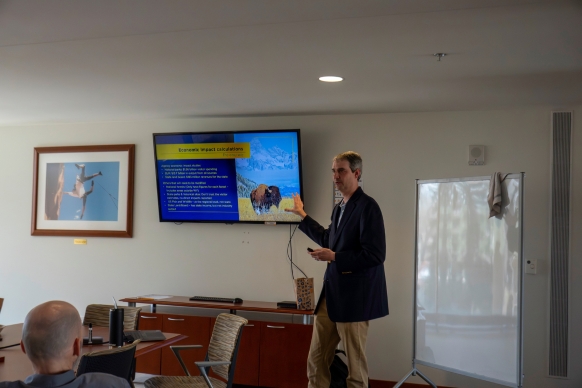
The WORTH Institute's senior research economist Morgan Holland presents his research on the economic contributions of Wyoming's public lands in the Skybridge Meeting Room in the University of Wyoming's College of Business on March 24, 2026.
A central focus of the session was the challenge of defining economic contribution in this context. Holland explored key considerations such as opportunity costs, substitution effects, and the treatment of tourism as an economic export, which is particularly relevant in Wyoming, where tourism employs more people than any other sector. These factors introduce important analytical distinctions that can significantly influence resulting estimates.
Importantly, the presentation was designed as a collaborative research exercise. Holland actively solicited feedback from attendees on the strengths and limitations of different approaches, with the goal of refining methodologies and identifying a defensible framework for future analysis.
“Showing how much public lands contribute to Wyoming's economy is an important part of the conversation around the purpose and value of public lands—not just as part of Wyoming's culture but also as engines of economic production,” Holland said. “I am happy to be in a position where I can contribute to this conversation, and I look forward to hearing from others about what public lands mean to them.”
This work reflects the WORTH Institute’s broader mission to provide timely, applied research that informs decision-making and supports Wyoming’s outdoor recreation, tourism, and hospitality industries. By engaging academic and industry partners in methodological development, WORTH continues to advance rigorous, policy-relevant economic analysis for the state.