
Who's Afraid of Imprecise Sexes?
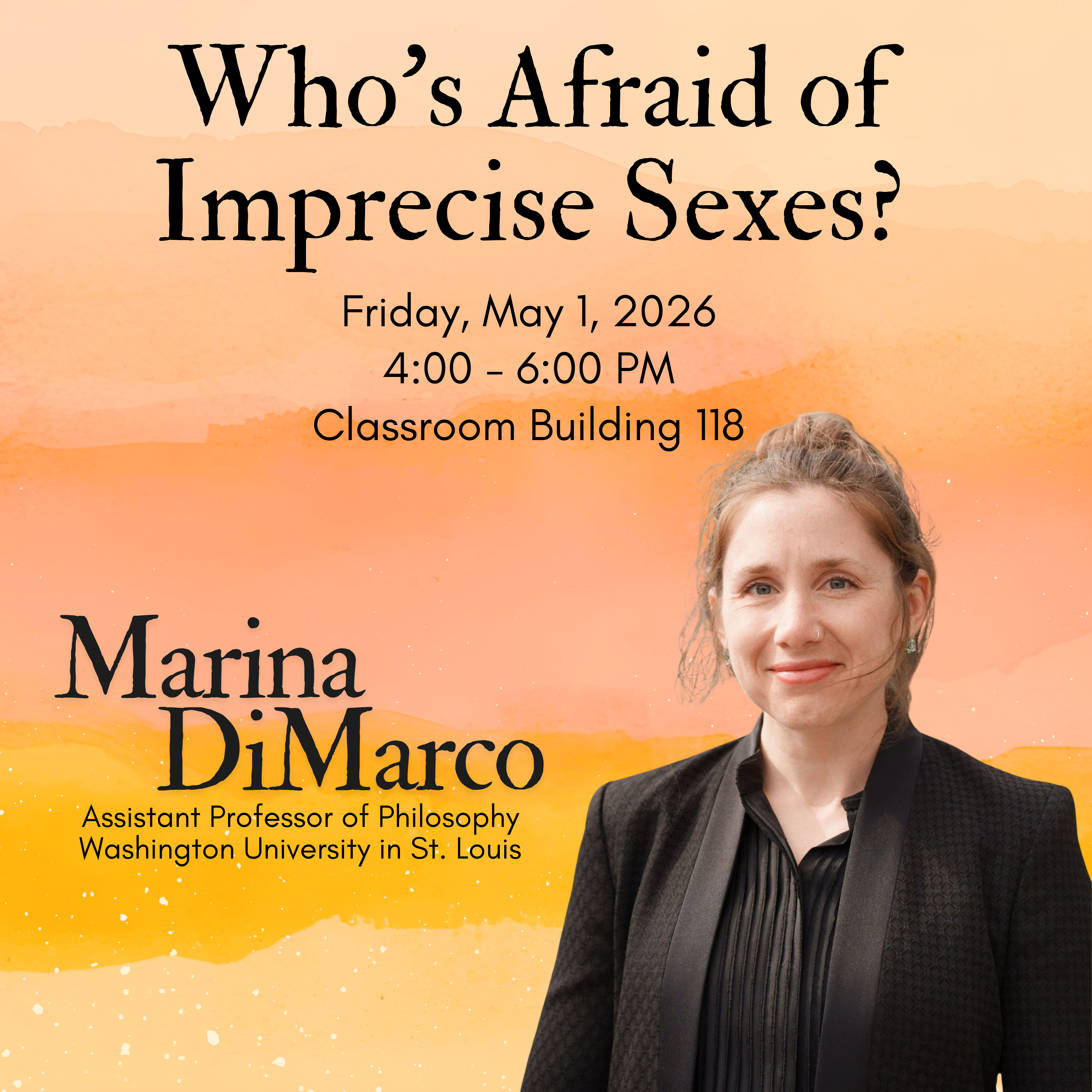
Dr. DiMarco is Assistant Professor of Philosophy at Washington University in St Louis. Dr. DiMarco will speak for one hour, followed by an hour of Q&A.
Dr. DiMarco is Assistant Professor of Philosophy at Washington University in St Louis.
Dr. DiMarco will speak for one hour, followed by an hour of Q&A.
Abstract: Sexes stand accused of many forms of indeterminacy: ‘male’ and ‘female’ might have
multiple meanings, perhaps in different contexts; they might under-specify other relevant
details; their boundaries may be blurry, and so on. One stream of philosophical work
on sexes has thus been concerned to achieve precision and clarity about their meaning(s)
as a scientific concept(s), or to abandon them if this can’t be adequately salvaged.
Against this current, however, some philosophers of science hold that conceptual ambiguity
can be ineliminable and even a feature, rather than a bug. In this talk, I’ll ask
(1) which imprecision arguments might apply to sexes, (2) how this bears on competing
proposals for moving forward with or without them, and (3) what we might learn about
conceptual indeterminacy in general from careful attention to sexes. It turns out
that various arguments for the value of conceptual imprecision depend on different
conditions being met, and that sexes will often struggle to meet them because of their
social, political, and methodological baggage. The upshot for the feasibility and
desirability of competing proposals for the future of sex concepts is that these may
depend on developing surrogates for imprecise sexes in science, changing the world
to better reap the benefits of imprecise sexes, or both.
For those who are interested in the talk and wish to learn more about her work, here
are a few recent articles by Dr. DiMarco on the topic of biological sex:
- Why “sex as a biological variable” conflicts with precision medicine initiatives: Cell Reports Medicine
- Sex in the medical machine: How algorithms can entrench bioessentialism in precision medicine
- Making a ‘sex-difference fact’: Ambien dosing at the interface of policy, regulation, women’s health, and biology
- Sex eliminativism

The University of Wyoming has earned its Research Level 1 (R1) status from the Carnegie Classification of Institutions of Higher Education, placing Wyoming's only four-year university with the top research universities in the United States.