
Kimonos: Strappo Prints by Harold Garde
May 11 – August 3, 2013
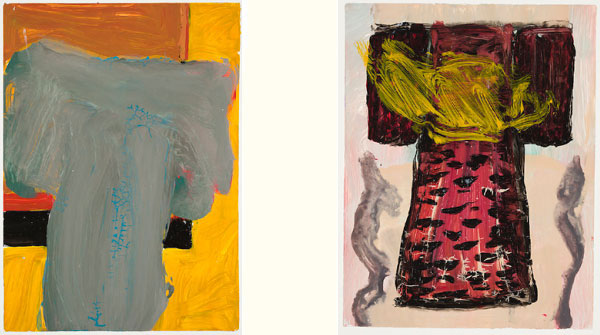
Harold Garde (American, b. 1923), a graduate from the University of Wyoming, creates images that are rooted in abstract expressionism. He leaves the pure abstraction behind and concentrates instead on finding and conveying the beauty of simple shapes. Garde usually works in a series by using tangible objects and symbols as recurring subjects that engage and elicit a personal response from the viewer. In his series of kimonos he explores the ‘T’ shape of the garment and creates a mixture of variations from bold to subtle.
To create the strappo print, a technique he invented, Garde paints in reverse on a piece of glass, adding layers and finally peeling off the smooth result. On the finished print the top layer of paint is actually the first layer applied; the opposite of a painting. This allows Garde to carefully consider each stroke of color applied. Garde is a painter’s painter. He is interested in what paint can do, making marks that expressively respond to his thoughts and actions.
- Exhibition premier for Touring Exhibition Service; available fall 2013
Images:
(Left) Harold Garde (American, b. 1923), Gray Kimono, not dated, Strappo print, 6-3/4 x 5 inches, lent by the artist
(Right) Harold Garde (American, b. 1923), Heavy Kimono, not dated, Strappo print, 9 x 7 inches, lent by the artist
Funded in part by FMC Corporation and UW Art Museum Gala Funds.


The University of Wyoming has earned its Research Level 1 (R1) status from the Carnegie
Classification of Institutions of Higher Education, placing Wyoming's only four-year
university with the top research universities in the United States.
The University of Wyoming Art Museum has been accredited by the American Alliance of Museums (AAM) since 1976. This accreditation recognizes the Museum's commitment to excellence,
high professional standards, and continued institutional improvements.