
Nature Morte: Still Life Masterpieces from the Art Museum Collection
May 11 – August 24, 2013
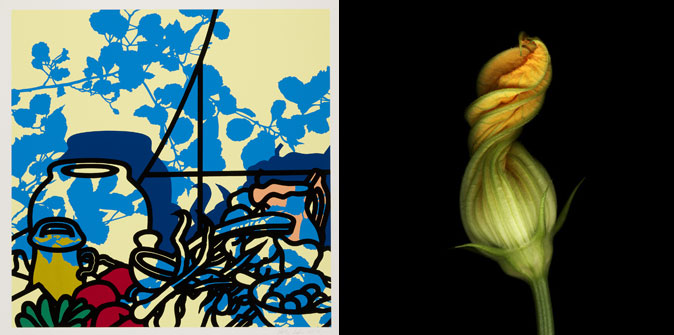
Classically defined as a work of art depicting inanimate, typically commonplace objects that are either natural, such a food and flowers, or man-made, such a books and vases, the still life remains an academic tradition of art in all mediums. As an artistic genre, the still life has served as a means for artists thought the centuries to assess and experiment artistically and as a means to express often-profound ideas on time, life and nature.
Drawn from the Art Museum collections, this exhibition explores aesthetic and conceptual artistic strategies that challenge the view that the still life is simply an art of imitation. Presenting the still life in a variety of mediums, including painting, photography, drawing and printmaking, from historic to contemporary, Nature Morte: Still Life Masterpieces from the Art Museum Collection underscores why the genre continues to be an important vehicle of expression.
Images:
(Left) Patrick Caulfield (British, 1936-2005), Still Life Ingredients (65/76), 1978, serigraph, 21 x 21 inches, gift of Mr. Gerry Levenberg, University of Wyoming Art Museum Collection, 1980.170
(Right) Edvard Koinberg (Swedish, b. 1964), Cucurbita pepo (31/100), 2001-2008, archival pigment print, 13 x 13 inches, UW Art Museum Purchase, University of Wyoming Art Museum Collection, 2012.4.2
Funded in part by UW Art Museum Gala Funds.


The University of Wyoming has earned its Research Level 1 (R1) status from the Carnegie
Classification of Institutions of Higher Education, placing Wyoming's only four-year
university with the top research universities in the United States.
The University of Wyoming Art Museum has been accredited by the American Alliance of Museums (AAM) since 1976. This accreditation recognizes the Museum's commitment to excellence,
high professional standards, and continued institutional improvements.