

WHAT IS IT LIKE TO STUDY HUMAN DEVELOPMENT?
Human Development and Family Sciences (HDFS) is a captivating field that explores the intricate dynamics of human growth, relationships, and family systems. One of the key aspects of HDFS is its interdisciplinary nature. Drawing from psychology, sociology, anthropology, and other disciplines, students examine human development through a holistic lens, considering the interplay of biological, psychological, and sociocultural factors. HDFS delves into the physical, cognitive, emotional, and social changes that occur from infancy through old age. Through hands-on work in developmental psychology, sociology, and family studies, students gain a deep understanding of how individuals evolve and interact within various contexts, such as family, culture, and society. ADD THIS MINOR
FREQUENTLY ASKED QUESTIONS
Consider adding this hands-on minor to complementary degree programs such as degrees in Psychology, Sociology, Anthropology, Education, Social Work, Public Health, and Counseling. Whether pursuing careers in counseling, social work, education, healthcare, or public policy, the knowledge and skills gained through an HDFS minor provide a strong foundation for making a positive impact on individuals and families' lives.
Here are seven of the most frequently asked questions regarding our Human Development and Family Sciences minor:
You’ll study human growth, family dynamics, relationships, and the social factors that influence well‑being across the lifespan. View the University's catalog for a list of required courses.
Absolutely—students in education, psychology, health sciences, social work, public administration, and many other majors find it highly complementary.
Yes—understanding human behavior and family systems is valuable in fields like healthcare, counseling, education, community services, and leadership roles.
The minor can be completed with 22 credit hours. More information on course requirements can be found in the University course catalog.
Yes—The three required introductory classes require either PSYC 1000 or SOC 1000. Other classes that build off of these three required classes have varying pre-requisites within the HDFS unit. More information can be found in the University's course catalog.
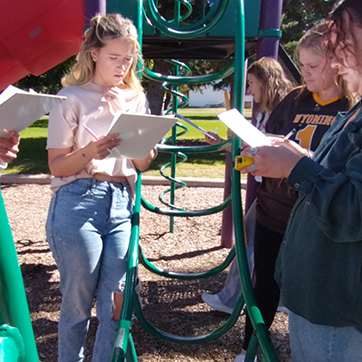
In many cases, yes. Our program prides itself on teaching the practical value of the study of Human Development and Family Sciences. In our on-campus classes, students engage in a wide variety of activities that mix active learning and hands-on experience with academic studies.
The minor requires 3 introductory classes + 4 HDFS electives. Students can choose to tailor their minor by selecting their electives from a choice of 13 classes that explore aging and development, family policy, or community leadership (for example). Here are some more course options...

The University of Wyoming has earned its Research Level 1 (R1) status from the Carnegie Classification of Institutions of Higher Education, placing Wyoming's only four-year university with the top research universities in the United States.