
Incorporating Study Abroad into International Research on Social Work
Published March 12, 2026
Dr. Neely Mahapatra is a professor in the Division of Social Work at UW. She researches violence against minority women, refugee and immigrant populations, human trafficking, international social work, social network sites and mental health of college students, social and public policy, and social justice. Dr. Mahapatra outlines outlines how leading study abroad programs supports her international research:
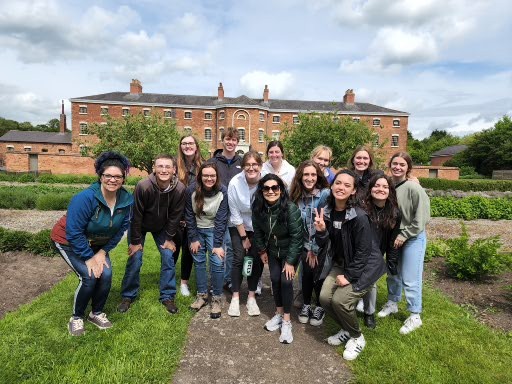
Students at the historic Southwell Workhouse, Nottinghamshire, England.
My program of research includes international social work education, international research, and support of international students in the U.S., besides identifying best prevention practices/strategies to stop and end intimate partner violence (IPV) and victimization against women in immigrant communities in the U.S. and the immigrant diaspora. Additionally, my research also addresses the needs of victims/survivors of human trafficking in Wyoming and in the U.S.
Over the past decade, I have co-led a highly successful study abroad program with a strong desire to increase students’ cultural and global awareness, competence, and knowledge. This program aims to familiarize students with the social, economic, and political forces that have shaped the development of the social welfare system in England and its influence on U.S. social welfare. Data collected over 3 years and from 8 study abroad programs, including ours at UW, to understand the impact of Short-Term Study Abroad (STSA) programs on intercultural competence of students found an increase in cross-cultural knowledge, skills, and attitudes among the student participants (Mahapatra et al., 2025).
In 2025, I embarked on an exploratory study to create new knowledge and develop best practices for South Asian immigrant women in London/UK who experience transnational marriage abandonment (TMA), which is a form of IPV. It highlights the significance of gender-based violence, migration policies, legal protection, and cultural shifts in understanding and combating transnational abandonment. The limited research conducted so far has not adequately captured the role of South Asian community-based organizations, which play a significant role in providing crucial support to this group of women. Preliminary findings indicate major themes such as types of abuse, culturally specific outreach, access to training, lack of community support of TMA victims/survivors, and overarching immigration laws/policies. This informs future efforts to strengthen practice around service delivery and coordination, policy changes to support TMA victims/survivors’ rights, train frontline workers/social workers about TMA, and develop research capacity surrounding the issue.
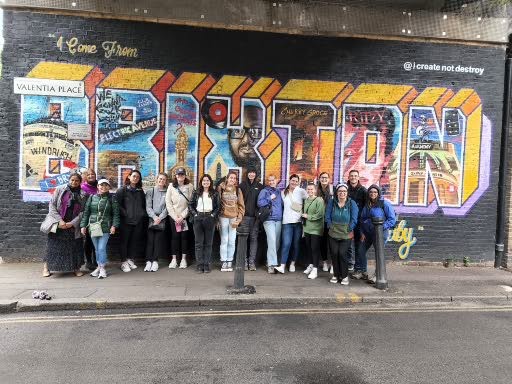
Students on an ‘Immigration Tour’ in the vibrant and multicultural neighborhood of Brixton, London.
Currently, I am obtaining information from students who have been a part of a study abroad program (or are currently enrolled in a study abroad program) about how they have engaged in ‘experiential learning’ as part of the course. Additionally, the study gathers information about how faculty members, who have taught or led a study abroad program or are currently teaching/leading a study abroad program, incorporate ‘experiential learning’ as part of their course content (both field-based and classroom-based). Recently I also completed collecting data from international students, scholars and their spouses/partners, those who have experienced IPV while at UW, and those who have not experienced IPV to help understand their help-seeking behaviors, including barriers that have prevented them or might prevent someone from seeking help. Analysis is ongoing.
I continue to develop and sustain impactful research that is focused on global engagement and education, improve the status of victims/survivors of violence in the U.S. and internationally, and advance meaningful collaborations with various stakeholders. In conclusion, I am deeply grateful to UW, the Division of Social Work, the Center for Global Studies, the Global Engagement Office, and International Students and Scholars Office for supporting my research and scholarship.

Global Engagement Office | Center for Global Studies | Education Abroad | International Students & Scholars | English Language Center