
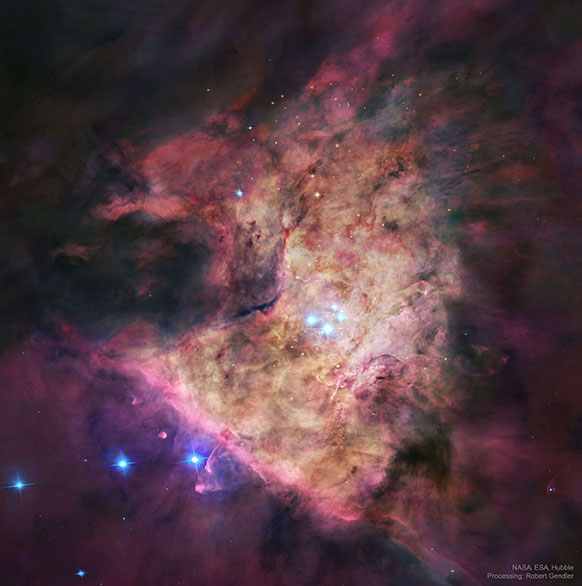
Four bright stars can be found near the center of this sharp cosmic portrait of the Orion Trapezium star cluster. Gathered within a region approximately 1.5 light-years in radius, these stars dominate the core of the dense Orion Nebula star cluster. Orion dominates the winter sky and will be featured prominently during the Wyoming Skies program at 7 p.m. Jan. 20 in the University of Wyoming Harry C. Vaughan Planetarium. (Hubble Legacy Archive Photo)
The University of Wyoming Harry C. Vaughan Planetarium will offer a varied plethora of programming to start off the new year.
“The programs this month will cover a large variety of topics with no particular theme, but will include diverse subjects such as astrophysics, telescopes, space exploration and constellation sky-cultures,” says Max Gilbraith, the planetarium's director. “Each weekend evening, look for your favorite genre or artists, such as The Beatles or Pink Floyd. Our lone Tuesday program Jan. 20 will take a survey of the winter sky constellations and deep sky telescope targets for backyard astronomers. We will tour the rooftop STAR Observatory at 8 p.m. afterward, if weather allows.”
To get tickets or receive more information about programs, email planetarium@uwyo.edu or leave a voicemail and a callback phone number at (307) 766-6506. Tickets are $5 for the public or online tickets, and $3 for students, senior citizens, veterans, first responders and those under 18. Seating is free for children under 5. Bulk tickets/gift cards are available at $2 each when 10 or more tickets are purchased.
Reservations or pre-purchase is not required, and walk-ins are welcome. Tickets can be purchased online with a credit card, reserved by email or voicemail, or purchased at the start of the show. Cash or check is accepted at the door. The planetarium, which seats 64, is in the basement of the Physical Sciences Building. Seating is on a first-come, first-served basis outside of designated ADA/wheelchair seating.
To pay for tickets with a credit card, go to www.uwyo.edu/uwplanetarium/ticket.aspx. For a group larger than six, email the planetarium for a private show at https://uwyo.sjc1.qualtrics.com/jfe/form/SV_bKuqIynOn7gFK2F. Tickets for private shows are the same as the public programs.
A film and special live talk for audiences will be featured each week. All programs are approximately an hour in length. As time allows, a portion of the show also may focus on a live sky tour or supporting information related to the film’s topic.
The January schedule is:
-- Saturday, Jan. 10, 2 p.m.: “Star of the Magi.” Learn about the heavens, wonder and speculate with Chip Kobulnicky, an astronomer and a UW professor of physics and astronomy, as he presents some of the celestial possibilities that may underlie the storied “star that rose in the East” and led the magi to the birthplace of Jesus.
-- Friday, Jan. 16, 7 p.m.: “Big Astronomy: People, Places, Discoveries,” a full-dome movie. The film takes a journey to three world-class observatories in Chile’s rugged Andes Mountains and arid Atacama Desert -- remote, extreme regions that have the perfect conditions for astronomical research. Featured is an inspiring cast of astronomers, engineers, technicians and support staff who keep the megamachines running.
-- Friday, Jan. 16, 8:30 p.m.: “Liquid Sky: Indie Folk,” a music-based light show. Enjoy a custom playlist of “out-of-this-world” indie folk music in 5.1 surround sound. The 4K-resolution planetarium sky melts and becomes a canvas of color, patterns and movement with cutting-edge music visualization software and live VJ talent.
-- Saturday, Jan. 17, 2 p.m.: “We Are Stars” and “The Great Solar System Adventure,” two full-dome movies. “We Are Stars” connects life on Earth to the evolution of the universe by following the formation of hydrogen atoms to the synthesis of carbon and the molecules for life. This film is narrated by Andy Serkis.
During “The Great Solar System Adventure,” join showman extraordinaire “The Great Schiaparelli” as he takes the audience on a death-defying, space-time adventure within his wondrous observatorium. From the sun-scorched surface of Mercury to the icy expanses of Pluto and beyond, the audience will be subjected to the myriad dangers and wonders of our solar system.
-- Saturday, Jan. 17, 7 p.m.: “Dawn of the Space Age” and “Always Above.” The first film explores the launch of the first artificial satellite, Sputnik, the magnificent lunar landings and privately operated space flights.
“Always Above” looks at how much our modern way of life depends on the thousands of satellites that fly around our planet. Orbiting the Earth are satellites that allow us to communicate with one another, monitor the weather, help us get to where we’re going and keep our country safe.
-- Saturday, Jan. 17, 8:30 p.m.: “Liquid Sky: Space Rock,” a music-based light show. Enjoy a custom playlist of “out-of-this-world” space rock music from artists in 5.1 surround sound. The 4K-resolution planetarium sky will become a canvas of color, patterns and movement with cutting-edge music visualization software and live VJ talent.
-- Tuesday, Jan. 20, 7 p.m.: “Wyoming Skies: Losing the Dark and The Winter Sky,” a discussion of the winter sky and a screening of the full-dome movie “Losing the Dark.” Orion is the center point of the constellations seen in the early months of the year. Early sunsets and stable cold air make for excellent observing for those who can brave the cold.
“Losing the Dark,” a public service announcement planetarium show, introduces and illustrates some of the issues regarding light pollution and suggests three simple actions people can take to help mitigate it. The film is a collaboration of Loch Ness Productions and DarkSky International.
After the planetarium show finishes at 8 p.m., informal telescope observing on the rooftop of the Physical Sciences Building at the STAR Observatory will be available, weather permitting.
-- Friday, Jan. 23, 7 p.m.: “Dark Biosphere,” a full-dome movie. Deep beneath the earth’s crust, hundreds of meters or kilometers below the surface -- with no light, no air and very little water, in pores and fissures of hard rock -- scientists have found an enormous biodiversity of microorganisms that thrive in extreme conditions in an area known as the dark biosphere. This film is narrated by actor Viggo Mortensen.
-- Friday, Jan. 23, 8:30 p.m.: “Liquid Sky: Tranquility and Relaxation,” a music-based light show. Enjoy a custom playlist of “out-of-this-world” tranquil and relaxing music from artists in 5.1 surround sound. The 4K-resolution planetarium sky will become a canvas of color, patterns and movement with cutting-edge music visualization software and live VJ talent.
-- Saturday, Jan. 24, 2 p.m.: “The Sun: Our Living Star” and “Europe to the Stars,” both full-dome movies. The sun consumes 600 million tons of hydrogen each second and is 500 times as massive as all of the planets combined. Viewers will discover the secrets of the sun and experience never-before-seen images of its violent surface.
“Europe to the Stars” takes viewers on an epic journey behind the scenes at the most productive ground-based observatory in the world -- the European Southern Observatory -- revealing the science, history, technology and people.
-- Saturday, Jan. 24, 7 p.m.: “One Sky,” a full-dome series of short films. Each short film represents the perspective of a different culture or Indigenous society from around the globe. Each film stands alone as a short story, or in combination, as a longer narrative organized around themes of “finding patterns” and developing tools. Short films are “The Forge of Artemis,” “Thunderbird,” “Jai Singh’s Dream,” “Celestial Canoe,” “The Samurai and Stars” and “Wayfinders.”
-- Saturday, Jan. 24, 8:30 p.m.: “Liquid Sky: The Beatles,” a music-based light show. Enjoy a custom playlist of “out-of-this-world” music from the legendary British band in 5.1 surround sound. The 4K-resolution planetarium sky will become a canvas of color, patterns and movement with cutting-edge music visualization software and live VJ talent.
-- Friday, Jan. 30, 7 p.m.: “The Hot and Energetic Universe,” a full-dome movie. The film investigates the achievements of modern astronomy; the most advanced terrestrial and orbital observatories; the basic principles of electromagnetic radiation; and the natural phenomena related to high-energy astrophysics.
-- Friday, Jan. 30, 8:30 p.m.: “Liquid Sky: Pink Floyd’s ‘The Dark Side of the Moon,’” a music-based light show. Enjoy the classic album in 5.1 surround sound. The 4K-resolution planetarium sky will become a canvas of color, patterns and movement with cutting-edge music visualization software and live VJ talent.
-- Saturday, Jan. 31, 2 p.m.: “Two Small Pieces of Glass: The Amazing Telescope” and “Seeing!,” both full-dome movies. In the first, attendees will learn about the history of the telescope, from Galileo’s modifications to a child’s spyglass -- using two small pieces of glass -- to the launch of the NASA/European Space Agency Hubble Space Telescope and the future of astronomy.
“Seeing!” follows the journey of a single photon as it is produced in a distant star, before traveling across the vast expanse of space to land on someone’s retina. This film is narrated by Neil deGrasse Tyson.
-- Saturday, Jan. 31, 7 p.m.: “Dark Matter Mystery,” a full-dome movie. Dark matter is a theoretical form of invisible mass, which is believed to be present in galaxies, but it has never been seen or detected. This film takes the audience on the biggest quest of contemporary astrophysics: solving the dark matter mystery.
-- Saturday, Jan. 31, 8:30 p.m.: “Liquid Sky: Synthwave,” a music-based light show. Enjoy a custom playlist of “out-of-this-world” synth music in 5.1 surround sound. The 4K-resolution planetarium sky will become a canvas of color, patterns and movement with cutting-edge music visualization software and live VJ talent.
For more detailed descriptions of all programs, go to www.uwyo.edu/physics/planetarium/schedule.html.

The University of Wyoming has earned its Research Level 1 (R1) status from the Carnegie Classification of Institutions of Higher Education, placing Wyoming's only four-year university with the top research universities in the United States.