
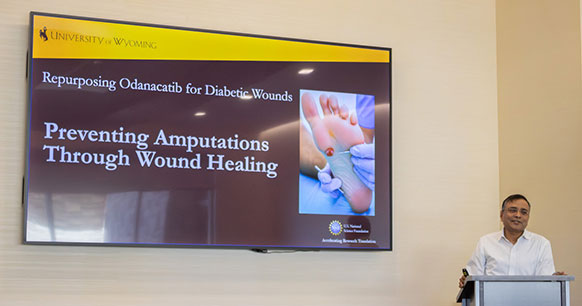
Sreejayan Nair, a professor in the UW School of Pharmacy, makes his presentation, titled “Preclinical Development of Odanacatib for Diabetic Wound Healing,” at the recent Accelerating Research Translation Symposium. The event was hosted by UW’s Research and Economic Development Division April 20. (Michala Drum Photo)
The University of Wyoming’s Research and Economic Development Division hosted the
Accelerating Research Translation (ART) Symposium April 20, an event that focused
on the concept of research translation -- turning scientific discoveries and ideas
into tangible tools, technologies and applications that people can use in everyday
life.
These outcomes are not limited to commercial ventures. They also include public-facing
resources such as improved healthcare treatments; more accurate environmental monitoring;
enhanced agricultural practices; and technologies that support public safety and infrastructure.
The event, supported by a grant from the Technology, Innovation and Partnerships Directorate
of the U.S. National Science Foundation (NSF), highlighted innovative projects aimed
at transforming cutting-edge research into practical solutions that directly benefit
the public.
This emphasis reflects UW’s land-grant mission to generate knowledge that serves the
people of the state and beyond.
“Through research, education and outreach, the university is committed to ensuring
that discoveries made in the lab translate into meaningful improvements for the people
and economy of Wyoming,” says Parag Chitnis, vice president for research and economic
development. “The ART program plays a key role in advancing that mission by accelerating
the delivery of research-based solutions into real-world settings where they can have
the greatest impact.”
The NSF ART program is designed to strengthen the United States’ leadership in science
and economic development by supporting universities in moving research beyond the
lab and into practical use. While commercialization is one pathway, the program also
prioritizes innovations that provide broad societal benefit -- whether through public
health advancements or accessible technologies that improve daily life.
At UW, the ART program emphasizes collaboration among students, faculty, and industry
and community partners to accelerate the path from discovery to application. This
approach not only fosters economic prosperity, but also ensures that research outcomes
are responsive to public needs. Students involved in ART gain hands-on experience
in translating ideas into solutions, preparing them to become leaders in research,
public service and innovation.
The symposium featured eight projects currently funded through the ART program in
the College of Engineering and Physical Sciences; College of Health Sciences; College
of Agriculture, Life Sciences and Natural Resources; and School of Energy Resources.
The project titles, UW faculty members involved and project synopses are:
-- “Improved Hydrogel-Based Plant Growth Substrates for Controlled Environment Agriculture,”
Cynthia Weinig, a professor and Wyoming Excellence Chair in the Department of Botany,
and John Oakey, a professor of chemical and biomedical engineering. This project aims
to develop a superior alternative to traditional rockwool substrates, improving efficiency
and sustainability in plant growth systems.
-- “Final Steps Toward a Commercial Photoacoustic Absorption Spectrometer,” Shane
Murphy, a professor of atmospheric science, and Max Appelbaum, a Ph.D. student in
atmospheric science. The focus is to create a specialized tool that uses lasers and
sound to measure how tiny particles in the air, such as soot and wildfire smoke, absorb
light. This device will be more accurate than older tools and portable, with a goal
to help to better understand exactly how these particles heat the atmosphere, influence
the environment, affect people’s health and affect directed energy systems.
-- “Preclinical Development of Odanacatib for Diabetic Wound Healing,” Sreejayan Nair,
a professor in the School of Pharmacy. Diabetic wounds are notoriously hard to treat.
Nair and his team are working to repurpose a known drug to treat chronic diabetic
wounds, a condition affecting millions of Americans annually.
-- “Stabilization of RNA-Based Therapeutics Outside of the Cold Chain,” Thomas Boothby, an associate professor of molecular biology, and Tyler Gonzalez, a
graduate student studying molecular biology. Researchers are developing methods to
store RNA-based medicines without refrigeration, increasing accessibility and reducing
cost -- especially in resource-limited settings.
-- “Improved Assays for Diagnosis of Flu and Other Diseases,” Debashis Dutta, a professor
of chemistry. False negatives in rapid diagnostic tests for flu and other diseases
are being addressed using advanced lateral flow technology, improving timely and accurate
care.
-- “Full 3D Tomography Software,” Po Chen, an associate professor of geology and geophysics.
This is a novel imaging approach with applications in engineering, geophysics and
medical diagnostics that support safer infrastructure and improved hazard assessment.
-- “Exploration of Potential Uses for Tailings, Byproducts and Co-Products,” Tyler
Brown, School of Energy Resources research program manager. This work identifies new
uses for low-value rare earth element byproducts, supporting resource efficiency and
reducing environmental waste.
-- “Low-Cost Carbon Recovery for Economic Valorization and Development,” Maohong Fan,
a professor of chemical and biomedical engineering. The project aims to reduce the
cost of carbon capture and enable its reuse, contributing to environmental sustainability
and responsible energy development.
The ART Symposium underscored UW’s commitment to advancing research that serves the
public good. By connecting discovery with application, the university continues to
fulfill its land-grant mission -- ensuring innovation leads not only to economic opportunity,
but also to healthier communities and efficient resource use.
For more information about the ART program and ongoing research initiatives, go here.

The University of Wyoming has earned its Research Level 1 (R1) status from the Carnegie Classification of Institutions of Higher Education, placing Wyoming's only four-year university with the top research universities in the United States.