
UW INBRE Program Receives $18.9M NIH Grant for Biomedical Research and Education
Published August 24, 2026
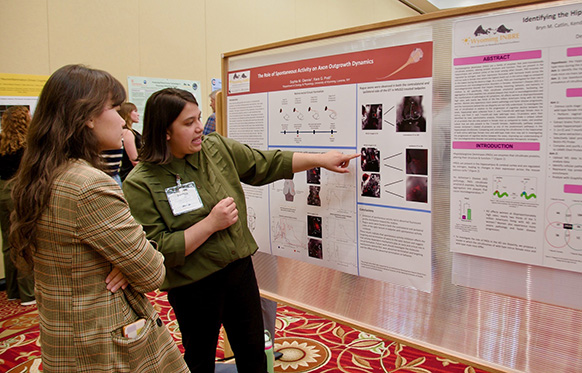
Sophia Glennie (right), a UW undergraduate student from Cheyenne majoring in molecular biology, shows her poster presentation to Jasmin Mahoney, a UW undergraduate student from Gillette majoring in chemistry and secondary education, at the Wyoming INBRE Spring Research Conference in April. The UW INBRE program recently received a five-year $18.9 million grant -- its largest ever -- from the National Institutes of Health to fund biomedical research and education. (Annie Bergman Photo).
Biomedical research and education in Wyoming will be bolstered by the largest single
research grant ever awarded to the University of Wyoming INBRE program -- nearly $18.9
million from the National Institutes of Health (NIH).
The five-year award funds the Wyoming Institutional Development Award (IDeA) Networks
for Biomedical Research Excellence (INBRE) program. The research program will focus on biomedically relevant research areas,
student training, institutional competitiveness and building infrastructure throughout
the state.
The goal of the NIH’s INBRE program is to build and strengthen biomedical research
capacity in states that historically receive low levels of NIH funding. Twenty-three
states, including Wyoming, are eligible for INBRE grants.
“The new grant will maintain its focus on student training and biomedical research
within Wyoming. We’ll continue to support advanced computing capacity throughout the
state, particularly with an eye to artificial intelligence (AI)-based applications,”
says David Fay, INBRE program director and its principal investigator. “Another goal
is to increase scientific collaborations and exchanges between the community colleges
and UW, which we hope leads to these students coming to UW for further training and
degrees.”
The new Wyoming INBRE grant -- totaling $18,892,420 -- began in May and will run through
April 2031. The program is now in its 24th year. In addition to Fay, core Wyoming
INBRE staff members include Nic Blouin, data science core director; Florence Teule-Finley,
program coordinator; Grant Bowman, developmental research project program director;
Annie Bergman, student research program director; Sean Harrington, data science core
staff scientist; Yana Nightingale, administrative coordinator; and Dawn Vialpando,
program accountant.
“I feel fortunate to be able to work with a fantastic Wyoming INBRE team and to have
spent the past dozen years working closely with Dr. Scott Seville, the previous INBRE
director, who taught me the ropes and did an amazing job advocating for this program
at a national level,” says Fay, who also is a UW professor of molecular biology.
Wyoming INBRE funds are shared by 10 campuses around the state, with UW in Laramie
serving as the lead institution. Additionally, state institutions that benefit are
UW-Casper, Casper College, Eastern Wyoming College, Laramie County Community College,
Northwest College, Sheridan College, Western Wyoming Community College, and Central
Wyoming College’s Riverton and Jackson campuses.
“Because of the Wyoming INBRE, our state arguably leads the nation in terms of its
broad-based support for student research and training within its community college
system. The Wyoming INBRE devotes a greater proportion of its funds to community college-based
research than other INBRE programs,” Fay says. “Most importantly, we want young people
from rural Wyoming to have opportunities to develop so they can have productive careers
in research, healthcare and other STEM fields.”
Over its long history, Wyoming INBRE has supported research and learning experiences
for thousands of undergraduate students at UW and Wyoming’s community colleges, Fay
says. This includes funding for more than 200 research projects; investing in high-end
scientific instrumentation and operational support staff; investing in data science
and computing, including the Advanced Research Computing Center; and enhancing faculty
recruitment via startup funds.
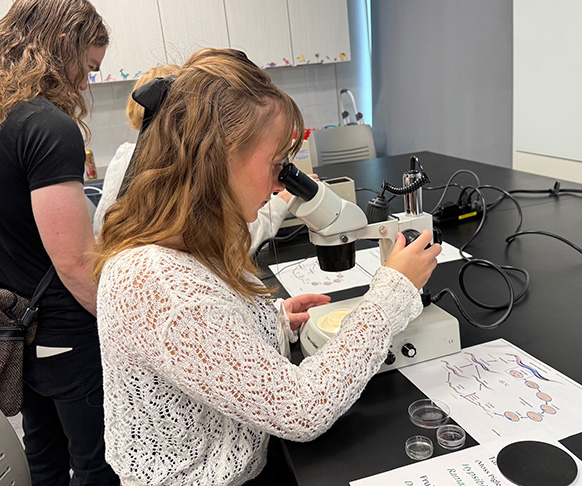
Zoey Woods, a Laramie County Community College student from Cheyenne, peers through a microscope during an activity at the Wyoming INBRE fall network retreat in October 2025. (Annie Bergman Photo)
Fay points to Rafael Homer and Merry Teague as a few of the recent success stories of students who benefited from INBRE. Homer, of Laramie, received his bachelor’s degree in molecular biology and finance from UW in 2022. As an undergraduate student, he was supported by INBRE to conduct research. More recently, Homer was a Translation Research Fellow at the University of Pennsylvania Perelman School of Medicine in 2025-26. He is currently a third-year medical student in the WWAMI (Washington, Wyoming, Alaska, Montana and Idaho) Medical Education Program. In addition to research at the University of Washington School of Medicine, Homer volunteers for the Sun Bus, which carries out skin checks in Western rural communities.
Teague, of Casper, received her bachelor’s degree in molecular biology from UW in 2025. She started conducting INBRE-funded research at Casper College and was a Wyoming INBRE transfer student awardee. Teague is currently in her second year of a two-year NIH Intramural Research Training Award fellowship program where she is working in translation medicine at the National Center for Advancing Translational Sciences in Rockville, Md. She plans to obtain a Ph.D. in epidemiology. Teague was a student representative at Capitol Hill Days in Washington. D.C., in 2025, where she advocated for NIH/IDeA programs, including INBRE.
“We’ve also funded scores of research projects for UW faculty and graduate students;
provided pieces of critical infrastructure; and promoted dozens of collaborations
between UW and the community colleges,” Fay says, noting there have been 50-plus collaborations
with community colleges. “These investments have led to hundreds of published scientific
papers; many additional millions of dollars in grants coming to Wyoming; and the development
of intellectual property.”
About INBRE
Wyoming INBRE strengthens biomedical research, experiential learning and workforce
development by fostering collaborations between community college and UW investigators. INBRE
promotes statewide access to learning through advanced instrumentation, infrastructure
awards and expertise. In Wyoming, statewide research capacity and student biomedical
research opportunities rely heavily on INBRE-supported resources.
In 2001, UW received a $6 million, three-year award from IDeA's Biomedical Research
Infrastructure Networks (BRIN) program -- the predecessor to the INBRE program --
to bolster biomedical research infrastructure.
UW received its first INBRE award in 2004, a $13 million, five-year NIH grant. The university received a $16.9 million INBRE grant renewal in 2009; $17.4 million in 2015; and $17.2 million in 2020.

The University of Wyoming has earned its Research Level 1 (R1) status from the Carnegie Classification of Institutions of Higher Education, placing Wyoming's only four-year university with the top research universities in the United States.