
UW Professors Receive NIH Grant to Further Study Brain Circuitry Changes During Aging, Alzheimer’s Disease
Published August 24, 2026
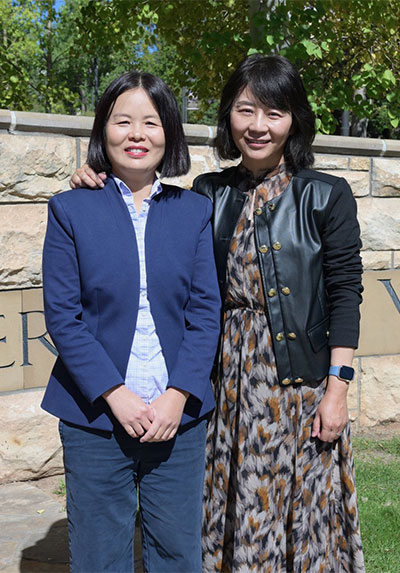
Rongsong Liu (left), a UW professor of mathematics, and Yun Li, a UW professor of neuroscience, recently received a three-year, nearly $2.15 million grant from the National Institutes of Health’s National Institute on Aging. The grant will further their research in understanding the microcircuit changes that occur in the brain’s prefrontal cortex during normal aging as well as disease progression in Alzheimer’s disease. (Zhuang Niu Photo)
Two University of Wyoming faculty members will further their research in understanding the microcircuit changes that occur in the brain’s prefrontal cortex during normal aging as well as disease progression in Alzheimer’s disease.
To help them continue their study, Rongsong Liu, a professor in the Department of Mathematics and Statistics, and the Department of Zoology and Physiology, and Yun Li, an associate professor of neuroscience in the Department of Zoology and Physiology, recently received a three-year, nearly $2.15 million grant from the National Institutes of Health’s (NIH) National Institute on Aging.
The grant was awarded as a second, expanded development phase or funding extension for their project, “Integrating Experimental and Computational Models to Study the Prefrontal Microcircuit Changes During Aging and Alzheimer’s Disease.” The latest grant began July 1 and runs through June 30, 2029.
Receiving the grant was contingent on successfully meeting preset milestones from an initial exploratory research phase and will provide support of innovative exploratory and developmental research activities initiated under the first grant. Liu and Li had previously received an exploratory phase grant for this research project. That initial grant began Sept. 1, 2024, and concluded June 30.
“The Phase 1 grant allowed us to perform a small cohort of empirical calcium recordings and to develop the mathematical and machine learning framework to studying changes in prefrontal cortical microcircuits with aging and Alzheimer’s disease,” Liu explains. “The (new) phase will allow us to scale up to a large cohort of experimental recordings; to further integrate the analytical framework using a larger dataset; and to establish and validate mathematical simulation models that describe how neural connectivity changes over time during normal aging and Alzheimer’s disease progression.”
Microcircuits in the brain’s prefrontal cortex play essential roles in planning, reasoning, decision-making and problem-solving. Disruptions in prefrontal microcircuits are associated with behavioral abnormalities in a variety of brain disorders, including Alzheimer’s disease. Mice will remain an important part of the study.
Li’s lab will continue to perform longitudinal in vivo calcium imaging recordings in freely behaving mice. This is done by repeatedly monitoring the exact same groups of neurons across a period of time -- weeks or months -- to observe the neural activity changes in the prefrontal cortex.
“We then represent the functional connectivity among these neurons as networks and apply graph theory, machine learning and mathematical modeling to quantify how the organization of these networks changes with aging and disease,” Liu says. “The goal is to identify network-level differences that may accompany or potentially even appear before obvious behavioral or cognitive changes.”
The grant is a continued collaboration with Rong Chen, an associate professor in the School of Medicine and associate vice chair of artificial intelligence at the University of Maryland. Li, Liu and Chen serve as the grant’s co-principal investigators (PIs). Li is the grant’s contact PI.
“Our complementary expertise is essential because the project connects empirical recordings, neuroscience, diseased animal models, mathematics and computational modeling,” Liu says.
Li has expertise in neuroscience, and she provides an empirical calcium imaging recording dataset obtained from mouse models of aging, Alzheimer’s disease and biomedical interpretations. Liu focuses on mathematical simulation modeling and graph theory-based network quantitative data analysis. Chen contributes her expertise in neural decoding data analysis.
The latest grant will support UW graduate students from mathematics and neuroscience programs, Liu says. Students will have opportunities to work with experimental neural calcium imaging data and learn quantitative and computational methods.
Navin Adhikari, a fifth-year Ph.D. student from Ranigaun, Tanahun, Nepal, and Sishir Gautam, a fourth-year Ph.D. student from Nagarjun, Kathmandu, Nepal, are working on in vivo calcium imaging, Li says. Mallory Lai, a postdoctoral fellow in mathematics from Parker, Colo., who earned her Ph.D. from UW’s Data Science Program, brings expertise in machine learning to the project.
“We hope to develop simulation models that can study how microcircuit organization changes over time and identify network features that may serve as indicators of aging-related cognitive decline or Alzheimer’s disease progression,” Liu says. “We are very grateful to the NIH for supporting the continuation of this work.”

The University of Wyoming has earned its Research Level 1 (R1) status from the Carnegie Classification of Institutions of Higher Education, placing Wyoming's only four-year university with the top research universities in the United States.